IN Brief:
- SPEAR low-rate production began in 2026, with initial operational deliveries expected in early 2027.
- The turbojet-powered weapon combines a range beyond 100km with multimode guidance and a two-way datalink.
- Launcher qualification, seeker manufacture, software assurance, and supplier capacity will shape future output.
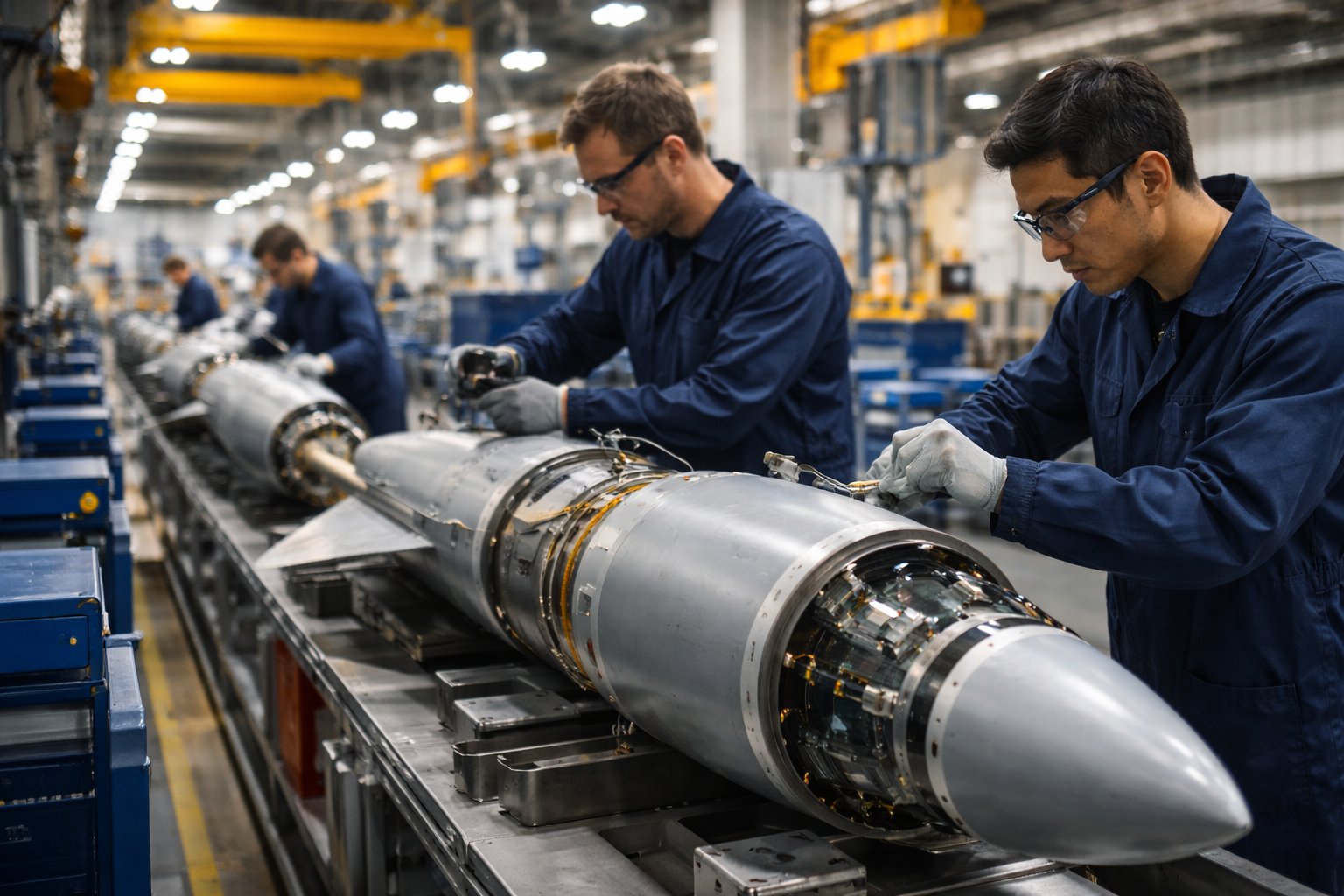
MBDA has begun low-rate production of the SPEAR precision-strike missile, moving one of the UK’s principal complex-weapons programmes from development towards operational inventory.
Initial deliveries are expected in early 2027, while further platform, launcher, and qualification activity continues. Beginning manufacture at a controlled rate gives MBDA and its suppliers an opportunity to validate tooling, assembly sequence, inspection, and component availability before demand rises.
SPEAR is a compact turbojet-powered weapon with a stated range exceeding 100km. It combines inertial and satellite-aided navigation with a multimode seeker, including active millimetric radar and laser guidance, while a two-way datalink can support updates after launch.
Four weapons can be carried on an internal launcher inside an F-35B weapons bay, preserving low-observable carriage while increasing the number of aim points available during one mission.
Flight activity with the four-round launcher is being used to gather environmental, mechanical, and integration data. Typhoon has already supported guided firing work through a trials launcher, while a three-round external launcher is being developed for other crewed and uncrewed aircraft.
Low-rate production does not indicate that every element of integration has finished. An aircraft-carried weapon must pass through mechanical, electrical, aerodynamic, software, safety, and environmental qualification before it becomes a routine operational store.
The missile and launcher must tolerate vibration, moisture, temperature cycling, electromagnetic exposure, and prolonged carriage. Separation behaviour needs to remain predictable across speed, altitude, manoeuvre, and aircraft loading conditions.
Software must exchange target, navigation, status, and release information without disrupting the host aircraft. A change to the weapon’s code or interface can require regression testing across launcher, aircraft, mission-planning, and support systems.
Early production exposes faults that are difficult to identify during small development builds. Fixtures may need adjustment, test stages can become bottlenecks, supplier tolerances may prove too variable, and components that worked in hand-built rounds may resist repeatable assembly.
SPEAR brings together several demanding manufacturing disciplines within a small airframe. Its turbojet depends on precision-machined rotating parts, controlled alloys, fuel-system components, engine electronics, and reliable seals.
The seeker combines radio-frequency equipment, optics, processing, and calibration, while compact actuators must move control surfaces quickly without consuming excessive volume or electrical power.
Packaging leaves little room for variation. Cabling, shielding, fuel, electronics, guidance hardware, and mechanical interfaces occupy a tightly controlled envelope, so a minor dimensional change can interrupt assembly elsewhere in the weapon.
The datalink and guidance software introduce continuing configuration work. A physically completed missile cannot enter inventory until its software baseline matches the aircraft, launcher, mission-planning equipment, and approved target data.
MBDA is also developing SPEAR-EW as an electronic-warfare derivative and SPEAR Glide as an unpowered configuration. Orchestrike work is examining collaborative behaviour between multiple weapons.
A family approach can create commonality across structures, interfaces, software, test equipment, and training. Introducing too many variants before the base production line stabilises, however, can divide suppliers and increase the number of configurations moving through assembly.
Integration work elsewhere in the UK weapons portfolio demonstrates the scale of the task. The qualification of Brimstone and Paveway IV for Protector required extensive evidence even though both weapons were already mature.
SPEAR’s planned employment across F-35B, Typhoon, and potential uncrewed platforms multiplies the number of interfaces, release conditions, mission systems, and software baselines requiring control.
Production volume will depend on assured procurement as much as engineering. Specialist suppliers are unlikely to invest in additional clean-room capacity, machine tools, or trained shifts for irregular short-term orders.
Energetic materials and propulsion capacity are particularly resistant to rapid expansion. Safety approvals, controlled buildings, environmental permits, process qualification, and specialist workforces make new output slower to establish than conventional machining.
Recent conflicts have also changed assumptions about stockpile size. Precision weapons procured for limited expeditionary operations may be consumed far faster during sustained high-intensity activity, while complex-munition production can take years to increase.
Higher carriage numbers only provide operational depth when sufficient rounds exist in storage. A four-weapon internal launcher has limited value if aircraft and training requirements compete for a small inventory.
Storage life will require continuing attention. Fuel systems, batteries, seals, electronics, and energetic components need monitoring, while production records must support later inspection, refurbishment, and life extension.
Supplier resilience will become increasingly visible as output grows. A small number of constrained components can hold back an otherwise mature missile line, particularly where electronics, propulsion, or seeker equipment depends on a single source.
Second-source qualification can reduce that exposure, but alternative suppliers must reproduce the original component’s behaviour and pass through testing at subsystem and weapon level.
Low-rate manufacture gives MBDA a controlled route through these pressures. Assembly data, test failures, supplier performance, and rework levels can be used to improve the line before larger batches arrive.
The production milestone therefore begins another demanding phase. SPEAR’s range, networking, compact packaging, and multi-platform potential have been established through development; serial value will depend on whether those features can be reproduced reliably, supported across several aircraft, and delivered in quantities that match the operational concept.