IN Brief:
- KIZILELMA has released TOLUN and TEBER-82 precision weapons from its internal bay and recorded direct target hits.
- Internal carriage requires controlled door sequencing, store separation, electrical interfaces, mission software, and structural tolerances.
- Serial production will depend upon stabilising a common airframe and weapons configuration across successive aircraft.
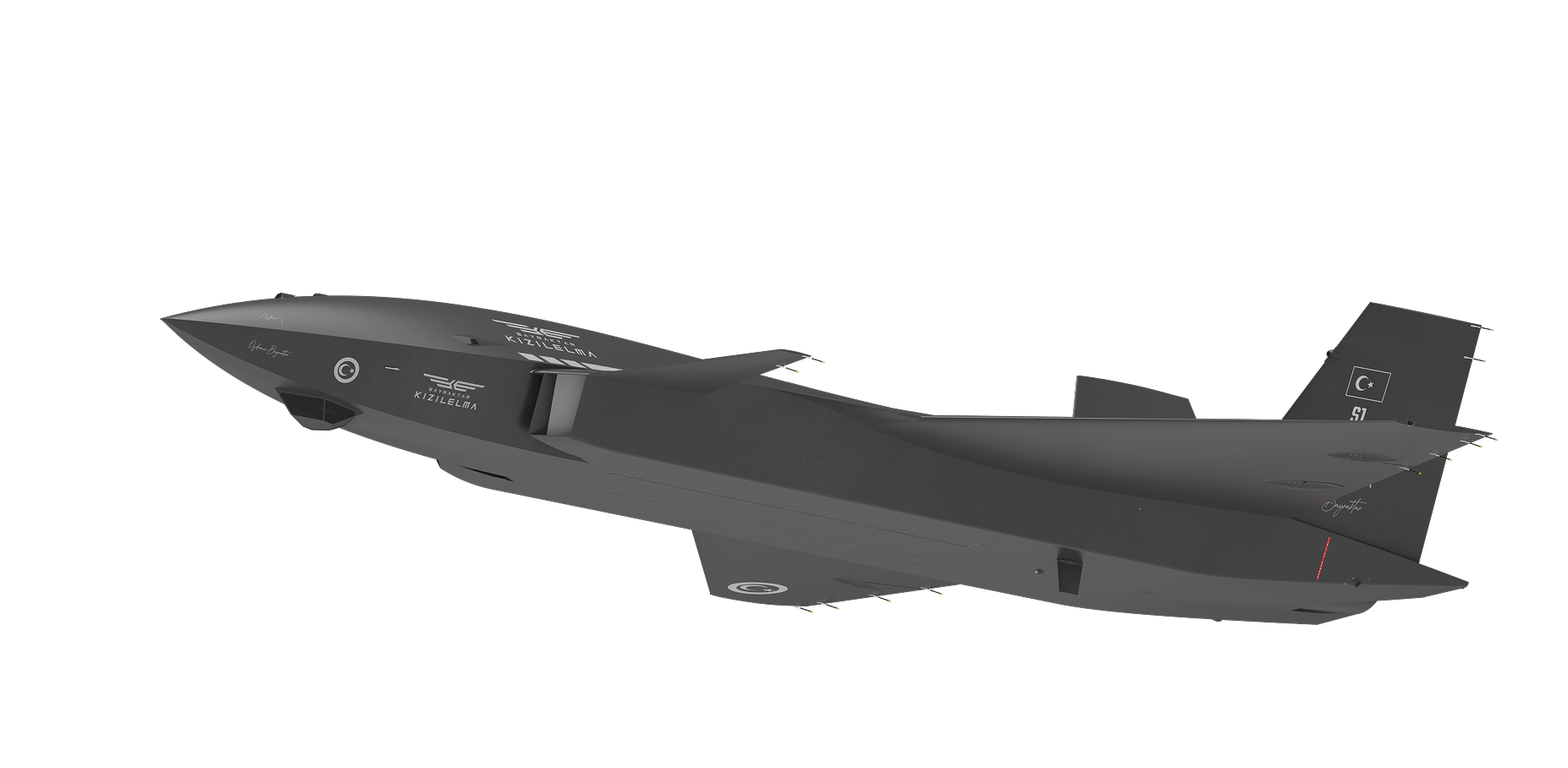
Baykar’s KIZILELMA uncrewed combat aircraft has released guided weapons from its internal bay, adding a more demanding level of systems integration to a programme moving rapidly through flight and weapons testing.
The aircraft released TOLUN and TEBER-82 precision weapons during the trials and recorded direct hits. Unlike externally mounted stores, both weapons were carried inside the fuselage before release, allowing KIZILELMA to retain the aerodynamic and signature characteristics associated with internal carriage.
Although an internal bay protects a weapon from the external airflow during flight, release becomes considerably more complex. Doors, ejectors, wiring, software, weapon dimensions, airflow, vibration, and safety interlocks must operate inside a confined volume where small deviations can affect separation.
Once a weapon leaves the bay, it initially passes through disturbed airflow generated by the fuselage and open doors. Engineers must model and test the resulting movement across the intended flight envelope, accounting for airspeed, angle of attack, weapon mass, centre of gravity, ejector performance, and the position of any adjacent stores.
Door operation must remain closely synchronised with the mission computer and release sequence. Opening too early increases drag and exposure, while incomplete or delayed movement can prevent the weapon from clearing the aircraft safely. Sensors, actuators, locks, power supplies, and emergency procedures therefore become integral parts of the weapons system.
The internal releases follow KIZILELMA’s earlier JET-230 firing, which demonstrated an externally carried supersonic strike weapon. Together, the trials show Baykar expanding the aircraft’s weapons envelope rather than concentrating upon a single demonstration load.
KIZILELMA is expected to carry guided bombs, air to air missiles, stand off weapons, cruise missiles, and sensor payloads, but every new store creates a separate integration and certification programme. Physical compatibility is only the beginning: the aircraft must identify the weapon, supply power, exchange data, calculate release solutions, present correct information to operators, and respond safely when a release is interrupted.
Development aircraft can be altered between flights, fitted with temporary instrumentation, and supported by engineers who understand every local modification. Serial aircraft require the same function to emerge from approved drawings, controlled software, repeatable assembly processes, standard parts, and maintenance procedures that work away from the development site.
Successful test installations must therefore become production standard bay structures, harnesses, release units, door mechanisms, cooling provisions, and software loads. Tolerances adjusted manually on an experimental aircraft need to be reproduced consistently as several airframes move through assembly.
Weapons suppliers face an equivalent requirement. Guidance kits, suspension points, connectors, mechanical dimensions, and software interfaces must remain consistent across batches. An alteration introduced to improve a seeker, control section, fuze, or manufacturing process may require renewed aircraft compatibility work even when the weapon retains the same designation.
Low observable aircraft bring further production controls. Bay door edges, panel alignment, coatings, fasteners, gaps, and repairs can influence signature performance, so quality assurance must cover characteristics that are less obvious than conventional dimensional inspection. Maintenance procedures must preserve them after repeated access to the bay.
Several KIZILELMA standards, propulsion options, weapons, sensors, and collaborative functions are progressing in parallel, increasing the risk that test aircraft will diverge from one another. Digital configuration management must identify exactly which hardware, software, and weapon combination produced each test result before that evidence can be applied to later aircraft.
Rapid iteration gives Baykar considerable development speed, but customers will eventually require stable baselines, documented interfaces, predictable maintenance, and a defined upgrade route. Early aircraft that remain unique can absorb disproportionate engineering support and create separate training, spares, and software requirements.
The internal bay could also support customer specific weapons if Baykar defines its mechanical, electrical, data, and safety interfaces clearly enough. Such an approach would widen export options, although it would increase the burden of protecting design information, managing national approvals, and preventing individual customer configurations from fragmenting production.
A controlled integration framework would allow new weapons to enter the programme without requiring extensive airframe redesign. Standard ejectors, power supplies, communication protocols, software modules, and physical envelopes could reduce later development effort, provided weapons manufacturers remain within the agreed interface.
Factory inspection will need to confirm that every bay reproduces the clearances, alignment, door movement, wiring condition, and software configuration established during testing. End of line checks may also require instrumented door cycles, electrical simulations, release unit testing, and verification that the aircraft recognises each approved store correctly.
The latest firing demonstrates that KIZILELMA’s internal bay can function during a live strike sequence. The production challenge now lies in repeating that result across aircraft built in quantity, while maintaining enough commonality to support training, maintenance, future weapons, and export configurations without repeated structural or software redesign.