IN Brief:
- L3Harris completed a full-duration hot-fire of NGI’s stage-two advanced solid rocket motor.
- The firing simulated high-altitude vacuum conditions and generated performance data for further testing.
- L3Harris supplies both large rocket motors plus attitude and divert-control propulsion equipment for Lockheed Martin’s interceptor.
L3Harris Technologies has completed a full-duration hot-fire of the second-stage advanced solid rocket motor for the US Next Generation Interceptor, validating another major propulsion element as Lockheed Martin’s missile-defence programme moves towards more advanced testing and an eventual first flight.
The firing took place in a simulated high-altitude vacuum environment intended to reproduce conditions in the upper atmosphere. The motor completed its planned burn, allowing engineers to collect data on performance and design integrity before the propulsion system progresses into later test activity.
Next Generation Interceptor is being developed for the Missile Defense Agency as the future interceptor element of the Ground-based Midcourse Defense architecture protecting the United States against long-range ballistic missile threats. Lockheed Martin leads the interceptor programme, with L3Harris providing the main boost propulsion and several of the smaller control-propulsion systems needed during the engagement.
L3Harris produces both the first- and second-stage advanced large solid rocket motors for NGI. It also supplies the Attitude Control System and Divert and Attitude Control System, which provide substantially finer manoeuvring authority than the large boost motors and become critical as the interceptor aligns and positions its kill vehicle against the target.
The difference between those propulsion tasks illustrates the technical range contained inside one interceptor. The large motors have to generate reliable high thrust while surviving pressure, thermal, vibration, and structural loads during acceleration. Attitude and divert systems have to produce controlled impulses accurately enough to manoeuvre the vehicle during later phases of flight.
A successful full-duration firing does not establish the performance of the complete interceptor, but it removes one set of propulsion uncertainties before integrated flight testing. Ground tests allow engineers to instrument the motor far more heavily than would be practical during an operationally representative flight, producing detailed measurements of chamber pressure, thrust, temperature, structural response, vibration, and other variables.
Running the second-stage motor under simulated vacuum conditions adds an important level of realism. Nozzle behaviour changes as ambient pressure falls, while insulation, seals, structures, and other components have to continue operating as the missile climbs out of the denser lower atmosphere. Testing under those conditions gives engineers data closer to what the second stage will encounter during an actual intercept sequence.
Any anomaly is also cheaper to diagnose on a static test stand than after a complete interceptor has been launched. A ground firing can be repeated with changes to instrumentation or configuration, whereas a failed flight test may destroy the hardware and leave engineers reconstructing the event primarily from telemetry.
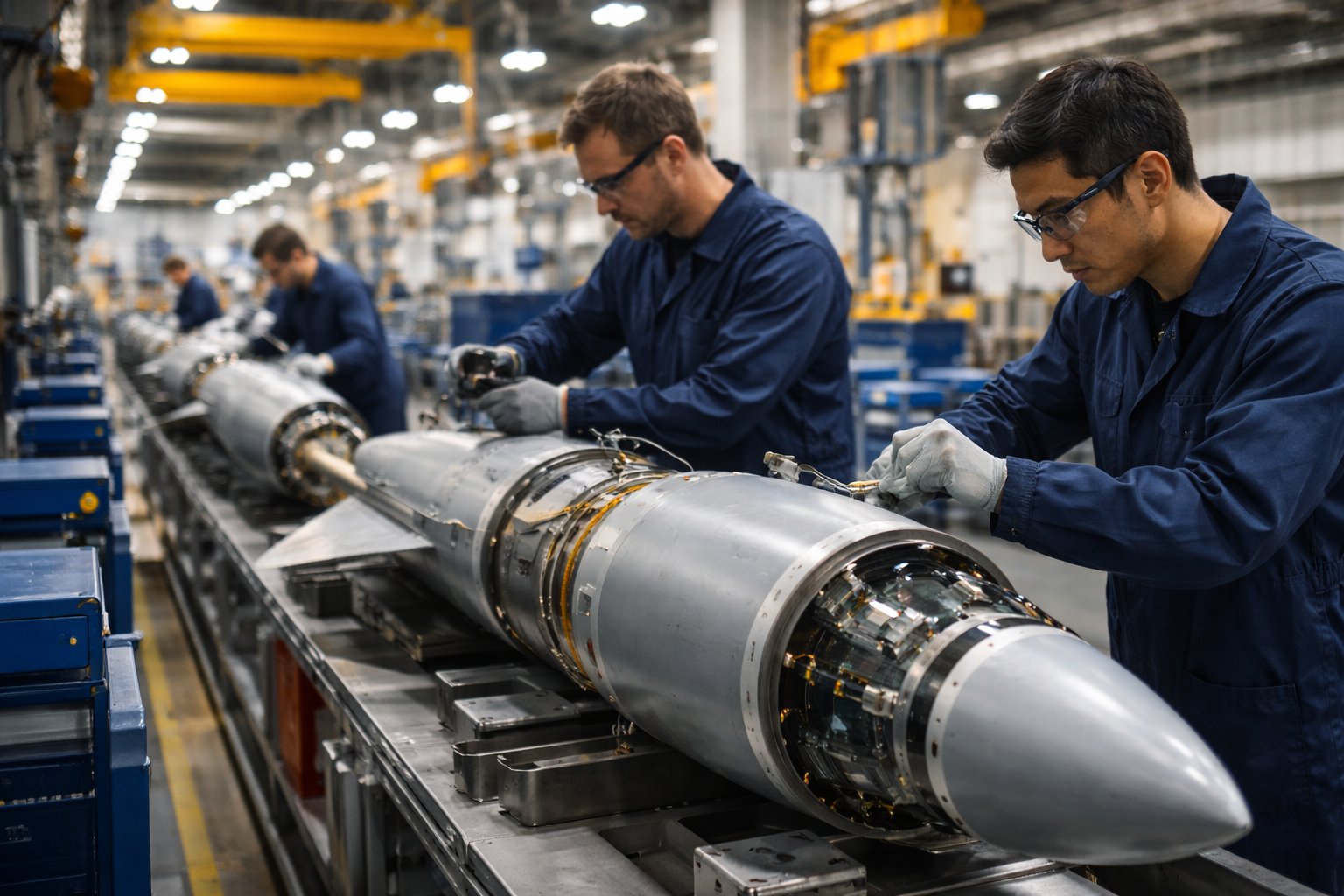
L3Harris manufactures NGI’s large motors across facilities in Alabama and Arkansas, while attitude and divert-control components are produced in California and Virginia. The distributed industrial arrangement spreads specialist work across several locations but places a premium on configuration control, process consistency, and supply-chain coordination.
Those disciplines matter increasingly as the wider US missile industrial base is being asked to increase production across several programmes at once. Solid rocket motors rely on specialist energetic materials, manufacturing equipment, skilled labour, cases, nozzles, insulation, and test infrastructure that cannot be expanded instantly. Different weapon programmes may serve very different missions while still competing for portions of the same propulsion supply chain.
NGI sits at the high end of that technical demand because the interceptor must accelerate and position a kill vehicle capable of engaging strategic ballistic threats outside the atmosphere. Propulsion performance has to remain tightly controlled if guidance, discrimination, seekers, communications, and terminal manoeuvring are to receive the vehicle at the right point in space with sufficient energy remaining.
That makes qualification an accumulation of subsystem evidence rather than one dramatic demonstration. Motors are fired individually, control systems are tested, software is verified, integration facilities are commissioned, and full vehicles are assembled progressively before the programme accepts the cost and complexity of flight testing.
The 10 August firing provides another piece of that evidence. L3Harris says the data will support more advanced testing later in 2026 and the programme’s first flight-test preparations. The immediate achievement is deliberately narrow: a stage-two motor ignited, completed its full-duration burn, and behaved sufficiently close to design expectations to move the programme onward.
Missile programmes ultimately attract attention when complete interceptors fly, but their schedule is often determined much earlier by propulsion, manufacturing, and qualification work that remains largely invisible outside the industry. NGI’s latest milestone is one of those events — less spectacular than a launch, but essential before the interceptor can attempt one.