IN Brief:
- The Bundeswehr has ordered 149 additional protected and unprotected mobile rescue stations worth more than €500 million.
- Production is due to begin in the first quarter of 2027, taking the programme to 165 systems worth over €600 million.
- The containerised stations combine independent power, configurable medical equipment, and compatibility with several Bundeswehr carrier vehicles.
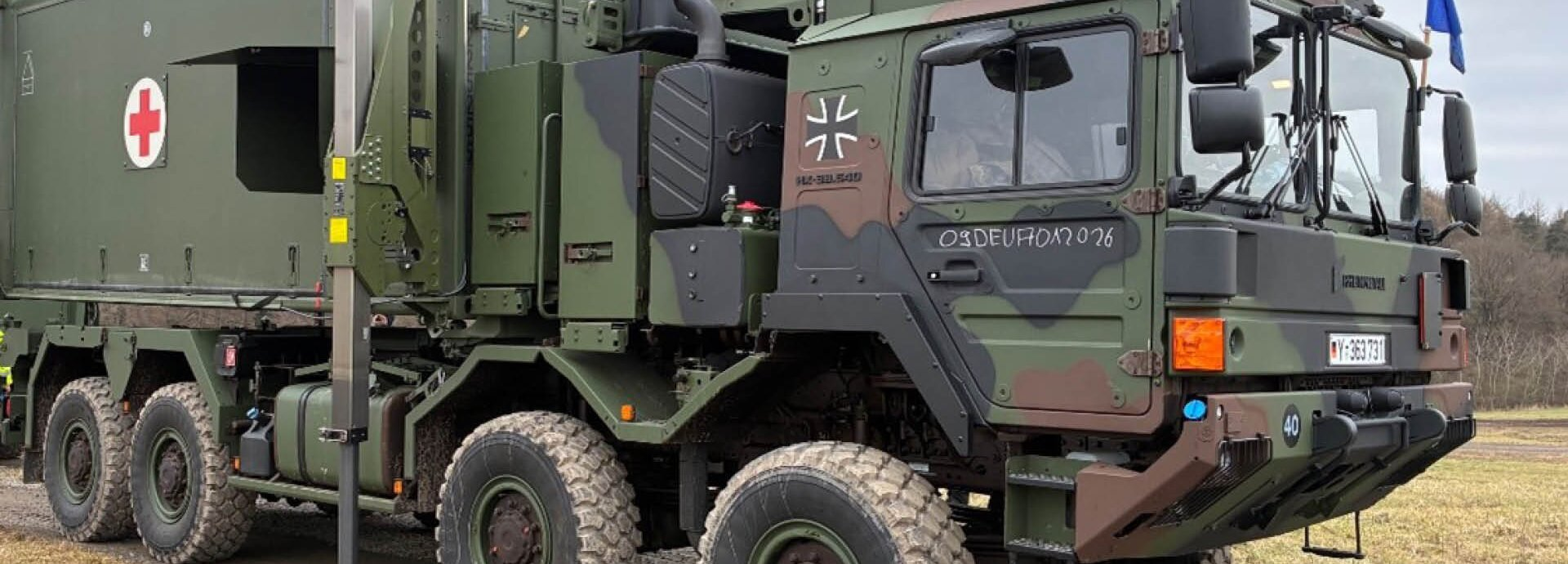
Rheinmetall will supply the Bundeswehr with another 149 mobile rescue stations under a call-off worth more than €500 million, substantially expanding Germany’s programme for deployable military medical infrastructure.
The order covers protected and unprotected systems and is the largest contract secured to date by Rheinmetall Project Solutions. Production is scheduled to begin in the first quarter of 2027, with the latest call-off taking the programme to 165 rescue stations with a gross value exceeding €600 million.
The procurement sits under a framework agreement awarded at the end of 2024. The Federal Office of Bundeswehr Equipment, Information Technology and In-Service Support initially ordered ten ballistically protected and six unprotected stations, with the contract also providing options for further armoured and unarmoured systems and associated personnel training.
The latest order turns what began as a comparatively small initial batch into a three-figure production programme. That changes the manufacturing task from integrating a limited number of specialist shelters into maintaining a repeatable supply chain for container structures, power generation, environmental control, lifting equipment, medical fittings, and vehicle interfaces.
Each rescue station comprises two containers that can operate together or independently. Both are fitted with their own generators and air-conditioning systems and are designed to remain self-sufficient for several days, while the electrical arrangement allows the complete station to continue operating from one generator if the other unit fails.
Inside, the system combines a fully equipped emergency-treatment position with four additional treatment stations. Medical equipment is mounted on Airliner rails rather than fixed permanently to the structure, allowing the interior configuration to be altered according to clinical requirements and the deployment.
Mobility has influenced the mechanical design as much as the medical fit-out. The stations are compatible with several Bundeswehr carrier vehicles and can be erected on ground with longitudinal or transverse inclination, giving units more freedom to establish treatment capability without needing a prepared level site.
Rheinmetall developed a dedicated lifting system because commercially available equipment could not meet the specified requirements. The company says four personnel can set up or dismantle a station rapidly, reducing the manpower and preparation needed to move medical capability with deployed formations.
The new configuration also replaces a more complicated tent structure with a modular 3:1 container produced by Rheinmetall Mobile Systeme. Containerisation provides a rigid transport and operating envelope for medical equipment, power, air conditioning, and protection while reducing the amount of separate infrastructure that has to be assembled after arrival.
Protected and unprotected versions address different operating requirements. Not every medical site needs the weight and cost associated with ballistic protection, while facilities closer to a threat may require a shelter able to provide emergency treatment without exposing staff and patients to the same level of risk as an unprotected structure.
Buying both configurations gives the Bundeswehr scope to match the system to the deployment rather than standardising on the heaviest variant. The approach also affects transport planning because protection, payload, and vehicle compatibility determine how easily a medical station can move with the formation it is intended to support.
The programme illustrates how mobility requirements are spreading into support equipment traditionally treated as comparatively static. Medical infrastructure, workshops, communications nodes, command facilities, and power systems all become harder to sustain if they depend on lengthy site preparation while the supported force is expected to move frequently.
That places greater emphasis on integrated shelter engineering. The container, electrical system, climate control, lifting equipment, medical installation, vehicle interface, and protection package have to function as one deployable unit and withstand repeated movement without disrupting equipment alignment or clinical readiness.
The production order also creates a longer requirement for specialist suppliers than the initial 16-system batch. Rheinmetall will need consistent access to container structures, generators, environmental systems, protection materials, medical fittings, and the mechanical equipment used to deploy the stations as manufacturing moves into the larger series.
The order was booked in July and announced on 17 August, with production due to begin in early 2027. The next stage is therefore industrial rather than contractual: Rheinmetall has to move the expanded design into repeatable manufacture and deliver protected and unprotected stations at a scale substantially larger than the original procurement.
Once completed, the programme will give the Bundeswehr 165 mobile rescue stations, turning a specialist medical-support capability into a fleet large enough to require the same attention to production continuity, training, maintenance, and configuration control as other deployable military equipment.