IN Brief:
- Patria and General Cherry signed a letter of intent on 23 August covering planned drone production in Finland.
- General Cherry develops and serially produces FPV, fibre-optic, interceptor, and fixed-wing uncrewed aircraft.
- Production location, capacity, customer orders, and a binding manufacturing agreement remain undisclosed.
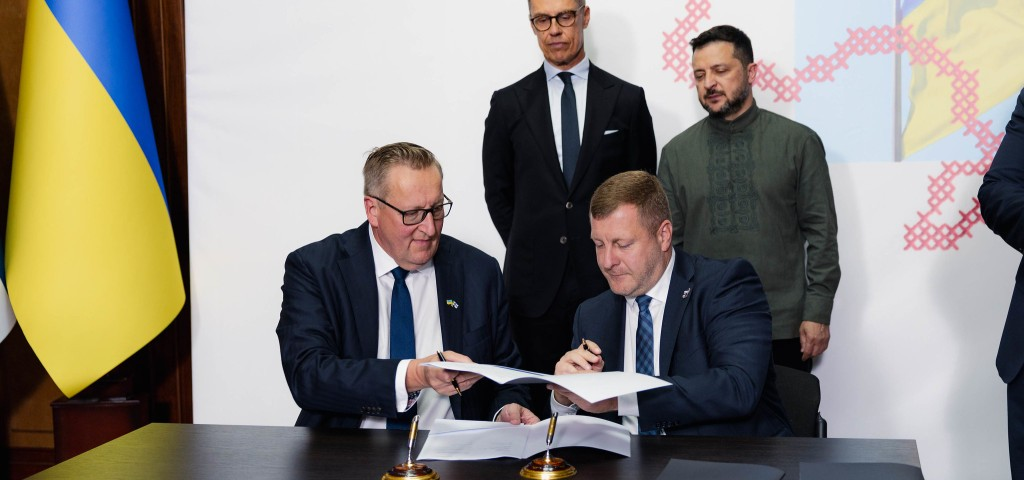
Patria has signed a letter of intent with Ukrainian drone manufacturer Center of Unmanned Technologies, known as General Cherry, covering planned production of uncrewed aerial systems in Finland. The agreement was signed on 23 August and is intended to combine Ukrainian design and serial-production experience with Patria’s established European defence manufacturing and integration base.
The companies have not disclosed a Finnish production site, investment value, annual capacity, start date, customer, or a definitive list of systems that would be manufactured. A letter of intent also stops short of a binding production contract. The announcement therefore establishes a planned industrial route rather than confirming that a Finnish drone line is already under construction or taking orders.
General Cherry specialises in strike FPV drones, fibre-optic-controlled systems, aerial-target interceptor drones, and fixed-wing UAVs. Those categories share some electronics and software, but they impose different requirements on airframes, propulsion, communications, payload integration, and test. A factory set up to assemble inexpensive multirotor systems cannot simply be assumed to handle fixed-wing aircraft or high-speed interceptors without changes in tooling, processes, and quality controls.
Transferring production from Ukraine into Finland would also require a controlled technical baseline. Drawings, bills of materials, approved suppliers, software versions, inspection criteria, test equipment, and configuration-management rules have to move with the product if output from a new site is to remain consistent. Component substitutions add another complication because small drones often rely on commercial electronics whose availability can change much faster than a conventional defence procurement cycle.
That problem is particularly acute for high-volume, comparatively low-cost systems. Motors, batteries, cameras, processors, radios, and flight-control hardware may be sourced from several commercial suppliers, while military customers increasingly require traceability, cybersecurity assurance, and predictable performance. A European production line will need enough flexibility to change components without turning every substitution into a complete redesign or qualification programme.
Patria already develops unmanned systems within a wider architecture of sensors, communications, data, artificial intelligence, and platforms. The General Cherry agreement adds another potential source of aircraft designs and production experience, but the companies have not announced that either portfolio will be merged into an existing Patria product. Any specific platform choice will have to wait for a binding agreement or customer programme.
The attraction of Ukrainian industrial experience lies partly in development speed. Drone manufacturers supporting active operations have been forced to alter designs quickly in response to electronic warfare, changing components, operator feedback, and new mission requirements. European procurement systems generally place greater emphasis on formal qualification, documented test evidence, controlled configurations, and long-term support.
Qualification requirements will also vary with the eventual customer and mission. An expendable FPV aircraft may tolerate a very different acceptance regime from a fixed-wing ISR platform expected to fly repeatedly, while an interceptor used around protected airspace may require tighter evidence on reliability and command links. A Finnish production plan will therefore need to define which characteristics are standardised across the portfolio and which remain specific to individual aircraft classes.
Finland provides a plausible base for that transition. Patria already operates inside a defence industrial environment built around national security requirements, protected supply, multinational programmes, and long-term support. Producing Ukrainian-designed systems inside the EU could also give European customers a more familiar contracting, quality, and support framework, although the resilience of the arrangement will depend on how much of the component supply chain can be secured or localised.
Final assembly alone does not guarantee supply security. A line can be physically located in Finland while remaining dependent on imported batteries, processors, sensors, motors, or communications hardware from suppliers outside Europe. The industrial value will therefore depend on component sourcing, test capability, repair arrangements, and the ability to qualify alternatives when particular parts become unavailable.
The agreement remains deliberately preliminary. A binding production contract, named facility, defined product baseline, customer order, capacity target, and qualification plan would each move it closer to a measurable manufacturing programme. Until those details appear, Patria and General Cherry have created the framework for Finnish drone production rather than the production system itself — a useful distinction in a market where announcements can travel rather faster than factories.