IN Brief:
- Kitron's Longum facility adds approximately 7,500 square metres of Norwegian electronics manufacturing capacity.
- Defence and Aerospace became the group's largest market sector as first-half revenue reached €568 million.
- Production growth will depend on qualified staff, components, test capacity, and programme approvals as well as factory space.
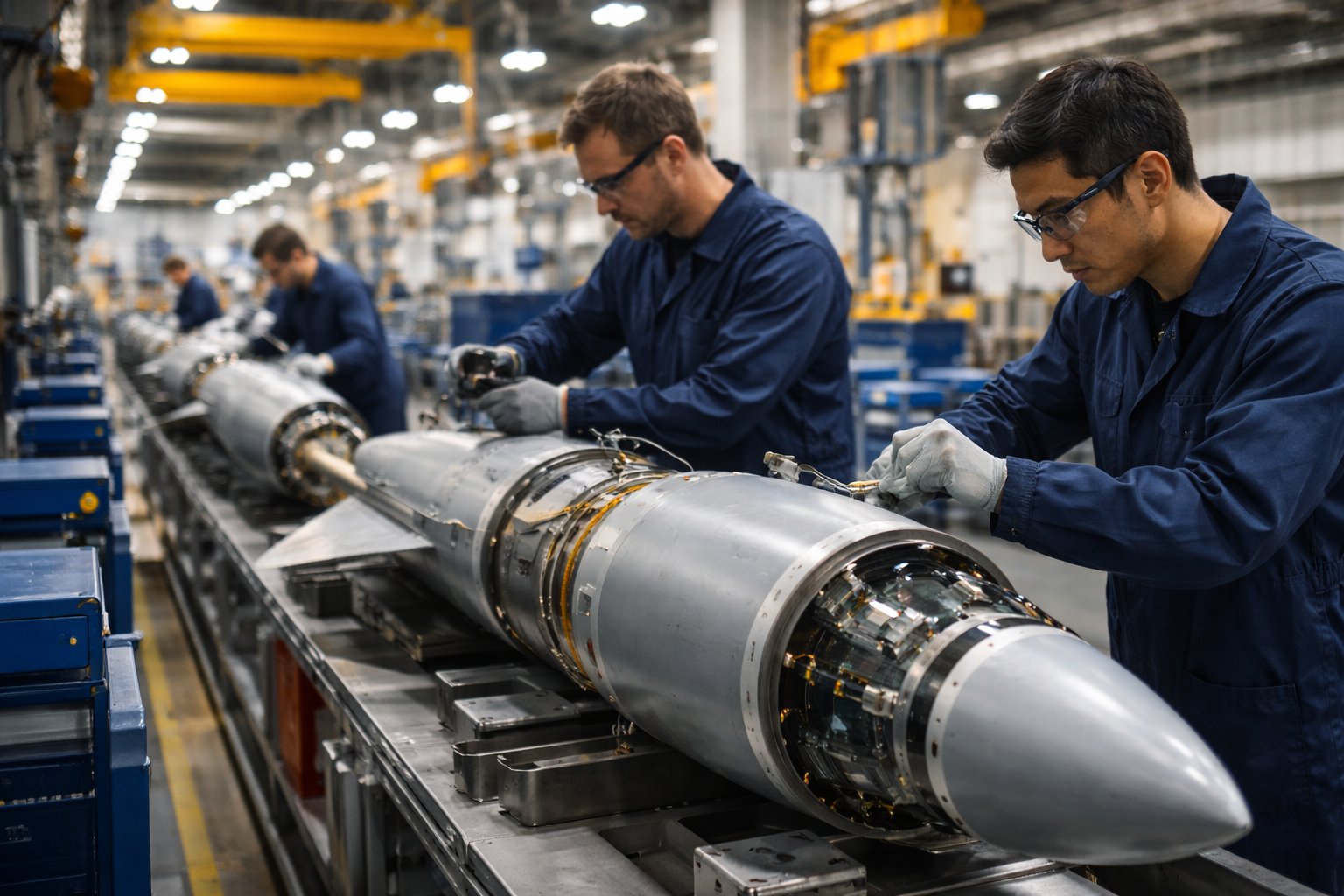
Kitron has opened a 7,500-square-metre electronics manufacturing facility at Longum outside Arendal, expanding its Norwegian production base as defence and aerospace becomes the group’s largest market sector.
The new plant sits alongside Kitron’s existing factory at nearby Kilsund. Together, the two Norwegian sites employ about 550 people, giving the company additional capacity for electronics manufacturing, industrialisation, integration, test, and support in a region where it already has established skills and customer relationships.
Kitron reported revenue of €568 million in the first half of 2026, 69% higher than in the corresponding period a year earlier. Defence and Aerospace became its largest market sector during that period, reflecting stronger demand for electronics used in military and other high-reliability applications.
The company operates as an electronics manufacturing services supplier rather than a defence prime. Its work spans development support, industrialisation, printed circuit board assembly, complete product manufacture, upgrades, repair, sourcing, logistics, and full-system integration and test. That position places it between component manufacturers and system suppliers, where a shortage of qualified production capacity can slow larger defence programmes even when final assembly lines are available.
Defence electronics cannot be scaled by adding floor area alone. Programmes require controlled manufacturing environments, traceable components, approved suppliers, repeatable assembly processes, configuration management, and test equipment capable of reproducing the same results across production lots. Customers may also impose security, documentation, and access requirements that prevent work from being moved freely between factories.
Longum gives Kitron physical room to increase output, but the usable capacity will depend on the people, equipment, components, and approvals that populate it. The company’s proximity to Kilsund should make it easier to share engineering skills, management, suppliers, and established processes while creating space to separate programmes where customers need dedicated or controlled production areas.
The expansion comes as European defence programmes compete for many of the same electronics components and specialist manufacturing skills. Military customers often need products to remain supportable for years or decades, while commercial semiconductor and component cycles can be far shorter. Obsolescence management, second-source qualification, long-term procurement, and engineering change control consequently sit alongside machinery and labour when manufacturers plan output.
Kitron’s international footprint provides some flexibility. The group has operations in Norway, Sweden, Denmark, Lithuania, Germany, Poland, the Czech Republic, India, China, Malaysia, and the United States, with more than 3,000 employees. Revenue for 2025 was €738 million, giving the Longum opening a broader context of rapid growth rather than an isolated site investment.
Defence work is less interchangeable between those locations than ordinary commercial electronics assembly. A programme may be tied to a particular factory by customer approval, security conditions, specialised test equipment, national sourcing rules, or workforce qualifications. Expanding a Norwegian site therefore adds regional capacity that cannot simply be replicated by moving the same work to another country when demand rises.
That regional capacity also responds to greater customer interest in secure and resilient supply chains. Local manufacturing does not remove dependence on globally sourced semiconductors, connectors, passives, and specialist materials, but it can shorten some logistics routes, improve visibility over final assembly, and keep industrialisation and acceptance activity closer to European defence customers.
The group revised its full-year 2026 outlook a day before the Longum opening, citing strong demand and better visibility in electronics supply. It now expects revenue of €1.05 billion to €1.15 billion and operating profit before interest and tax of €97 million to €112 million. Those figures cover the whole business rather than Defence and Aerospace alone, but they show the scale at which Kitron is planning production.
The Norwegian expansion therefore addresses one part of a broader capacity problem. Defence demand can rise faster than factories can add qualified operators, test stations, process approvals, and component supply, and each of those constraints can determine delivery rates as decisively as available space. Longum gives Kitron additional room to build that industrial base without abandoning the engineering ecosystem around its existing Kilsund operation.
The next measure will be how quickly the new facility fills with qualified work. Customer transfers, additional production lines, recruitment, test capacity, and order conversion will show whether the 7,500 square metres becomes a meaningful increase in defence-electronics output or remains headroom waiting for programmes to catch up.