IN Brief:
- SkyHop will evaluate up to ten NOEMI aircraft by FY2030, with an option for five more.
- The MoU is conditional and does not constitute a firm 15-aircraft order.
- The partners will also assess possible future Indian manufacture and assembly of electric and hybrid aircraft.
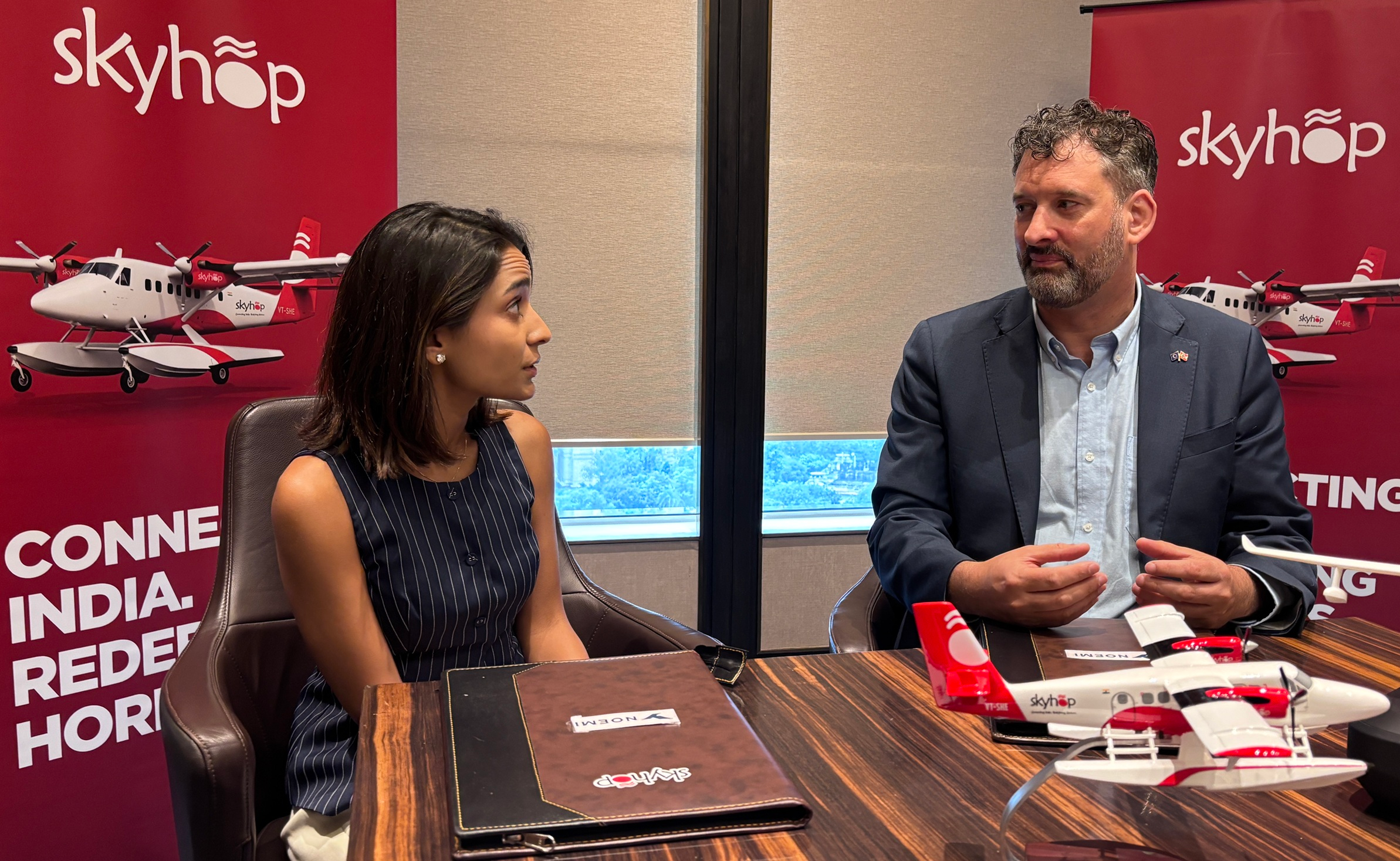
NOEMI Aerospace has signed a memorandum of understanding with Indian seaplane operator SkyHop Aviation covering the possible introduction of up to 15 amphibious aircraft, with the partners also planning to examine future manufacture and assembly in India.
The agreement is not a firm order. SkyHop plans to evaluate the technical, operational, commercial, and regulatory requirements for introducing NOEMI aircraft into its fleet, with an initial proposal covering up to ten aircraft by FY2030 and an option for five more following successful introduction of the first aircraft.
Purchase, leasing, or a combination of both remain possible. Deliveries would be subject to operational suitability, regulatory approval, commercial evaluation, and definitive agreements, while any Indian production arrangement would require further assessment and separate contracts.
The MoU gives Norwegian developer NOEMI another prospective operator as it works towards entry into service of its first aircraft in 2030. The initial platform is being developed as a fully electric amphibious aircraft capable of operating from water and conventional runways, with accommodation for nine passengers and one or two pilots.
NOEMI is also studying hybrid-electric and conventional-fuel derivatives around the same platform architecture. Its wider development strategy includes passenger and cargo transport, medical evacuation, search and rescue, government operations, aerial firefighting, and other special missions.
Those proposed missions give the platform potential dual-use relevance, but the present SkyHop agreement is a commercial regional-aviation arrangement. No military customer, defence requirement, or defence procurement is identified in the MoU, and the potential special-mission variants remain part of NOEMI’s broader platform strategy rather than this specific Indian transaction.
For SkyHop, the immediate attraction lies in India’s geography. Islands, coastal regions, rivers, and lakes create routes where conventional airport construction may be expensive or impractical, while an amphibious aircraft can combine water operations with access to existing land runways.
The operator says it intends to begin around Lakshadweep, connecting islands with one another and with the mainland before expanding into other Indian markets. SkyHop is targeting a total fleet of up to 40 aircraft by FY2030 and is considering electric and hybrid aircraft as part of its longer-term fleet strategy.
That ambition sits within a broader attempt by India to restore seaplane operations as part of regional connectivity policy. Government data published in 2025 recorded 32 valid seaplane routes awarded under different rounds of the UDAN scheme, linking 25 water aerodromes across several states and union territories.
The Ministry of Civil Aviation also reported ₹122.52 crore allocated for development of water aerodromes. A later government update said letters of intent had been issued under UDAN 5.5 for 150 routes connecting 30 water aerodromes, showing a substantially larger forward pipeline even though awarded routes, operational routes, and future proposals should not be treated as the same measure.
The infrastructure remains important because an aircraft type cannot create a viable network on its own. Regular seaplane services need approved water operating areas, passenger facilities, maintenance, refuelling or charging arrangements, weather procedures, trained crews, and regulatory systems able to support routine rather than occasional operations.
The aircraft presents its own engineering challenge. An amphibious design has to combine the aerodynamic efficiency of a regional aircraft with hull structures and systems capable of repeated water operations. Corrosion protection, spray, impact loads, water handling, structural mass, landing gear, and stability all compete with payload and range requirements.
Electric propulsion adds another constraint. Battery mass, energy density, thermal management, charging rate, reserve requirements, and certification all influence the distance and payload available for commercial use. Short regional sectors can make electric aviation more practical than longer routes, but useful economics depend on balancing those systems without allowing the battery or amphibious structure to consume too much of the aircraft’s payload capability.
NOEMI’s current published specifications remain development targets and are subject to change. The company lists a 16-metre aircraft with a 21-metre wingspan, maximum take-off mass of 5,670kg, payload around 1,000kg, and 400kWh battery capacity, with certification planned under CS-23 Level 3.
The Indian manufacturing discussion could become more significant than the initial fleet MoU if it develops into a funded industrial programme. Local assembly could support maintenance and operator availability, while deeper manufacture could create work around composite structures, electrical systems, propulsion integration, interiors, tooling, and test equipment.
No manufacturing site, investment figure, local-content target, industrial partner, or production schedule has yet been disclosed. The memorandum therefore establishes an area for examination rather than a commitment to build aircraft in India.
NOEMI says its announced international commercial pipeline now represents more than 90 aircraft across Europe, North America, and Asia. That number includes agreements at different levels of maturity and should not be treated as a firm order backlog. The SkyHop element itself remains explicitly conditional.
The development timetable adds another degree of uncertainty. NOEMI has said it completed its preliminary design review and is progressing prototype and propulsion work, with first flight targeted for 2027 and commercial operation in 2030. Certification, flight testing, production industrialisation, and operator acceptance all remain ahead of the programme.
The SkyHop agreement therefore establishes an early customer and industrial relationship rather than a completed 15-aircraft sale. The important milestones will be a definitive purchase or lease agreement, progress through certification, identified Indian routes and operating infrastructure, and evidence that the proposed local manufacturing discussion has developed into a funded programme.