IN Brief:
- HexaForce spans land, air, sea, cyber, the electromagnetic spectrum, space, and information operations within one C2 architecture.
- Thales says the system supports command requirements involving more than 100,000 personnel and distributed operation under degraded communications.
- The architecture supports NATO Federated Mission Networking and Data-Centric Security standards and was tested during CWIX 2026.
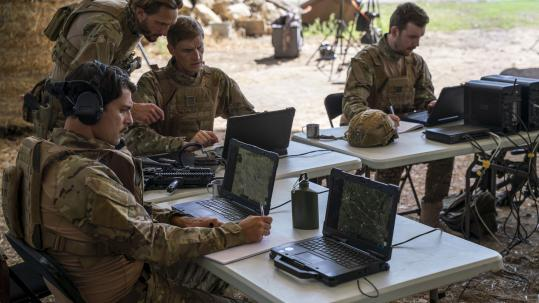
Thales has launched HexaForce, an AI-enhanced multi-domain command-and-control system designed to connect national and coalition systems across land, air, sea, cyber, the electromagnetic spectrum, space, and information operations.
The architecture combines a core software platform, command applications, and a distributed data network, and was tested during NATO’s Coalition Warrior Interoperability Exploration exercise in 2026. Thales says HexaForce is already available and can support command requirements involving more than 100,000 personnel.
Open integration is central to the design. HexaForce supports NATO Federated Mission Networking and Data-Centric Security standards and is intended to connect existing third-party and legacy systems rather than require customers to replace every element with a single proprietary stack. Nations retain control over incoming and outgoing data feeds while adding technology from other suppliers within the wider architecture.
That requirement becomes more difficult as command systems span additional domains. A headquarters may need to combine information from aircraft, ships, ground formations, space-based sensors, cyber systems, and open sources while distributing a usable operational picture to users working at different command levels. The engineering problem is not simply collecting more data, but maintaining timing, identity, provenance, and access control as information moves between systems.
Thales is using artificial intelligence to reduce part of that processing burden. HexaForce draws on the company’s cortAIx organisation, which brings together around 800 engineers and data scientists, and incorporates large language models and agentic AI. Thales identifies mission planning, operational-picture consolidation, target prioritisation, effector allocation, and maintenance support among the functions where the software can assist users.
The company is also using live trials to increase processing capacity. Its stated development target is to move from about 100 to 1,000 targets processed per day. That figure is a programme objective rather than a demonstrated operational throughput rate, and practical performance will depend on the data sources, rules, interfaces, and communications available in each deployment.
Distributed architecture forms another part of the system. Thales says HexaForce is designed to remain usable under severely degraded communications rather than depend on permanent high-bandwidth links to a central node. Coalition command networks have to account for headquarters, sensors, or units losing connectivity while still retaining enough local information to continue their assigned tasks.
The architecture draws on experience from Artemis.IA, the French Ministry of Armed Forces data platform deployed since 2023. Thales presents that programme as part of the technical heritage behind its multi-source processing and AI scaling, although HexaForce is a separate product with a broader command-and-control role.
Interoperability testing at CWIX provides a more useful engineering reference than a standalone product demonstration. NATO uses the exercise to expose systems to coalition interfaces and information-sharing requirements before operational deployment. Testing there does not establish that every future national configuration will integrate without additional work, but it provides a structured environment for identifying data-exchange and configuration problems.
Thales has already been working on narrower command-and-control integration elsewhere. Its partnership with Systematic around Danish air defence combines C2 software with sensors and effectors inside a NATO-compatible architecture. HexaForce takes the same general integration problem across more operational domains and command levels, increasing the number of interfaces that have to remain secure and supportable.
Open architecture also creates a continuing engineering burden. Every connected system can introduce a different data model, security policy, interface standard, and software release cycle. Configuration management therefore becomes essential if a coalition is to know which connections are approved, what information is available to each user, and how a software change affects the wider network.
The AI functions add another assurance layer. Automated correlation and prioritisation can reduce the manual work involved in combining numerous data streams, but command staff still need to understand the origin and confidence of information presented to them. Processing speed has limited value if the chain between source data and operational decision becomes difficult to trace.
Thales has not identified a first customer contract in the launch announcement. National selections, implementation projects, and operational deployments will therefore provide the next industrial milestones, particularly where HexaForce has to integrate systems from several suppliers within an existing national C2 estate.
Support requirements will continue after installation because the architecture is software-intensive by design. Interfaces, cyber controls, AI functions, and third-party applications will change at different rates, requiring regression testing and release management if coalition interoperability is to survive successive upgrades.
HexaForce enters that environment with a defined architecture, a NATO CWIX testing record, and explicit support for FMN and Data-Centric Security. Customer deployments will establish whether those elements remain coherent as the number of connected systems, users, and software configurations increases.