
IN Brief:
- Hanwha Aerospace Romania participated in EXPERIMENT 26.2 at Prislop from 26–30 October 2026, alongside 27 defence industry participants.
- The GRUNT unmanned ground vehicle exchanged surveillance and position data with Romanian C4ISR systems and demonstrated an alternative communications link.
- Hanwha Systems tested a radar, electro-optical and radio-frequency counter-drone configuration, reporting successful detection, tracking and electronic interference.
Hanwha Aerospace has demonstrated unmanned ground vehicle interoperability and integrated counter-drone equipment during a Romanian Land Forces exercise, testing how its systems exchange operational information with existing military networks. The programme involved reconnaissance, alternative communications links, radar surveillance and electronic interference against uncrewed aircraft.
Hanwha Aerospace Romania disclosed the results on 19 November 2026 after participating in EXPERIMENT 26.2, held from 26 to 30 October at the Prislop training range in Argeș County. Romanian military personnel and 27 defence industry participants took part in the exercise, which provided opportunities to evaluate emerging equipment under field conditions.
Hanwha deployed its GRUNT six-wheeled unmanned ground vehicle, an integrated counter-unmanned aircraft system developed by Hanwha Systems, and the THeMIS tracked robotic platform produced by Estonian manufacturer Milrem Robotics. The equipment was used to examine separate ground reconnaissance and aerial threat detection functions, with interoperability a central element of the trials.
GRUNT is a development of Hanwha’s earlier ARION-SMET robotic vehicle family. The company specifies hybrid propulsion and a payload capacity of approximately 900kg, giving the platform scope to carry surveillance equipment and other mission loads. Its combination of autonomous and remote control functions is intended to support operations in which personnel do not need to remain aboard the vehicle.
The tests included movement through mountainous and forested terrain, where the vehicle used electro-optical and infrared sensors to observe personnel and vehicles. Different sensor types can provide complementary information: optical equipment captures visible imagery, while infrared systems detect radiation associated with temperature differences. Their performance depends on conditions such as visibility, vegetation, range and the characteristics of the observed object.
GRUNT transmitted surveillance imagery and vehicle position information to a Romanian military command post. The data entered the armed forces’ command, control, communications, computers, intelligence, surveillance and reconnaissance environment, known as C4ISR. The demonstration showed that the vehicle could provide information to an existing military network rather than operating exclusively through a separate manufacturer control station.
Interoperability requires agreement on how information is represented and transferred. A video feed must be associated with its source, while location data needs suitable coordinates and timing information to remain useful. Systems exchanging those inputs must also manage access and communications interfaces, allowing military personnel to view the information through approved command arrangements.
Hanwha reported successful transmission through an alternative communications link when the primary route was interrupted. The test demonstrated that the configured vehicle could continue a defined information exchange using another connection. The company did not disclose the communications architecture, data rate, operating range or duration of the alternative-link demonstration.
Communications resilience is important for robotic equipment operating beyond the immediate position of its controllers. A loss of connectivity can interrupt the transfer of commands, surveillance imagery or technical status information, even when some vehicle functions remain available through onboard control. The effect depends on the platform’s operating mode and the behaviour programmed for communications failures.
The successful alternative-link test does not establish unrestricted operation without communications. The vehicle’s performance under complete network loss, prolonged interference or other untested conditions remains outside the public results. Further assessment would be needed to determine the complete operating limits of the communications arrangement.
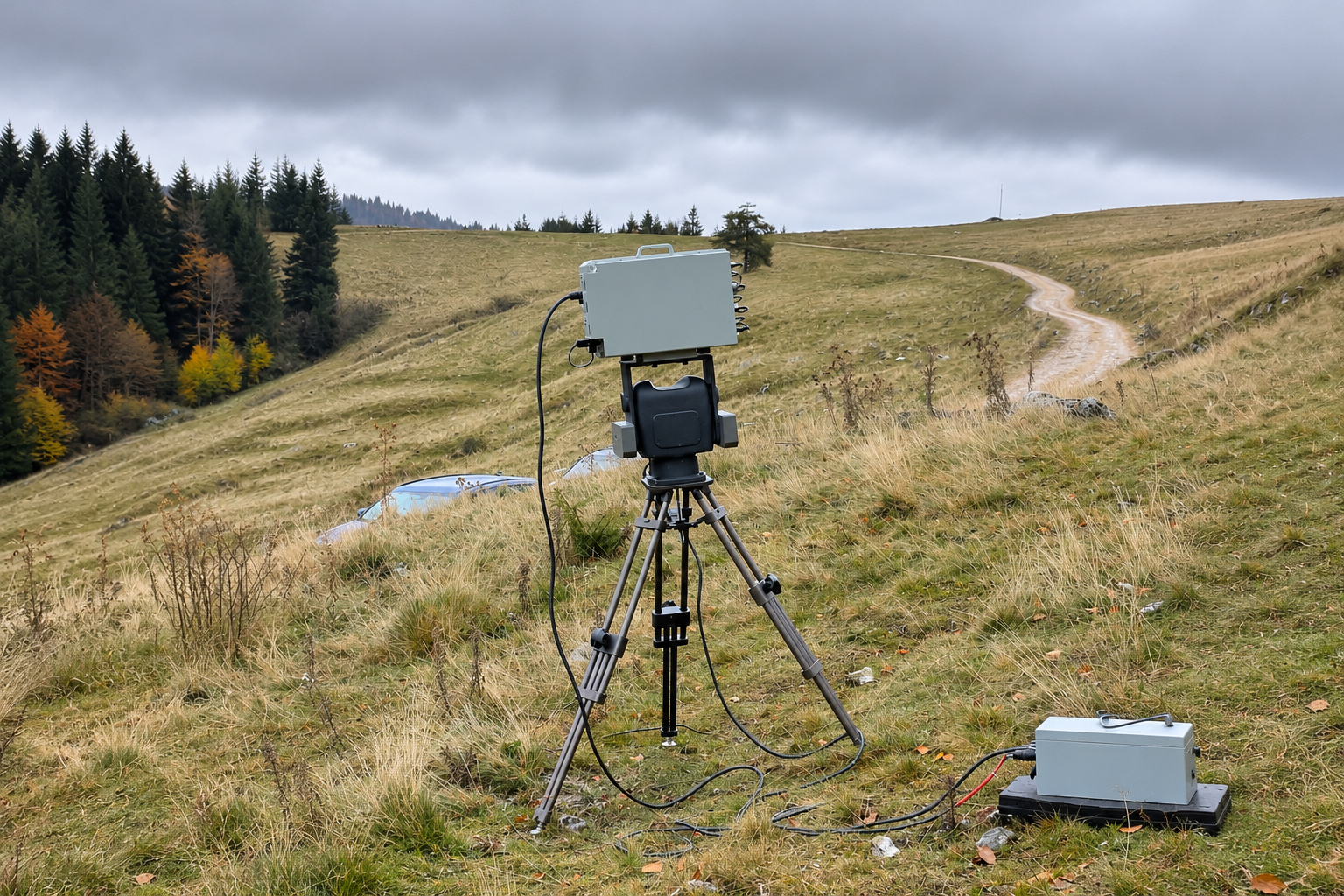
Alongside GRUNT, Hanwha demonstrated counter-drone equipment that combines several sensor types with electronic countermeasures. The configuration included a short-range active electronically scanned array radar, a TAS-815K electro-optical and infrared camera, a radio-frequency scanner and a jammer connected through a command and control system.
The radar draws on core technology associated with the M-SAM multifunction radar programme. In the counter-drone configuration, radar observations can provide information about airborne contacts, while optical and infrared equipment offer another means of examining a detected object. The radio-frequency scanner monitors relevant emissions, providing a further input to the command system.
Combining those sources allows information from different sensors to be assessed together. A radar may detect an object without providing enough detail for positive identification, while an optical sensor can be affected by visibility or distance. Information from several systems can improve the basis for operator decisions, although its accuracy depends on successful integration and the quality of the underlying measurements.
The electronic countermeasure element was tested against multiple drones. Hanwha reported that its equipment disrupted the targets’ operation, causing them to hover or return to their departure point. Those outcomes are consistent with particular drone responses to interference, but they should not be treated as universal results for every aircraft or communications system.
The company also reported successful testing during rain and dense fog. Weather affects sensing technologies differently, particularly optical equipment, while electronic interference depends on additional factors such as frequency and signal strength. Hanwha has not published the detection ranges, success rates or detailed test conditions necessary to establish performance across a wider range of environments.
The counter-drone configuration exchanged information with Romanian command systems using NATO-aligned communications standards. Demonstrating that exchange is an integration milestone, although it does not automatically qualify the equipment for every national or NATO network. Additional configuration, security assessment and testing may be required for other deployments.
Hanwha’s Romanian activities include an earlier demonstration of crewed and uncrewed vehicle cooperation during the Black Sea Defense & Aerospace exhibition in May. GRUNT participated alongside the TIGON armoured vehicle and THeMIS, establishing an earlier basis for the company’s work with Romanian military and industrial partners.
Hanwha Aerospace Romania and Milrem Robotics also signed a teaming agreement in May 2026 to pursue opportunities in Romania’s unmanned ground vehicle programme. The arrangement is intended to combine expertise in wheeled and tracked platforms and examine domestic development and manufacturing opportunities. It has not been identified as a confirmed Romanian order for GRUNT or THeMIS vehicles.
The company is separately developing its H-ACE Europe manufacturing facility in Romania to support local production of K9 artillery vehicles, with the possibility of expanding into other land systems. No allocation of GRUNT or counter-drone manufacturing work to that facility has been confirmed. Those potential industrial activities remain separate from the results of the October exercise.
The completed demonstrations establish tested data exchange between GRUNT, the counter-drone installation and Romanian military command networks, alongside the electronic countermeasure results reported by Hanwha. Future progress will depend on additional customer evaluations, technical qualification and procurement decisions. No new vehicle order, counter-drone contract or completed operational certification has been announced as a result of EXPERIMENT 26.2.