IN Brief:
- WAM-V 8, 16, and 22 unmanned surface vessels carried out five different mission sets during REPMUS26.
- Tasks included surf-zone surveying, mine countermeasures, harbour security, surveillance, and surface-target identification.
- OPT vessels integrated with US command-and-control, while a WAM-V 22 supported Navy and Marine Corps autonomy training.
Ocean Power Technologies has deployed all three sizes of its WAM-V unmanned surface vessel family across five mission sets during REPMUS26 in Portugal, assigning the platforms to tasks ranging from surf-zone surveying to mine countermeasures and surface surveillance.
The multinational exercise is led by the Portuguese Navy in collaboration with NATO, the University of Porto, and the European Defence Agency. It provides an operating environment in which different autonomous systems can be tasked alongside military units rather than demonstrated as isolated vehicles.
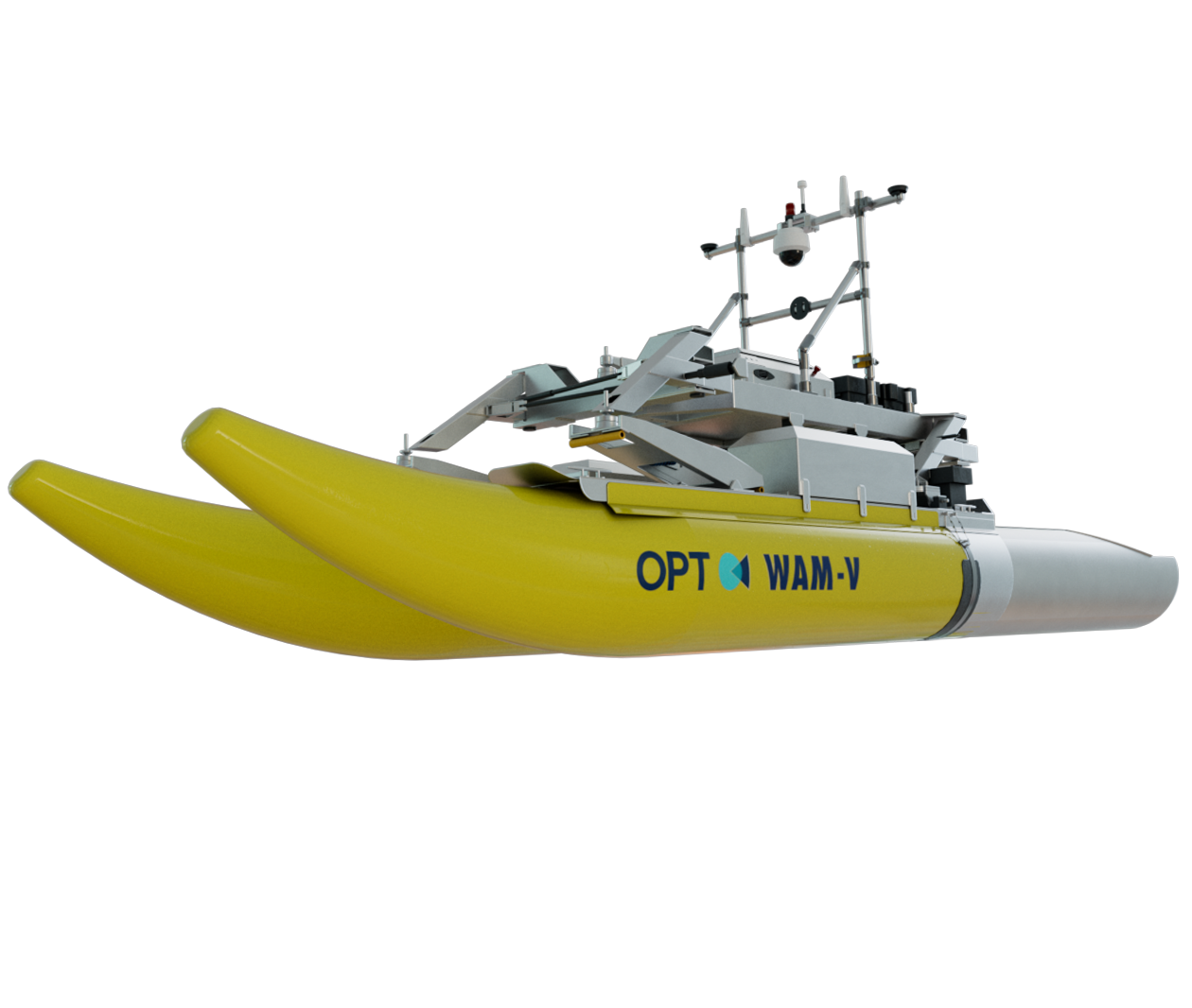
OPT used its WAM-V 8, WAM-V 16, and WAM-V 22 vessels during the exercise. Each size was assigned work suited to a different part of the littoral operating environment, giving the deployment a broader engineering focus than simply operating several versions of the same product.
The WAM-V 8 conducted rapid environmental assessment, collecting bathymetric data in amphibious surf zones before landing and raiding activity. Its shallow draft and compact dimensions make it the most portable member of the family, with the current model measuring 2.7 metres long and drawing about 10 centimetres.
OPT lists the eight-foot vessel with electric propulsion, a speed of up to six knots, endurance of up to ten hours at three knots, and a payload capacity of 45kg. Those are product specifications rather than measured results from REPMUS26, but they explain why the smallest vehicle was allocated to near-shore survey work.
The larger WAM-V 16 supported mine-countermeasure tasking in beach and harbour approaches. At 5.3 metres long, the electric vessel is designed for a heavier sensor fit and carries up to 193kg with a four-battery configuration, falling to 147kg when six batteries are installed to extend available energy.
OPT quotes endurance of up to 7.5 hours at five knots for the WAM-V 16. Its optional equipment includes multibeam and side-scan sonar, illustrating the type of payload integration needed for hydrographic and mine-countermeasure work, although the company has not published the precise sensor configuration used during the Portuguese exercise.
The WAM-V 22 operated farther along the mission spectrum, conducting surface-target identification, intelligence, surveillance, and reconnaissance, and above-water warfare activity. The current model is 7.1 metres long, carries up to 270kg of payload, and uses twin 30hp petrol engines.
OPT lists burst speed at up to 20 knots and endurance at up to 72 hours at eight knots. Again, those figures define the platform’s published capability and do not establish that the REPMUS missions were conducted at maximum speed, load, or endurance.
The use of three sizes under one exercise provides a practical view of why navies are exploring families of unmanned surface vessels rather than one universal hull. A compact vehicle can be carried and launched close to shore, while progressively larger platforms provide more payload capacity, power, speed, and endurance for missions farther from the launch point.
Common design elements can reduce some integration work across the family, but each size still presents different transport, launch, maintenance, power, and payload constraints. Mission planning has to account for those limits rather than treating a small survey craft and a multi-day surveillance platform as interchangeable assets.
Command-and-control integration formed another part of the REPMUS deployment. OPT says its vessels connected with US command systems during the exercise and were the only US unmanned surface vessels to do so, placing vehicle position and mission activity inside a wider operational picture rather than relying solely on supplier control stations.
A WAM-V 22 was also used to train US Navy and Marine Corps personnel in basic autonomous operations. Operator training becomes increasingly important as uncrewed vessels move from demonstrations into routine tasking because users have to understand mission planning, communications limits, autonomy behaviour, payload operation, recovery, and intervention when the vehicle does not behave as expected.
The company has already been testing the smallest member of the family in demanding near-shore environments. On 18 September, OPT disclosed a separately evaluated WAM-V 8 trial at the US Army Corps of Engineers’ Field Research Facility in North Carolina, using the results to inform development of the larger WAM-V 16 and 22 platforms.
That work and the REPMUS deployment show two sides of the same development process. Controlled testing can identify vehicle and sensor behaviour in difficult surf conditions, while a multinational exercise adds command relationships, other systems, military operators, and competing mission demands.
OPT has also been extending WAM-V into US naval survey work. The company entered a US Navy seabed-mapping framework in August, giving it an avenue to compete for individual autonomous survey requirements alongside other suppliers.
No vessel procurement or new contract value was announced with REPMUS26. The current milestone is operational: three WAM-V classes were assigned five distinct mission sets, connected to US command-and-control, and used by military personnel within a multinational exercise.
The commercial test comes later. Exercise activity becomes materially different when customers establish funded operating concepts, training pipelines, support arrangements, communications standards, and recurring tasking for the vehicles. REPMUS26 gives OPT evidence across several missions; subsequent orders will show which of those roles customers are prepared to sustain outside the exercise environment.