IN Brief:
- The $871.24 million modification increases the ceiling of an existing F-35 support IDIQ contract.
- Scope covers support equipment and initial sustainment for new land-based and at-sea operating locations.
- No funds were obligated with the modification; expenditure follows through subsequent individual orders.
Lockheed Martin has received an $871.24 million modification that increases the ceiling of an existing F-35 Lightning II site-activation and sustainment contract, adding ordering capacity for support equipment and initial sustainment at new land-based and at-sea operating locations.
The modification applies to cost-plus-incentive-fee indefinite-delivery/indefinite-quantity contract N0001926D0010. Naval Air Systems Command says the additional ceiling will support equipment required under the F-35 site-activation and hardware non-recurring sustainment effort for the US Air Force, Marine Corps and Navy, Cooperative Program Partners, and Foreign Military Sales customers.
No funds were obligated when the ceiling was increased. Money will instead be committed through individual orders as requirements are issued, so the $871.24 million figure represents additional contractual capacity rather than an immediate expenditure of the same amount.
Work associated with the contract is expected to continue through February 2031, with 90% performed in El Segundo, California, and 10% in Fort Worth, Texas. The modification was not competitively procured, with Naval Air Systems Command at Patuxent River acting as the contracting authority.
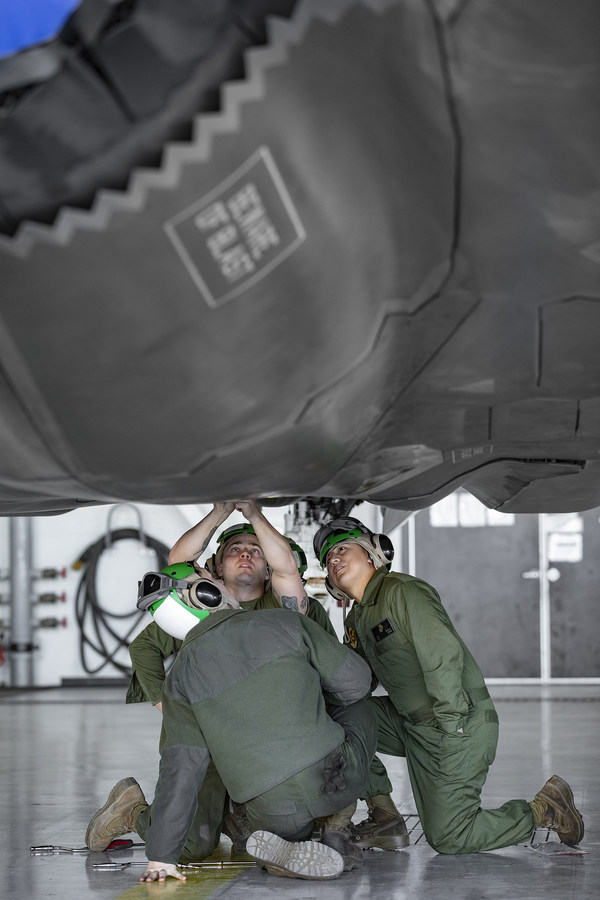
Site activation is the point at which aircraft procurement meets the infrastructure and support system required to operate the fleet. A new F-35 location requires ground-support equipment, maintenance tooling, initial spares, technical services, and the logistics arrangements needed to begin flying before the unit settles into a mature sustainment pattern.
The contract covers both land-based and at-sea sites, widening the range of equipment and support conditions that have to be addressed. Shore bases can build dedicated maintenance and storage infrastructure around the aircraft, while carrier and amphibious operations introduce tighter constraints around space, handling, environmental exposure, and equipment movement.
Initial sustainment differs from mature fleet support because a new unit starts without the depth of local inventory and experience available at an established operating location. Equipment, supplies, and technical support have to arrive ahead of or alongside the aircraft so maintainers can generate sorties from the beginning of the activation cycle.
The F-35’s expanding international footprint creates a rolling sequence of those activations rather than a single programme-wide event. Operators bring aircraft into service at different times, while US services continue opening or expanding locations as fleet numbers increase. An IDIQ structure allows orders to be placed against individual requirements instead of fixing every future site package years in advance.
Existing infrastructure, fleet size, basing arrangements, training plans, and national support choices affect the amount and timing of equipment required at each location. At-sea operations impose a different support model again, even where the underlying aircraft and many maintenance processes are common.
The contract also sits outside the aircraft production line itself. Final assembly delivers completed F-35s, but readiness depends on a wider industrial chain supplying tools, test equipment, support hardware, logistics services, and engineering work. Delays in those supporting elements can restrict sortie generation even when aircraft have been delivered on schedule.
Configuration control adds another layer to the process. Ground equipment and technical support have to remain compatible with the aircraft hardware and software standard used by each customer while upgrades continue across a global fleet. Site packages therefore need to reflect the configuration that will actually operate from the location rather than a generic support set frozen at an earlier point in the programme.
Lockheed Martin is the prime contractor for F-35 air-vehicle production and sustainment, giving the company a central role in coordinating aircraft, supply-chain, and support activity. US defence oversight material describes F-35 air-vehicle sustainment as spanning supply chain activity, logistics systems, depot maintenance, and pilot and maintainer training, illustrating the breadth of work surrounding aircraft manufacture.
The latest modification gives the Joint Program Office additional capacity to order site-activation and initial-sustainment work as requirements emerge through 2031. It does not commit the full ceiling increase and does not represent an order for additional aircraft.
As the international F-35 fleet grows, a larger share of industrial activity sits in the support system surrounding the aircraft. More operators and active locations create recurring demand for sustainment infrastructure, equipment, and technical services even when annual aircraft-production volumes are comparatively stable.
The practical test is whether activation packages arrive early enough to support aircraft introduction without creating gaps between delivery and usable capability. The ceiling increase gives the programme contractual headroom for that work; individual orders will determine how much of the additional capacity is ultimately used.