IN Brief:
- Rheinmetall's AGSW simulator has passed its Factory Acceptance Test in Bremen.
- The system reproduces vehicle logic, aiming, driving dynamics, ballistics, and platoon-level scenarios.
- Five systems are scheduled for delivery to Bundeswehr users by mid-2027.
Rheinmetall has completed factory acceptance of the Bundeswehr’s new Heavy Infantry Weapon Carrier gunnery and combat simulator, allowing crew training to develop alongside vehicle deliveries rather than waiting for the operational fleet to become widely available.
Rheinmetall completed the Factory Acceptance Test for the Ausbildungsgerät Schiess- und Gefechtsausbildung schwerer Waffenträger Infanterie, or AGSW, at its Bremen site in June. The result was formally confirmed by the responsible BAAINBw project manager in July after representatives from the procurement authority, Army development organisation, Infantry School, and fusilier troops inspected the system.
The acceptance closes a development phase that began after contract signature in early 2024. Rheinmetall says development was completed in July 2026, with the first AGSW due to be handed to the Infantry School this autumn. Five systems are scheduled to reach users by mid-2027.
The timing was designed into the programme from the beginning. The Bundeswehr and industry agreed in 2022 that initial training equipment should be available before the first operational vehicles arrived, reducing the risk of fielding new hardware while crews waited for representative simulation systems.
The first part of that two-stage training approach is already in service. Procedural trainers were delivered to fusilier battalions between September 2025 and April 2026, allowing personnel to begin learning controls and operating procedures before moving into the more complete gunnery and combat environment provided by the AGSW.
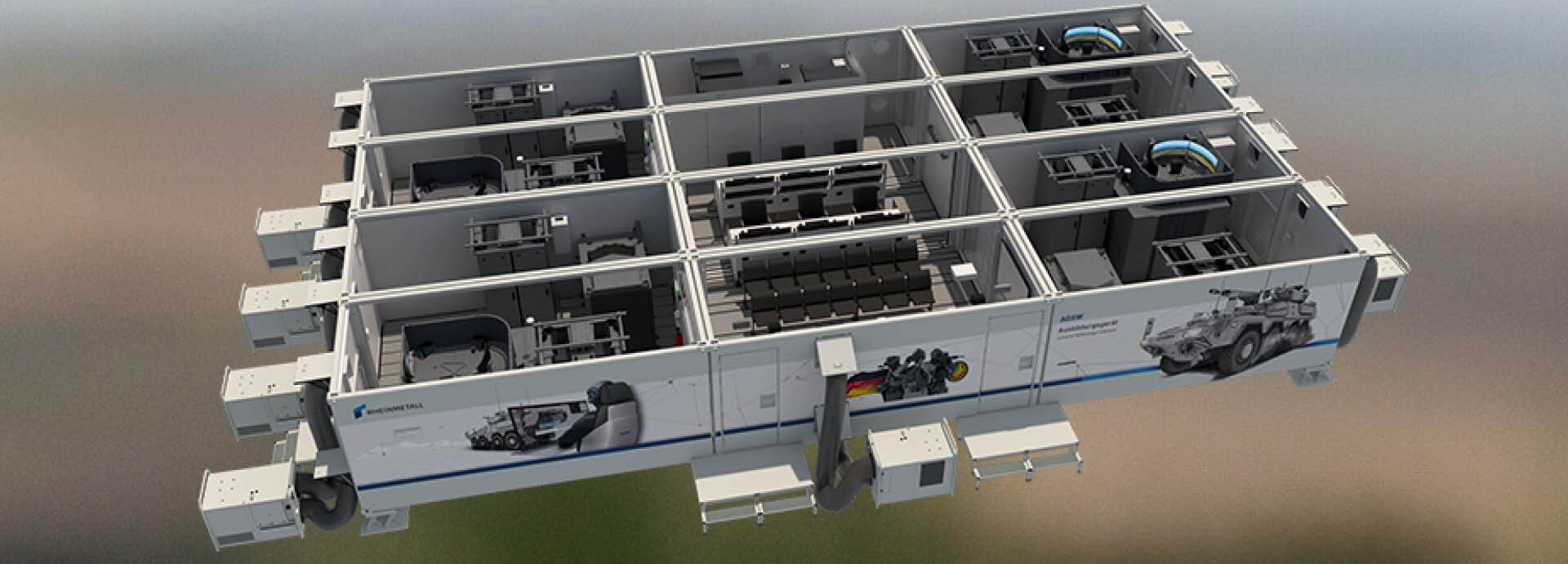
Each AGSW includes a control, evaluation, and monitoring station together with four fighting compartments. Rheinmetall says it reproduces the vehicle interior, operating logic, aiming behaviour, driving dynamics, and ballistics, allowing training to progress from individual crew tasks through complete crew coordination and into tactical activity at platoon level.
That scope reflects the difficulty of treating driver, commander, gunner, weapons, sensors, and digital systems as separate training problems. A modern armoured vehicle crew has to understand how information and decisions move between positions as well as how each individual control operates. Reproducing the logic of the vehicle is therefore as important as recreating the physical layout.
The simulators are also prepared for networking with infantry desktop trainers, allowing mounted crews to train with dismounted personnel. Both systems use the same simulation software and operating logic, creating a route from basic procedural instruction into larger combined scenarios without requiring every participant to occupy a full vehicle simulator.
Users can create and modify virtual terrain themselves, enabling routes, positions, and tactical procedures to be rehearsed against selected operating environments. That shifts part of scenario preparation to military instructors rather than leaving users dependent on a fixed library supplied with the equipment.
The training system is being introduced alongside Germany’s Heavy Infantry Weapon Carrier programme, based on the Australian Boxer Combat Reconnaissance Vehicle. Germany has ordered up to 123 vehicles, with more than 100 due to be produced in Australia for export. The platform combines the Boxer 8×8 chassis with the Lance turret and is intended to equip the German Army’s medium forces.
The distributed production model makes configuration control particularly important. Vehicles, simulator software, training material, support documentation, and later engineering changes have to represent the same approved baseline even though equipment is being produced and supported across two national industrial bases.
Rheinmetall has based the AGSW concept on technology developed for the Puma infantry fighting vehicle’s gunnery and combat training system. The Puma simulator moved into serial production after reaching a milestone in 2025, and the company is extending the underlying architecture to further Bundeswehr vehicle types.
Common technology can reduce duplicated engineering, but the simulation still has to represent the correct vehicle. Rheinmetall says the AGSW and procedural trainer software will be adapted to the final development status of the Heavy Infantry Weapon Carrier after testing and acceptance at individual locations, then rolled out as an identical version across both training systems.
That final-baseline update is one of the more important parts of the programme. High fidelity simulation loses value quickly if the operational vehicle receives different controls, software behaviour, ballistics, or performance characteristics. Training equipment therefore becomes part of fleet configuration management rather than a standalone system that can be delivered once and left unchanged.
The same applies when later upgrades arrive. A vehicle modification may alter displays, software, weapon behaviour, sensor interfaces, or operating procedures, forcing the simulator to change with it. If those updates lag behind the operational fleet, crews can spend valuable training time learning a configuration they will not actually use.
The first AGSW handover this autumn will begin the operational test of Rheinmetall’s approach. Factory acceptance demonstrates that the simulator meets its agreed configuration at Bremen; the harder measure will be whether five systems can be fielded, networked, updated, and kept aligned with vehicles arriving through the German-Australian production programme.
Delivering training equipment before the fleet is fully fielded gives the Bundeswehr an early start. Keeping that training technically synchronised with the vehicles throughout their service life is the less visible task that will determine whether the benefit survives beyond the first delivery cycle.