IN Brief:
- Visionary Machines and Hanwha Defence Australia are assessing Pandion Sentinel integration on the AS21 Redback.
- The passive multispectral system detects and tracks drones without emitting a targetable radio-frequency signal.
- The work remains joint development and assessment, with no fleet-wide procurement decision or installation quantity announced.
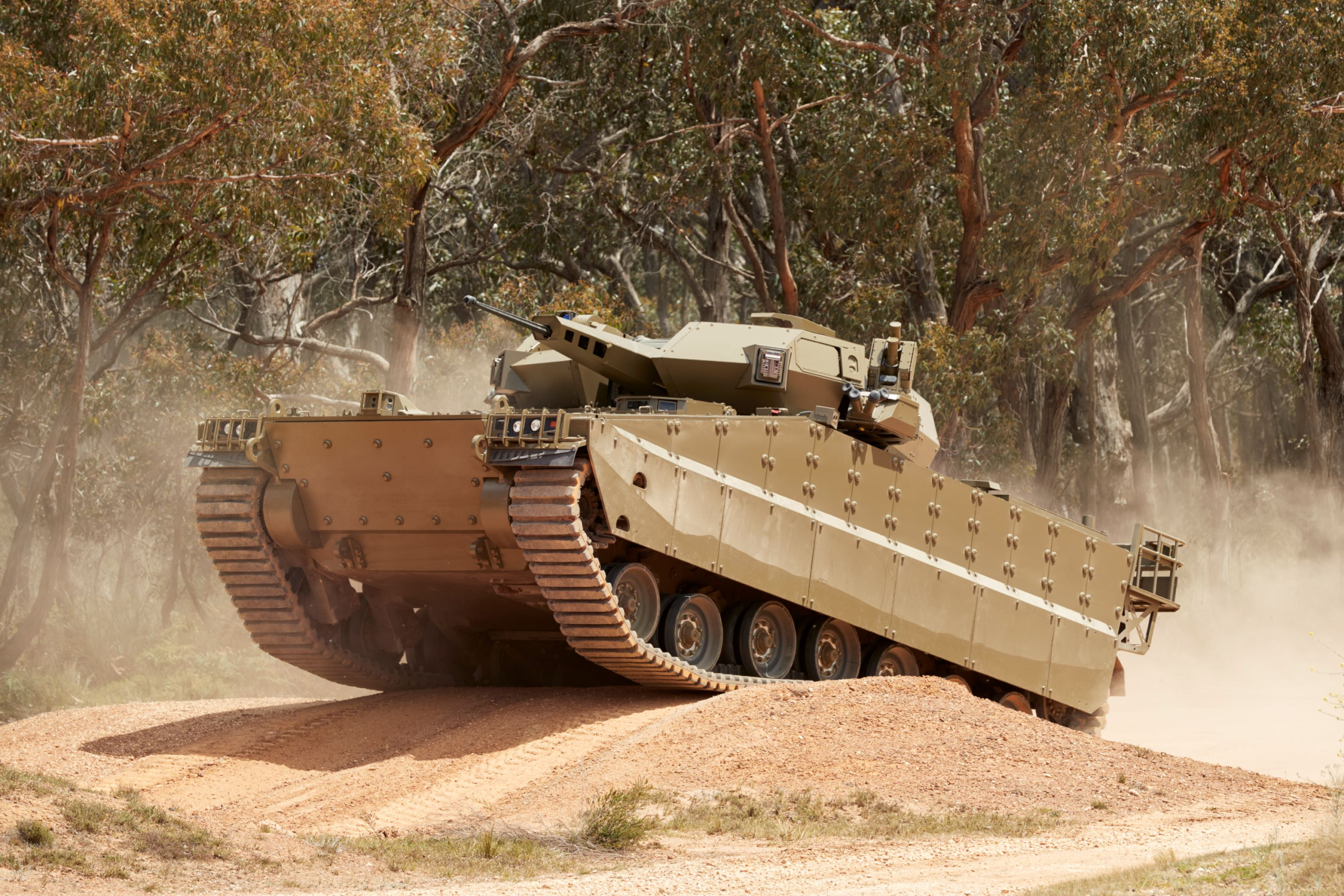
Visionary Machines and Hanwha Defence Australia have moved into a new phase of joint development to assess passive counter-drone sensing on the Redback infantry fighting vehicle using the Australian company’s Pandion Sentinel detection and tracking system.
Visionary Machines is working with Hanwha Defence Australia to examine how Pandion Sentinel could support force protection and situational awareness on the AS21 Redback. The activity follows a memorandum of understanding signed by Visionary Machines, Hanwha Defence Australia, and Hanwha Systems at the Avalon International Air Show in March 2025.
The current work is centred on sensing rather than adding another effector to the vehicle. Pandion Sentinel is a passive optical system designed to detect, track, classify, and generate targeting information on drones without transmitting radio-frequency energy. That allows the sensor to search without creating a radar or communications emission that could reveal its own position.
Visionary Machines describes Pandion Sentinel as a multispectral optical array operating across visible, near-infrared, shortwave infrared, and longwave infrared bands. The company says the system can detect and track Group 1 drones beyond one kilometre, operate against larger Group 2 and Group 3 targets, work without GPS, and consume less than 250 watts. Vehicle mounting and third-party command and control integration are among its available configurations.
Putting that capability on Redback is an integration exercise rather than a simple sensor fit. A vehicle-mounted passive array has to maintain useful fields of view while the platform is moving, survive vibration and environmental loads, feed track data into existing displays or command systems, and stay within vehicle power and space limits. It also has to maintain calibration when the host platform is subjected to shock, dust, temperature changes, and repeated movement.
Passive optical sensing offers a different detection route from radar or radio-frequency monitoring. It does not depend on a drone transmitting a control signal and it does not illuminate the surrounding area with its own radar energy. That can be useful against autonomous or low-emission drones, although optical systems remain dependent on line of sight and can still be affected by weather, obscurants, background contrast, and terrain.
For that reason, Pandion Sentinel is more likely to contribute one layer within a wider counter-UAS architecture than replace every other sensor. Visionary Machines presents the system as interoperable with third-party command and control and as an enabling detector for separate effectors. The value of the Redback work will depend on whether its tracks can be passed quickly and accurately enough for another system to make a decision or engagement.
Redback already provides a useful test platform for that question because Hanwha has been demonstrating the vehicle with different mission and protection systems. A separate September demonstrator combined a British 40mm turret with Lockheed Martin UK’s SkyKeeper command and control system, creating a different counter-UAS configuration focused on the decision and kinetic engagement chain.
The Pandion activity does not duplicate that demonstrator. Its focus is the sensing layer and the movement of target-quality data into the vehicle’s wider digital architecture. Keeping those functions separate allows Hanwha to assess whether Redback can accept different sensor, command, and effector combinations rather than tying the platform to a single counter-drone package.
That modularity only works if the interfaces are controlled. Track format, latency, coordinate accuracy, time synchronisation, software standards, and network security determine whether a sensor can cue another system reliably. A successful vehicle trial therefore needs to show more than detection range; it has to establish that the data remains useful after it passes through the vehicle’s electronics and reaches whatever system is responsible for the next action.
Power consumption is another practical constraint. Visionary Machines states that Pandion Sentinel draws less than 250 watts, a modest figure beside many active sensors, but the Redback still has to supply power to communications, sights, protection systems, computing, turret equipment, and other mission electronics. Every additional device also brings cabling, mounting, maintenance access, and environmental qualification requirements.
The work remains a development and assessment activity. The companies have not announced a fleet-wide order, installation quantity, or Australian Army decision to field Pandion Sentinel across its Redback vehicles. Visionary Machines and Hanwha Defence Australia are due to present their collaboration at the Land Forces exposition in Perth in October, providing a near-term point at which the physical integration can be examined more closely.
The programme is therefore best read as a test of how a passive Australian sensor can be incorporated into a modern tracked vehicle, not as a completed counter-UAS procurement. Its technical value will rest on whether Pandion’s detections can survive the less tidy conditions of a moving combat platform and become reliable data for the vehicle’s wider protection architecture.