IN Brief:
- Raytheon has placed LTAMDS production orders with Lyntris covering programme option years two and three.
- Lyntris will manufacture precision liquid-cooled thermal assemblies for the radar’s high-power AESA electronics.
- Production at the company’s California and Nevada sites will cover demand through 2028 under a long-term purchase agreement.
Lyntris has received production orders from Raytheon covering option years two and three of the US Army’s Lower Tier Air and Missile Defense Sensor programme, extending its manufacturing workload through 2028.
The orders fall under a long term purchase agreement established between the companies in 2023. Lyntris will manufacture precision thermal management assemblies used within LTAMDS as Raytheon increases radar output.
Production will take place at Lyntris facilities in Newark, California, and Carson City, Nevada. The company says the orders move its LTAMDS work from development quantities into sustained production.
The components combine liquid cooling circuits with tightly controlled machined features. Their role is to remove heat from the radar’s high-power active electronically scanned array electronics while maintaining temperature stability across the operating system.
Thermal management is fundamental to AESA radar performance because the arrays contain large numbers of electronic elements operating at substantial power density. Heat has to be removed consistently to protect components, maintain reliability and prevent temperature variation from affecting system performance.
Cooling hardware therefore becomes part of the radar production chain rather than an ancillary mechanical item. Increasing the number of complete radars requires corresponding growth in thermal assemblies, power equipment, electronics, structures and other supporting hardware.
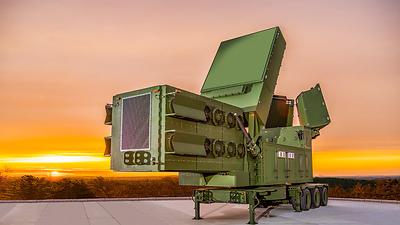
LTAMDS is intended to replace the radar currently associated with the Patriot system and remove the restricted rear-sector coverage of the older architecture. The new radar provides 360-degree surveillance and fire control from a single sensor.
The Army intends LTAMDS to detect and support engagements against threats including cruise missiles, uncrewed aircraft and manoeuvring hypersonic systems. Those requirements increase both processing and radio-frequency demands, placing corresponding pressure on power and cooling equipment.
The programme has moved from development into full-rate production, with Raytheon serving as prime contractor. That transition changes the demands placed on lower-tier manufacturers.
Development hardware can often be produced in relatively small quantities with substantial engineering attention around each unit. Serial production requires the same dimensions, cooling performance and quality to be repeated across growing volumes and predictable delivery schedules.
Lyntris says it has manufactured radio-frequency and thermal management hardware for radar programmes for more than two decades. That qualified production base gives the company a route to scale LTAMDS assemblies without starting another lengthy supplier qualification process.
The manufacturing tolerances remain demanding. Cooling passages, contact surfaces and machined features have to be controlled closely because small changes can affect thermal transfer or fluid behaviour across the electronics being cooled.
Those requirements also have to remain consistent between the Newark and Carson City sites. Equipment, drawings, inspection methods and process controls need to produce assemblies that are interchangeable from the radar programme’s perspective regardless of which facility completed them.
Using two plants provides additional production capacity and some resilience, but distributed manufacturing increases the importance of configuration control. Material substitutions, tooling changes or process adjustments cannot be allowed to create different thermal performance between production batches.
The long term purchase agreement gives Lyntris a clearer demand horizon through 2028. That supports planning for machine utilisation, material purchases, staffing and inspection capacity, although the agreement itself does not guarantee volumes beyond orders already issued.
Raytheon then has to synchronise thermal hardware with the radar’s other production streams. Cooling assemblies delivered ahead of antenna electronics or structural components create inventory rather than complete radars, while late thermal components can hold more expensive equipment outside final integration.
The Army’s fielding plans increase the importance of that coordination. LTAMDS is intended to become a central sensor within the wider Integrated Air and Missile Defense architecture, so production has to support operational systems alongside training, spares and maintenance requirements.
Lyntris is also supplying another Raytheon radar family. Earlier in September the company completed qualification of a production assembly for SPY-6, adding another qualified manufacturing source as US Navy radar output increases.
The two programmes use different hardware, but both illustrate the less visible constraints involved in increasing AESA production. Radar output depends on precision mechanical and thermal suppliers as well as the companies manufacturing the antenna electronics themselves.
The LTAMDS orders secure that workload across option years two and three. The next measure will be whether Lyntris can increase production across its two facilities while maintaining the thermal and dimensional consistency required as Raytheon moves the radar deeper into full-rate manufacture.