IN Brief:
- ROKS Daeho Kim Jong Seo is the third and final 8,200-tonne KDX-III Batch II destroyer.
- HD Hyundai Heavy Industries has built five of South Korea's six indigenous Aegis destroyers.
- Sea trials and performance evaluations precede planned delivery to the Republic of Korea Navy in December 2027.
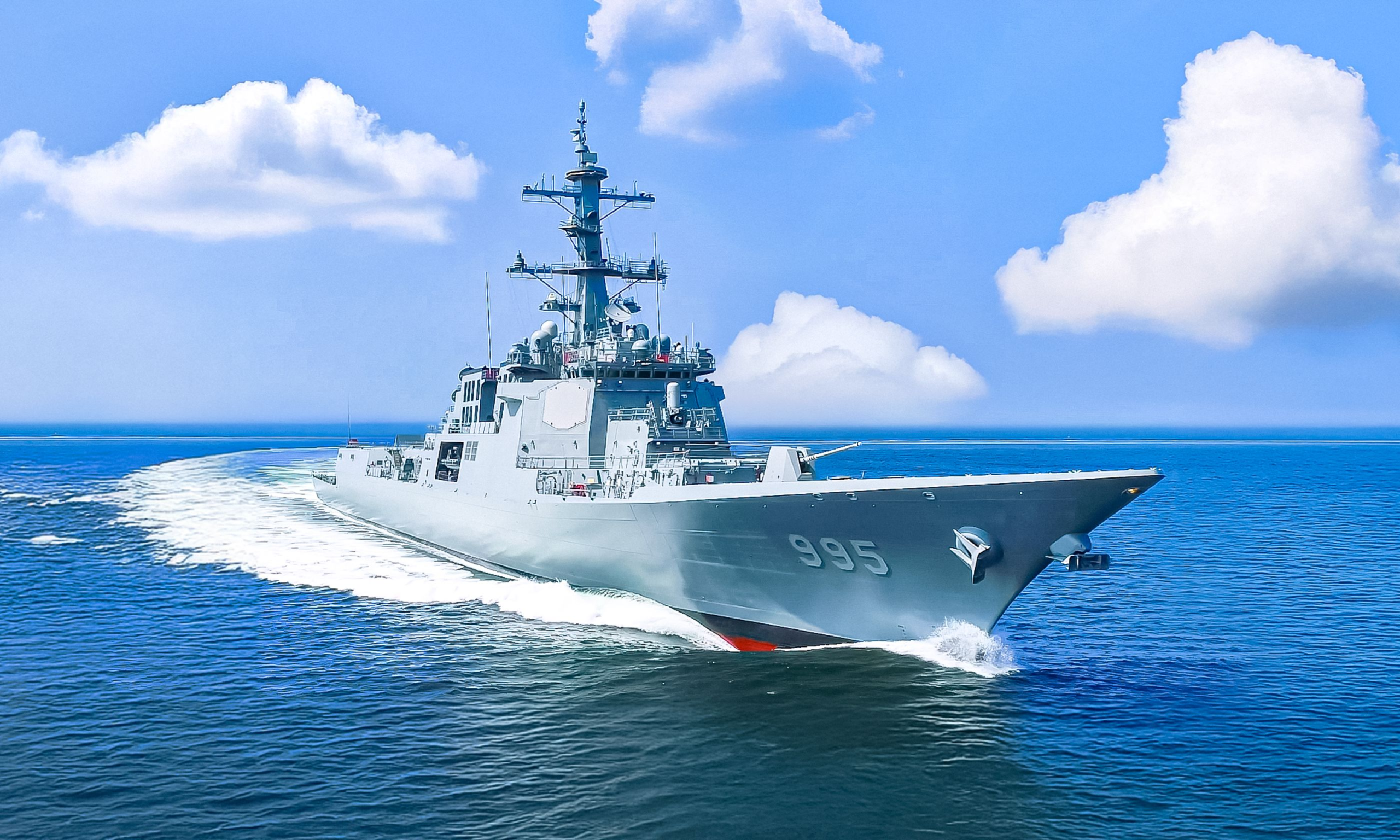
South Korea has launched ROKS Daeho Kim Jong Seo, the third and final KDX-III Batch II Aegis destroyer, completing the construction phase of a six-ship indigenous Aegis destroyer fleet built across two generations.
HD Hyundai Heavy Industries launched the vessel at its Ulsan shipyard on 30 September. The ship is about 170 metres long and 21 metres wide, with a light displacement of about 8,200 tonnes and a reported maximum speed of 30 knots. Sea trials and performance evaluations will follow before planned delivery to the Republic of Korea Navy in December 2027.
The destroyer is the third ship in the Jeongjo the Great class, following ROKS Jeongjo the Great and ROKS Dasan Jeong Yak-yong. The Batch II design is larger than the earlier Sejong the Great class and introduces a newer combat system, sonar suite, and ballistic missile defence capability while retaining the Aegis architecture at the centre of the ship’s air and missile defence role.
South Korean reporting on the launch says the ship carries an advanced integrated sonar system and a domestically developed ballistic missile defence system, giving the class an interception function not available on the older Batch I ships. The vessel is also intended to contribute to sea based missile defence while retaining conventional destroyer roles including anti-submarine warfare, surface warfare, and fleet air defence.
The launch closes a production sequence that began with South Korea’s first Aegis destroyers and has now produced six ships. HD Hyundai Heavy Industries has built five of the six vessels, including all three Batch II ships, giving the Ulsan yard repeated experience in integrating large combat systems, propulsion equipment, sensors, weapons, and naval accommodation into complex surface combatants.
That continuity is important at the end of a multi-ship build. Tooling, block assembly, supplier interfaces, test procedures, and the sequence of combat system installation can all be refined as the programme progresses. The third Batch II hull therefore represents the mature end of the current KDX-III production cycle rather than a first-of-class industrial exercise.
The programme does not leave South Korea without a follow-on destroyer workload. The KDDX project is moving through detailed design, propulsion selection, and production planning for a new class of locally designed destroyers. Hanwha Ocean’s preparation for lead-ship construction, alongside propulsion and missile work, gives the naval sector another route for retaining engineering, shipbuilding, combat system, and supplier capacity as the KDX-III Batch II line reaches completion.
For Daeho Kim Jong Seo, the immediate workload now moves from launch activity into harbour preparation, systems commissioning, and sea trials. Those stages place a different burden on the shipbuilder and equipment suppliers because propulsion, power generation, combat systems, sensors, communications, and weapons interfaces have to operate together as a complete ship rather than as separately installed systems.
The integration task is particularly demanding on an Aegis destroyer. Large radar arrays, combat system computing, missile interfaces, sonar, communications, and power and cooling equipment all depend on configuration control across hardware and software. A fault discovered during harbour or sea testing can sit at the boundary between several suppliers, making test planning and engineering authority as important as the completion of individual pieces of equipment.
The six-ship programme also shows how South Korea’s naval industrial base has broadened. The ships still include major foreign-origin systems, but they sit alongside a larger domestic base in sonar, missiles, ship design, integration, and electronics. Production has progressively required local industry to manage more of the interfaces between Korean and imported equipment rather than treating the hull and combat systems as largely separate packages.
That supplier depth becomes relevant beyond the home fleet because South Korean shipbuilders are pursuing naval export programmes. A shipyard can offer hull design and construction capacity, but repeatable delivery depends on qualified vendors, software integration, configuration management, test equipment, and the ability to resolve interface problems without stopping production. A six-ship Aegis programme provides a deeper reference base than a one-off demonstrator.
ROKS Daeho Kim Jong Seo still has to complete trials and acceptance before entering service. Its launch nevertheless closes the construction phase of South Korea’s original six-destroyer Aegis plan. With the last Batch II hull afloat and KDDX activity gathering pace, the next test for the country’s naval industry is whether experience accumulated at Ulsan can carry into a new generation of locally integrated surface combatants.