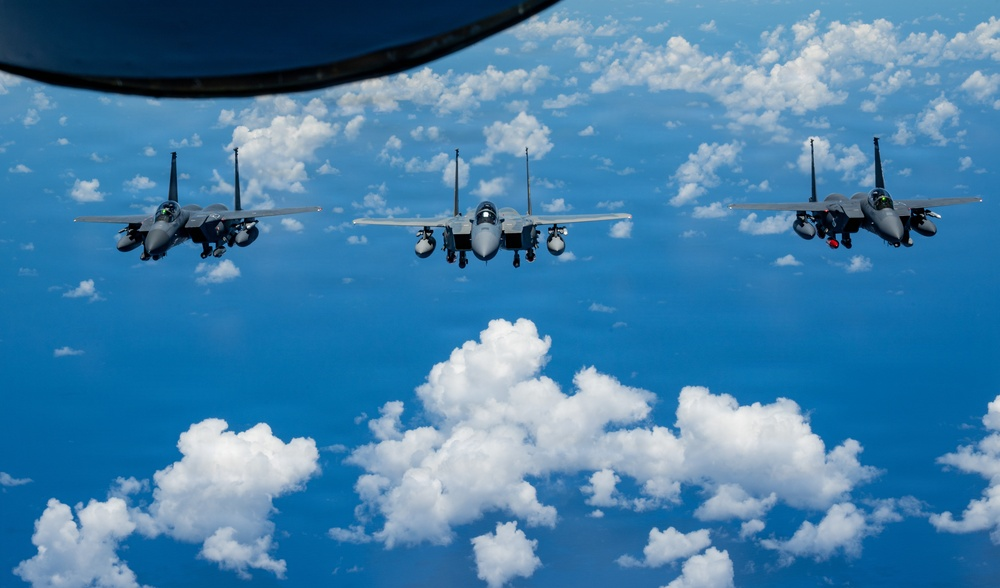
IN Brief:
- The US Air Force has awarded BAE Systems $146.7 million for 40 EPAWSS hardware sets supporting F-15EX Lots Seven and Eight.
- Work will be performed in Nashua, New Hampshire, with contract activity expected to continue through August 2030.
- EPAWSS is already in full rate production for new F-15EX aircraft and selected F-15E modernisation work.
BAE Systems has received a $146.7 million US Air Force award for 40 Eagle Passive Active Warning Survivability System hardware sets supporting F-15EX production Lots Seven and Eight.
The sole-source contract covers AN/ALQ-250 EPAWSS equipment and associated countermeasure dispenser hardware, with work centred on Nashua, New Hampshire, and scheduled to continue through August 2030.
The award adds another defined production batch to an electronic warfare programme already in full rate manufacture. EPAWSS is being produced for new F-15EX aircraft and selected F-15E modifications, giving BAE Systems parallel new-build and retrofit demand.
Those two production streams create different industrial pressures. Equipment destined for new aircraft can be scheduled directly against Boeing’s F-15EX build sequence, while retrofit hardware has to align with aircraft availability, depot capacity, modification schedules, and the condition of individual F-15E airframes.
EPAWSS replaces older analogue defensive systems with an all-digital architecture combining radar warning, threat geolocation, situational awareness, and electronic countermeasures. BAE Systems describes the system as providing 360-degree awareness and self-protection against modern radio-frequency threats.
The digital architecture also allows capability to evolve through software and firmware rather than requiring complete replacement of the underlying hardware whenever the threat environment changes.
That improves upgrade flexibility but places greater emphasis on configuration control. Hardware sets installed across different production lots need an accurately recorded electronic and software baseline so maintenance teams know which configuration is fitted to each aircraft.
Electronic warfare hardware relies on a specialist manufacturing chain. Radio-frequency components, processors, digital receivers, power electronics, circuit assemblies, cooling equipment, precision housings, and test systems all contribute to the finished installation.
Many of those components require controlled electronics manufacture and extensive verification before they can be accepted for flight use. Increasing output therefore depends on semiconductor availability and test capacity as much as final assembly labour.
Nashua is one of BAE Systems’ principal US electronic warfare manufacturing centres. Related engineering and production work also takes place in Austin, supporting a broader electronic combat business across several aircraft and mission programmes.
The latest 40-system award provides a clear demand signal around F-15EX Lots Seven and Eight. Suppliers can plan material orders and manufacturing slots against a known requirement rather than waiting for separate hardware purchases as each aircraft approaches final assembly.
That visibility is particularly useful for long lead electronic components. Some radio-frequency devices and specialised processors cannot be sourced immediately if stock runs short, especially where defence qualification limits the number of acceptable suppliers.
A missing electronic warfare set can become a wider aircraft production constraint. A fighter may be structurally complete, but if required defensive equipment is unavailable the aircraft can still be prevented from reaching its contracted configuration for customer acceptance.
The same applies to the countermeasure dispenser equipment included in the contract. Components that represent a small proportion of total aircraft value can still affect final delivery if they are mandatory for the approved build standard.
EPAWSS has already progressed through initial operational test and evaluation, moving the programme from development into recurring manufacture and fielding. That changes the production focus from building representative hardware to maintaining delivery quality across repeated aircraft lots.
Repeat manufacture allows assembly and test processes to stabilise, but it does not remove engineering work. Electronic warfare systems continue to evolve as threat libraries, software, algorithms, and digital processing capabilities are updated.
Hardware production and software development consequently run in parallel. The factory needs a stable physical configuration while engineering teams continue to introduce approved digital changes without creating incompatible aircraft baselines.
International F-15 modernisation programmes can add further demand. BAE Systems has also secured EPAWSS-related work associated with South Korea’s F-15K upgrade, broadening the production horizon beyond the US Air Force fleet.
International orders can improve continuity if customers use common hardware, although national configurations still require separate integration, certification, support, and contracting.
The F-15EX requirement remains the most straightforward production case because EPAWSS is part of the aircraft’s planned new-build configuration. Deliveries can be mapped directly against fighter lots, allowing BAE Systems, Boeing, and the Air Force to coordinate hardware availability with aircraft assembly.
The latest award runs through August 2030, providing several years of production visibility for BAE Systems and its suppliers. That supports workforce planning, component purchasing, test capacity, and manufacturing investment around a known block of aircraft.
The industrial challenge now is sustained delivery rather than proving the system. EPAWSS has moved into regular manufacture, and performance against Lots Seven and Eight will show how effectively BAE Systems can balance F-15EX production, F-15E modification work, and international demand across the same electronic warfare manufacturing base.