IN Brief:
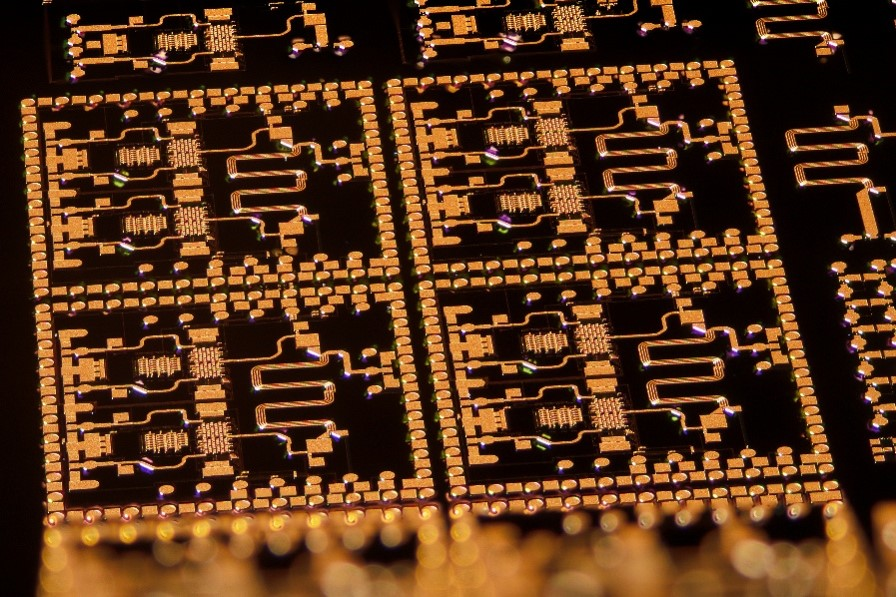
- FORTITUDE processes a broad portion of the electromagnetic spectrum on a gallium nitride chip approximately the size of a grain of rice.
- Northrop Grumman says the technology delivers three times more power and 20 times better signal quality while replacing dozens of conventional components.
- Production is supported by a US microelectronics network comprising two semiconductor foundries and an advanced packaging facility.
Northrop Grumman has introduced FORTITUDE, a US-manufactured gallium nitride microelectronics technology designed to consolidate radio-frequency functions currently spread across dozens of separate components in defence and commercial systems.
The multilayer chip processes a broad portion of the electromagnetic spectrum on a device approximately the size of a grain of rice. Northrop Grumman says the technology provides three times greater power and 20 times better signal quality while reducing the weight, power consumption, and component count of the wider electronic system.
Applications identified by the company include radar, satellites, GPS, electronic warfare, communications, and future 6G systems. That places FORTITUDE firmly within the specialist radio-frequency electronics chain, where performance depends on moving and processing high-frequency signals cleanly rather than carrying out the general computing tasks associated with conventional processors.
The technology was previously known as the Super Lattice Castellated Field Effect Transistor and has emerged from Northrop Grumman’s longer-term investment in compound semiconductor microelectronics. Its architecture is intended to combine functions that would otherwise require several discrete radio-frequency components and the circuitry needed to connect them.
That consolidation has direct consequences for defence system design. Every additional component introduces packaging, electrical connections, power distribution, cooling requirements, assembly operations, and potential failure points. Reducing the number of devices can therefore shrink the space occupied by an electronic subsystem while simplifying the surrounding hardware.
Those advantages are particularly relevant in aircraft, satellites, missiles, radar arrays, and electronic warfare systems, where size, weight, power, and cooling all compete for limited platform capacity. Removing separate components can create room for additional capability elsewhere, although the integrated device itself then carries greater responsibility within the finished system.
Northrop Grumman is positioning FORTITUDE as a domestically manufactured technology rather than an imported specialist semiconductor. Its Microelectronics Center operates three US government-accredited manufacturing facilities: semiconductor foundries in California and Maryland and an advanced packaging operation in Florida.
Together, those facilities provide a route from device design and wafer fabrication through assembly, test, and packaging. The company says the network produces millions of specialist microelectronics each year for defence and commercial applications.
The California Space Park foundry supports several compound semiconductor processes, including gallium nitride, gallium arsenide, and indium phosphide. Those materials are used where conventional silicon cannot always provide the required combination of frequency, power, efficiency, or survivability.
Gallium nitride is particularly important in modern radar and communications equipment because it can support high radio-frequency power while operating efficiently across demanding frequencies. That has made GaN increasingly valuable in active electronically scanned array radar, electronic warfare, and satellite communications systems.
Fabricating the semiconductor die is only one part of the production process. A device intended for an operational defence system still requires packaging, reliable electrical connections, thermal management, environmental protection, mechanical support, and extensive testing before it can be installed in a larger electronic assembly.
Northrop Grumman’s Florida capability addresses those later stages. Keeping wafer post-processing, advanced packaging, and test within the same domestic industrial network gives the company tighter control over qualification and reduces dependence on external production capacity for specialist defence devices.
That control matters because military radio-frequency semiconductors occupy a different market from high-volume consumer chips. Production quantities can be comparatively modest, programme lifecycles can extend across decades, and customers may need an approved process to remain available long after commercial semiconductor manufacturers would normally have moved to another technology generation.
Defence customers also require traceability across fabrication, packaging, inspection, and configuration. Changing a foundry process or substituting a component can trigger new engineering and qualification work even where the replacement appears functionally similar.
A domestic manufacturing chain therefore provides value beyond simple production volume. It allows Northrop Grumman to maintain specific processes around defence requirements and coordinate semiconductor development with its own radar, space, communications, and electronic warfare programmes.
FORTITUDE could strengthen that relationship if it becomes a reusable component across several product families. A common radio-frequency building block adopted in radar, electronic warfare, and satellite equipment would spread manufacturing demand across multiple programmes and give the foundries a broader production base.
The engineering case will depend on how much surrounding hardware the chip can actually replace. Consolidating dozens of components can reduce board area and assembly work, but it also concentrates functionality inside one device, increasing the importance of reliability and environmental qualification.
Moving from technology launch to repeated platform use will therefore require more than headline performance figures. FORTITUDE will need to pass the electrical, thermal, environmental, life, and electromagnetic testing demanded by the systems into which it is incorporated.
Manufacturing yield will also matter. Complex semiconductor technologies only become practical production components when foundries can reproduce performance consistently across wafers and production lots without excessive rejection rates.
Northrop Grumman enters that phase with an established domestic microelectronics organisation rather than having to qualify an external fabrication network around the new device. The same company developing the chip also operates foundry, packaging, and test capability and manufactures defence systems that could eventually use it.
The industrial significance of FORTITUDE consequently extends beyond one semiconductor announcement. Northrop Grumman is attempting to move more radio-frequency functionality onto a smaller US-produced device while retaining control of the specialist manufacturing processes required to take it from wafer fabrication into an operational electronic system.
The next measure will be adoption. If FORTITUDE moves into multiple production programmes, its value will be demonstrated by the hardware it removes from wider systems and by whether Northrop Grumman’s foundries can manufacture the device at the consistency and volume required by operational fleets.