IN Brief:
- Detroit Defense will equip US Army tactical wheeled vehicles with an end to end predictive sustainment system at Fort Hood.
- Vehicle fault, engine and fuel data will be combined with maintenance records through physics informed machine learning.
- Soldier led validation will continue through large scale training exercises into summer 2027.
Detroit Defense has received a US Army contract to equip tactical wheeled vehicles with predictive sustainment technology combining onboard vehicle data, soldier maintenance records, machine learning, rugged edge computing and tactical communications designed to keep functioning when network access is disrupted.
The Army Applications Laboratory awarded the work in coordination with the 1st Cavalry Division, with initial equipment due at Fort Hood during autumn 2026. Development and refinement will continue after installation, leading into soldier operated validation during large scale training exercises through summer 2027.
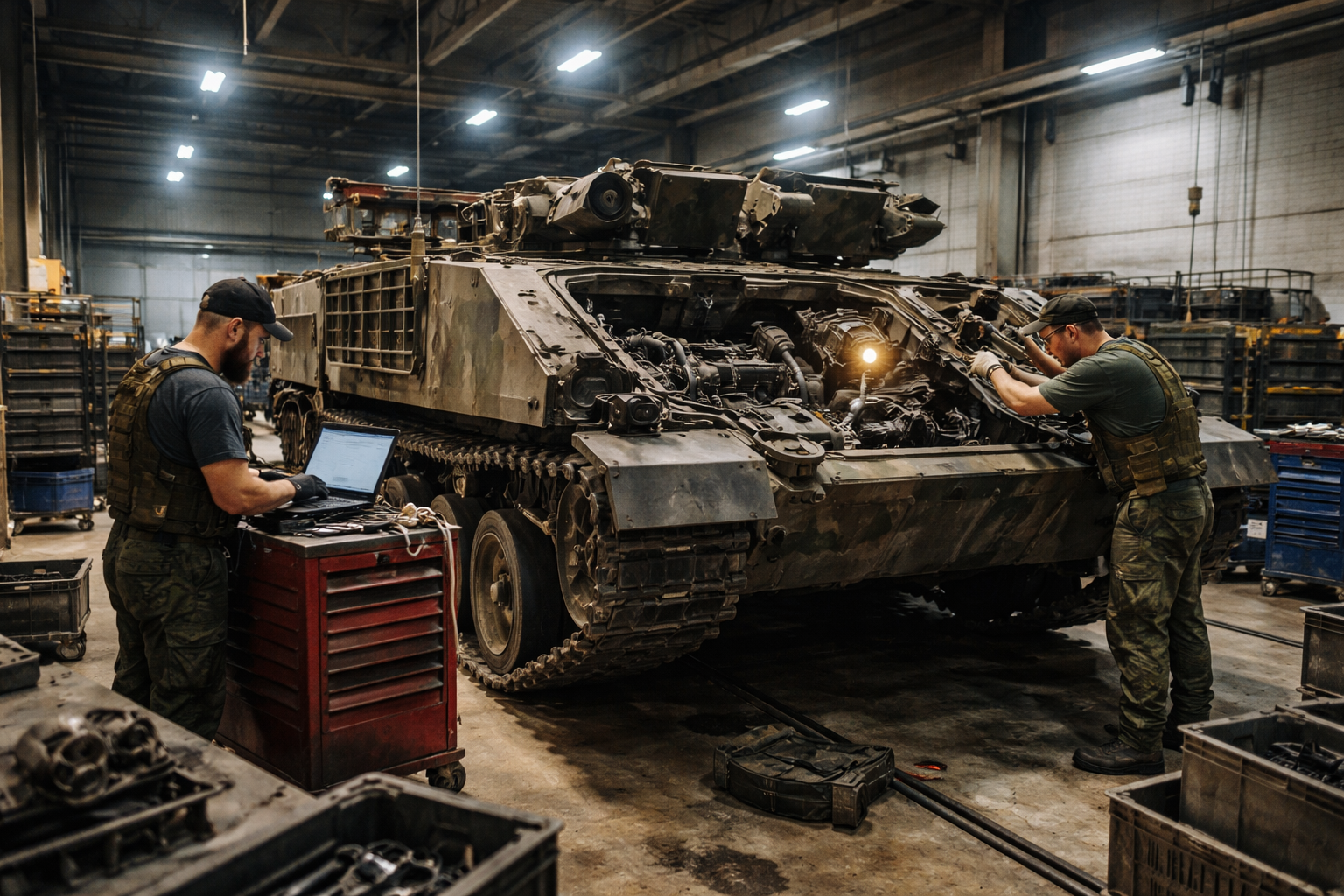
Rather than waiting for a component to fail or a diagnostic warning to cross a fixed threshold, the system is intended to identify patterns that indicate degradation before the fault removes a vehicle from service. Vehicle data will include fault codes, fuel information and engine parameters, while maintenance activity entered by soldiers adds observations that cannot be captured reliably by onboard electronics alone.
A damaged component, intermittent electrical problem or abnormal mechanical condition may be obvious to a maintainer before the vehicle produces a definitive electronic fault. Detroit Defense refers to this contribution as “Soldier as a Sensor”, using information recorded during inspections and repairs as another input to the predictive model rather than treating maintenance records as a separate administrative database.
The architecture then combines those inputs through physics informed machine learning. A model built only around statistical correlation may learn that certain combinations of sensor values often precede a failure, while a physics informed approach can also incorporate known relationships within the vehicle and its components. Detroit Defense and its partners have not disclosed the individual models, confidence thresholds or failure modes being predicted, so performance will have to be established through field use.
Predictive maintenance becomes useful only when the output identifies an action that can be taken. Detroit Defense says its FleetOps AI and LPPM applications will aggregate information at higher command levels, allowing maintainers and commanders to see emerging fleet condition and decide where parts, maintenance capacity or vehicle substitutions are likely to be needed.
The five-company team divides the architecture across specialist suppliers. Parker Hannifin supports onboard data collection, PredictiveIQ provides the physics based AI element, Persistent Systems contributes Wave Relay mobile ad hoc networking and Getac supplies rugged edge computing. Detroit Defense acts as prime contractor and systems integrator, giving it responsibility for turning those individual technologies into one operating sustainment chain.
Processing at the edge is necessary because tactical vehicles cannot assume continuous access to a remote data centre. Communications may be denied, disrupted, intermittent or bandwidth limited, so diagnostic and predictive functions have to retain enough local computing and storage to keep operating while connectivity is unavailable. Data can then be shared with higher echelons when the network permits rather than making each prediction dependent on a live cloud connection.
Mobile ad hoc networking provides another part of that resilience by allowing participating nodes to form and reform communications paths as vehicles move. Network performance will still vary with distance, terrain, interference and the number of active nodes, which means the sustainment applications have to tolerate delayed or incomplete information rather than assuming every vehicle reports continuously.
Detroit Defense already operates digital logistics systems within the Army environment. Its Digital Logbook and Data Integration for Ground Systems work have received Authority to Operate approval, giving the new predictive programme an existing route for handling platform and maintenance information instead of requiring a completely new digital record system.
The predictive layer introduces a more difficult accuracy problem. A model that warns too frequently can prompt unnecessary inspection or early replacement of usable components, consuming spares and maintenance hours. A model that misses degradation leaves the force exposed to the same unplanned failures the programme is intended to reduce. Vehicle age, terrain, payload, driver behaviour and maintenance history can all alter component life even within nominally identical fleets.
Training exercises provide a more representative environment for testing those predictions than a controlled demonstration because vehicle use becomes irregular and the supporting data are generated by soldiers carrying out normal work. The programme will have to show that the system can preserve useful accuracy when records are imperfect, communications drop out and vehicles operate under different duty cycles.
Fleet level visibility also links maintenance forecasting with supply. Identifying an emerging component problem several days earlier has limited value if the relevant spare, technician or recovery capacity cannot be placed where it will be needed. Aggregating predictions across many vehicles can give logistics planners more warning about concentrations of demand, provided the confidence of those predictions is understood.
The initial Fort Hood installation will begin that assessment during autumn 2026. Validation through summer 2027 should provide a larger body of operating data across real tactical vehicles and soldier maintenance workflows. The Army will then be able to judge whether predictive sustainment reduces avoidable downtime and improves parts planning or simply adds another layer of reporting around faults that maintainers would have identified anyway.