IN Brief:
- Ondas has received a $56 million order for electronic safe and arm devices supporting an unnamed European loitering munition programme.
- GATE Technologies supplies the qualified electronic fuzing technology, while Bron Technologies provides European manufacturing and certification capacity in Poland.
- The award is Ondas's first announced ESAD order since acquiring GATE and Bron in September.
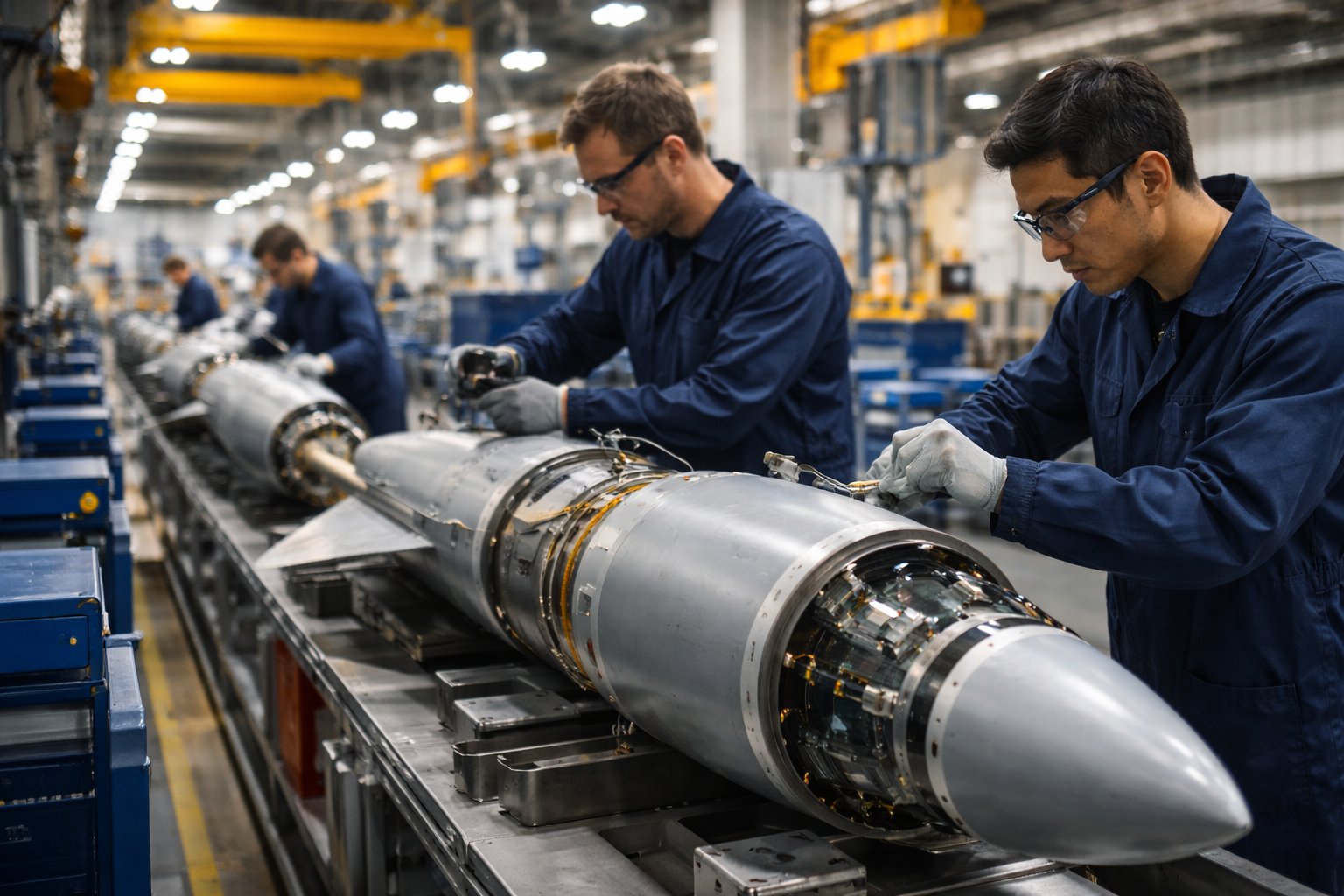
Ondas has received a $56 million order for electronic safe and arm devices supporting an unnamed European loitering munition programme, moving recently acquired GATE Technologies hardware into a substantial production run through Ondas’s European manufacturing operations in Poland.
The order covers one of the less visible but most safety critical parts of a modern weapon. An electronic safe and arm device controls when a munition must remain safe, when it may arm and when the initiation chain may become active. Ondas describes the component as sitting between the weapon platform, mission logic and energetic payload, where incorrect behaviour could affect both operational reliability and basic handling safety.
Safe and arm devices have to remain inert during storage, transport, handling and launch, then respond correctly once predetermined mission conditions are satisfied. Those conditions can be more complicated in a loitering munition than in a conventional projectile because the vehicle may remain powered for an extended period, receive updated mission information or abort an engagement before the payload is ever used.
Ondas has not identified the customer, munition type, unit quantity or delivery schedule. The $56 million figure therefore cannot yet be translated into the number of devices that will leave the Polish production line or the duration of the programme. The company does say that the order is moving into production with technology already qualified and a manufacturing base already in place, distinguishing it from an early development contract.
The capability entered Ondas through its September acquisition of GATE Technologies and Bron Technologies. GATE develops electronic safe and arm devices and advanced electronic fuzing for rockets, missiles, unmanned aircraft and loitering munitions, while Bron provides European manufacturing, certification and market access from Poland. The transaction gave Ondas a component business already designed into dozens of weapon systems rather than a technology still seeking its first qualification route.
GATE’s RUBI family uses a compact electronic architecture built around the company’s LEEFI initiation technology. Ondas says the system contains no moving parts and can be configured around different arming conditions, sensor arrangements, triggering functions and physical envelopes. Around 100 RUBI loitering munition configurations have been developed, illustrating how heavily the safe and arm unit can be adapted to the weapon surrounding it even when the underlying architecture remains common.
Removing mechanical elements does not remove the engineering burden. A software driven weapon still needs a deliberately constrained boundary between ordinary vehicle behaviour and the energetic chain, and that boundary has to work predictably after vibration, temperature changes, transport, launch loads and electrical transients. A configurable ESAD can accommodate different weapons, but each installed configuration still has to satisfy the relevant safety and qualification requirements.
Once a device has been designed into a certified munition, supplier substitution can affect mechanical interfaces, electrical behaviour, initiation characteristics and the weapon safety case. Changing that component may therefore force fresh engineering and qualification work. A comparatively small item can consequently have a long production life when the host weapon progresses into sustained manufacture.
Bron’s Polish operation gives the programme a manufacturing and certification route within NATO close to European customers. GATE retains the specialist design and engineering knowledge behind the devices, while Bron provides the industrial path for production. Strict configuration control will be required as individual munition programmes introduce changes to electronics, mission logic or payload interfaces.
The new order is the first ESAD award Ondas has announced since buying GATE and Bron. It also gives the wider precision strike strategy a production contract at component level rather than relying solely on complete autonomous platforms. Ondas has been assembling capabilities across unmanned systems, navigation, communications, mission systems, propulsion and weapon components, with the safe and arm business occupying the point where vehicle electronics meet the energetic effect.
As output rises, process control, component traceability and test consistency have to reproduce the same safety and initiation behaviour across every unit. A prototype can establish that the architecture works, but production qualification depends on manufacturing that result repeatedly. A defect in a safety critical component can affect the qualification position of the weapon programme as well as the individual munition in which it is installed.
Every loitering munition entering production requires a qualified method of keeping its energetic payload safe until the correct conditions are met, so expanding weapon output increases demand for fuzing technology alongside airframes, motors, batteries and seekers. The certification burden means the smallest components in the production chain can still become capacity constraints if the number of qualified suppliers remains limited.
Ondas has not disclosed whether the $56 million award covers one production lot or a requirement spanning several years, and it has not named the European weapon programme involved. Delivery milestones, subsequent orders and any future disclosure on unit volumes will show how much recurring production the GATE and Bron acquisitions have brought into the group. The confirmed development is that the newly acquired safe and arm business has moved directly into a sizeable European manufacturing programme.