IN Brief:
- Steel cutting for the future Luleå began at Naval Group’s Lorient shipyard one month after Sweden signed for four frigates.
- Sweden’s order raises the wider FDI production programme to 13 ships for the French, Greek, and Swedish navies.
- Naval Group says its industrial process can sustain production of up to two FDI frigates annually.
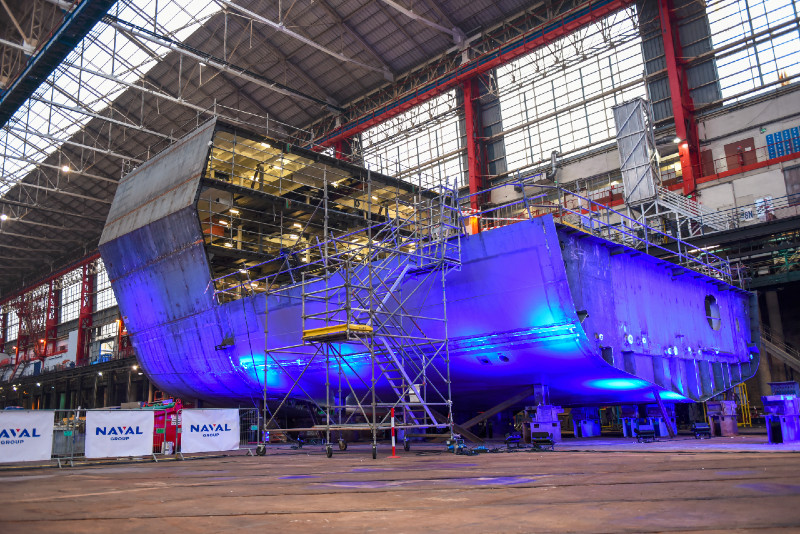
Naval Group has started construction of Sweden’s first FDI frigate at its Lorient shipyard, cutting steel for the future Luleå one month after the four-ship contract was signed.
The milestone moves Sweden’s programme from procurement into physical manufacture and adds another national customer to an FDI production system already building ships for France and Greece. The Swedish order raises the total programme to 13 frigates across three NATO navies.
For Lorient, the additional workload is more significant than a single steel cutting ceremony. Naval Group has developed the FDI around a serial production model rather than a sequence of isolated national shipbuilding projects, allowing work instructions, tooling, supplier relationships, and production planning to be reused across successive vessels.
The company says its industrial process can sustain output of up to two FDI frigates annually. One ship represents around one million hours of production work and a similar volume of design and development activity, giving the programme a substantial effect across both the prime yard and its wider supplier base.
Naval Group has previously identified around 1,200 of its own employees and roughly 400 subcontracting companies as contributors to FDI manufacture. That industrial footprint extends far beyond steel fabrication because each frigate combines hull structures with propulsion, electrical distribution, communications, sensors, weapons, combat management systems, aviation facilities, and a large software element.
Steel cutting is therefore only the first controlled manufacturing step. Structural blocks must move through fabrication before machinery, piping, ventilation, cabling, and electrical systems are installed, while equipment from external suppliers has to arrive against a build schedule that can span several ships at different stages of completion.
The baseline FDI design displaces around 4,500 tonnes and is approximately 122 metres long with an 18-metre beam. The class has been developed for anti-air, anti-surface, anti-submarine, and special forces missions and combines a conventional warship production programme with a heavily digital combat architecture.
That digital element affects manufacturing as directly as physical outfitting. Naval Group has designed the class around redundant computing infrastructure and virtualised systems, meaning software configuration and combat system integration have to progress alongside construction rather than being treated as a final activity after the ship is structurally complete.
The wider FDI family integrates equipment from suppliers including Thales and MBDA, with radar, sonar, communications, electronic warfare, and missile systems all feeding into the completed platform. Swedish requirements will introduce their own configuration choices, but the underlying industrial challenge remains the same: systems from several manufacturers have to be installed and verified without disrupting the wider shipbuilding cadence.
Repeat production gives the yard an opportunity to reduce that risk. Installation problems identified on earlier ships can be removed from later work instructions, while inspection routines and commissioning sequences can be standardised as more hulls move through equivalent stages.
The Swedish programme is entering manufacture while French and Greek vessels are already at other points in the build, trial, and delivery cycle. That creates a more continuous workload for Lorient but also increases pressure on specialist labour, common suppliers, test teams, and equipment whose availability may affect more than one national programme.
The ability to maintain two-ship annual output therefore depends on the complete industrial chain rather than plate cutting or block assembly alone. Combat system suppliers, machinery manufacturers, cable producers, electronics companies, and specialist subcontractors all have to increase deliveries in sequence if the yard is to avoid simply shifting the production bottleneck downstream.
The short interval between Swedish contract signature and steel cutting indicates that engineering and industrial preparation were already well advanced before the final procurement agreement. That reduces mobilisation time but does not remove the national integration work still required as the ship moves through detail design, assembly, outfitting, harbour trials, and sea acceptance.
A warship can be structurally complete long before it is operationally complete. Radar, sonar, weapons, communications, software, power systems, navigation equipment, and propulsion all require commissioning and integrated testing before the customer can accept the vessel.
Those stages will provide another opportunity to reuse experience gained on earlier FDI hulls. A recurring class allows test procedures and integration sequences to mature alongside manufacturing processes, potentially reducing the volume of corrective work required late in each build.
Sweden’s order also gives the programme a longer industrial horizon. Four additional ships mean suppliers can plan against work extending across several years rather than a single vessel, improving the case for maintaining tooling, specialist staff, and production capacity.
The first Swedish frigate is expected to be delivered in 2030. That leaves the Lorient industrial system with four years to move Luleå from first plate through assembly, outfitting, system integration, trials, and customer acceptance while production of the remaining three ships gathers pace behind it.
The significance of the 1 October milestone therefore lies in the transition from contract to repeatable manufacture. Sweden has entered an established FDI production line rather than commissioned an entirely separate frigate design, and Naval Group must now prove that the same industrial model can absorb another four hulls without weakening delivery performance across its existing customers.