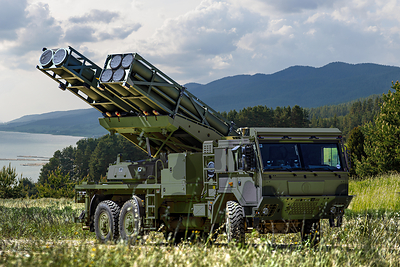
IN Brief:
- The approximately $235 million award was arranged through the Israeli and customer defence ministries.
- The package covers PULS launchers, EXTRA-MR rockets, additional platforms and integrated logistical support.
- The European customer, launcher quantity and rocket delivery schedule have not been disclosed.
Elbit Systems has received a contract worth approximately $235 million to supply PULS rocket artillery launchers and EXTRA-MR guided rockets to an undisclosed European customer. The agreement was concluded through a government-to-government arrangement between Israel’s Ministry of Defence and the purchasing country’s defence ministry, with performance scheduled over three years. Elbit also lists additional artillery-related platforms and integrated logistical support in the package. It has not disclosed launcher numbers, munition quantities, the customer’s identity or a schedule for individual deliveries.
The contract pairs a ground-based launcher with a medium-range guided munition rather than constituting a stand-alone missile order. PULS, short for Precise and Universal Launching System, is a modular rocket artillery architecture intended to fire different compatible munitions from a common launcher family. A common launcher can therefore serve several compatible ranges and payload types, provided its munition-specific software, handling arrangements and safety interfaces are configured and approved. The specific launcher configuration, reload equipment and command interfaces selected for this customer have not been published.
EXTRA-MR is the medium-range version of Elbit’s EXTRA rocket system. Elbit states that the precision-guided, supersonic rocket can engage targets at ranges of up to 80 kilometres. The figure is a manufacturer-stated maximum, not an independently documented result from this customer’s acceptance trials or a guaranteed range in every operating condition. Engagement performance also depends on targeting data, mission planning, environmental conditions and the configuration of the delivered system, none of which Elbit has detailed for the new order.
Launcher integration must connect targeting information and fire authorisation with trajectory planning, weapon preparation, launch control and post-launch reporting, while maintaining protected links between the battery’s equipment. Elbit says EXTRA-MR is compatible with PULS and existing command, control, communications, computers and intelligence architectures. Compatibility across the PULS system family does not mean that integration with the unnamed buyer’s national battle management network has been completed; customer interfaces, testing and security approvals may still be required.
Integrated logistics support extends the award beyond supplying rockets and launchers. Vehicle maintenance, trained personnel, diagnostic equipment, spares, safe munition handling and storage procedures determine whether a nominally available battery can sustain its operating tempo. Guided munitions also impose handling and inspection requirements of their own. Elbit has not itemised how the $235 million is apportioned between launch systems, ammunition, associated platforms and sustainment, leaving the size of each element unknown.
The three-year performance period establishes the contractual execution horizon, without specifying when individual batteries will be accepted or when training and qualification will finish. Acceptance normally depends on contracted tests, documentation and the integration standard required by the buyer. The announcement identifies neither an assembly site nor any additional European manufacturing investment associated with this order. It is therefore a confirmed supply contract, not evidence that a new production line or domestic industrial workshare has been awarded.
Because the purchasing country is unnamed, details from other European PULS programmes cannot safely be applied to this order. Elbit has won orders across the region, and some countries are reorganising long-range fires alongside new command-and-control networks. Each acquisition nevertheless has its own ammunition mix, mobility requirements, sustainment provisions and national approval process. The existing European customer base establishes that the system family is commercially active, but it does not establish the identity of this buyer, how many batteries have been purchased or which launch vehicle has been selected.
A launcher supporting several rocket types needs controlled interfaces across successive software and ammunition updates. Fire-control software must recognise munition characteristics, impose suitable safety rules and exchange the right information with the guidance and launch hardware. Reload and replenishment arrangements must also match the ammunition containers and handling equipment delivered. Those functions are particularly significant when a buyer expects to add munition variants later, although the new contract does not itself identify options or a future weapons roadmap.
Production planning extends from launcher vehicles to the propulsion, guidance and electronic subsystems inside the guided rockets. Precision munitions bring together structural components, propulsion, electronics and guidance assemblies whose manufacture, test and acceptance cannot simply be inferred from the headline value. Sustained output depends on qualified component sources, inspection capability and the availability of approved materials. Elbit’s release does not provide monthly production rates, inventory positions or separate delivery commitments, so the commercial value should not be translated into an assumed number of rounds.
Israel’s and the customer’s defence ministries provide the government-to-government procurement channel, while Elbit is the supplier identified in the contract announcement. Procurement under this mechanism does not remove the need to confirm actual contract scope, national operating authorisations or any customer-specific systems engineering before deployment. The manufacturer’s disclosure establishes a significant European order covering a launcher-and-rocket package, with the unknown buyer and delivery breakdown remaining material limits on what can be reported about its eventual fielding.
Image: Elbit Systems (archival).