IN Brief:
- Steyr Motors’ M12 Power Unit charges replacement batteries on the ground while Avilus’ electric Grille 9X is airborne.
- The companies say the modular generating equipment can fit inside a 20-foot ISO container and has supported aircraft trials and Bundeswehr exercises.
- Steyr reports approximately 15 litres of diesel used per flight, but neither a military acquisition order nor entry into service has been announced.
Steyr Motors is working with German aircraft developer Avilus to provide ground-based power for the electric Grille 9X uncrewed aircraft, using its M12 Power Unit to recharge spare battery packs while missions are under way. Announced on 16 October, the collaboration establishes a named generating system for the aircraft’s support operation. Steyr says the equipment has already been used in flight tests and Bundeswehr exercises, but neither company has announced a production order for the aircraft or its entry into military service.
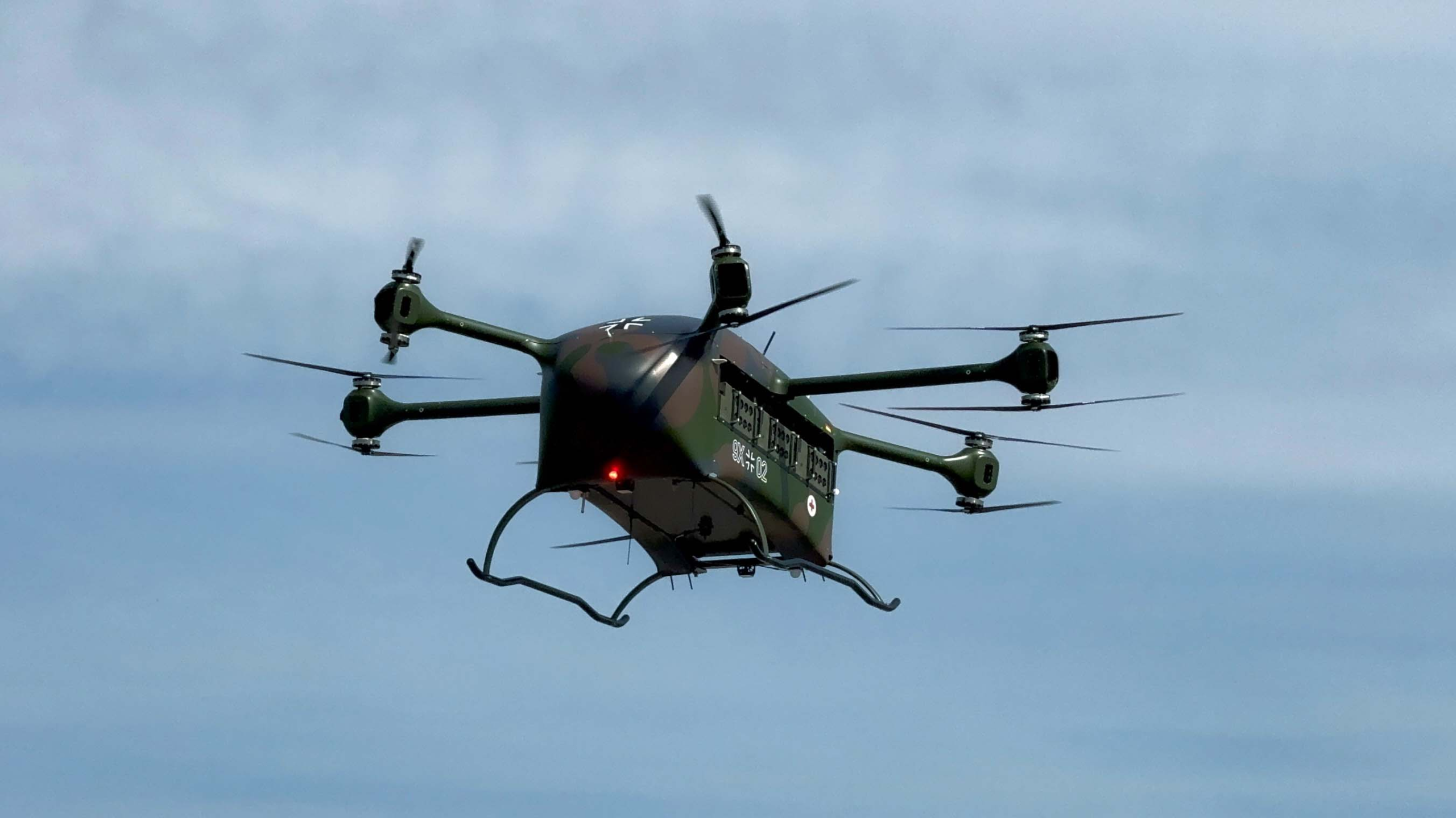
The Grille 9X is designed for casualty evacuation, tactical resupply and other logistics tasks. Its propulsion is entirely electric: the diesel generator does not fly aboard the aircraft or provide power directly to its motors during a sortie. Instead, the M12 Power Unit remains on the ground, charging a second set of batteries while the aircraft flies with the first. Once the aircraft lands, crews can install the charged packs rather than leaving the airframe idle while its depleted batteries recharge. The partners are therefore addressing aircraft turnaround through ground support equipment rather than changing the airborne propulsion architecture.
Avilus specifies a battery exchange time of approximately one minute. It separately states that two people can prepare the Grille 9X for operation in less than 15 minutes. Those figures describe different tasks: exchanging the packs does not eliminate landing checks, payload handling, flight planning or other preparations before another mission. Nor has either company published the charging time needed to restore a depleted pack to the level required for its next flight. A repeated-flight schedule would depend on how that charging time compares with actual mission duration and the number of spare packs available.
Steyr puts diesel consumption for the ground power arrangement at approximately 15 litres per flight. The figure is a company-reported estimate associated with the charging operation, not fuel burned by the electrically powered aircraft. The announcement gives no defined sortie profile, battery energy requirement or separately measured consumption series against which to test that figure. Without those inputs, a per-flight fuel estimate cannot establish the charging system’s efficiency across different payloads, mission lengths or sequences of flights. It nevertheless places the generator’s fuel requirement within the logistics provision needed to sustain electric aircraft in the field.
The companies describe the M12 Power Unit as a modular, high-power-density system capable of being integrated into a standard 20-foot ISO container. Additional modules could be used where demand requires greater generating capacity. The statement concerns a possible deployment configuration; it does not identify a completed container installation, the number of generators in an operational unit or the maximum number of battery sets that one module can recharge simultaneously. Steyr has also not specified the charging interface, the electrical output selected for the Grille installation or a verified maximum sortie rate for the combined system.
Avilus describes the Grille 9X as having a maximum payload of 175 kg, a range of 51 km and a cruising speed of 86 km/h. The company also identifies redundant propulsion, navigation intended to resist interference and an integrated rescue system. These are stated aircraft characteristics rather than independently established results for the generator-aircraft combination. In particular, the figures do not demonstrate that maximum payload and range can be achieved together, or that the aircraft has been qualified to carry casualties in routine military operations. The platform’s intended mission therefore remains distinct from an approved medical evacuation capability.
Steyr says its generators have been used during Avilus flight testing and Bundeswehr exercises, including ExpS Land. The Grille was also demonstrated to German defence minister Boris Pistorius at that event. This provides evidence of practical evaluation of the power equipment alongside the aircraft, rather than merely a proposal for a future technical connection. The partners have not published the number of tested flights, the results of battery cycling trials or a military acceptance report demonstrating continuous availability in service. The announcement also makes no claim that the German armed forces have ordered the Grille 9X or the M12 Power Unit package.
The ground power partnership adds a defined support element to Avilus’ development programme. Earlier Grille X4 reporting concerned the aircraft’s initial flight and progress towards repeatable production, whereas the October collaboration identifies the external power equipment intended to support Grille 9X operations between sorties. Steyr previously described motor-generator units and autonomous platforms within its wider defence programme pipeline. That earlier backlog is not evidence of a Grille order; the October announcement neither assigns a contract value to the partnership nor discloses quantities or delivery dates for generators.
Separating the charger from the aircraft creates operational choices as well as constraints. Spare batteries must be available where the aircraft lands, and charging equipment requires fuel, transport, electrical connections and safe procedures for handling high-energy packs. A containerised power unit could make the system easier to position with a deployed support detachment, but the available material does not identify its transport arrangements or an approved military container layout. Charging while the aircraft is flying reduces dependence on a single battery set; it does not, by itself, demonstrate sustained operations without delays caused by maintenance, weather, payload changes or other ground tasks.
Steyr also sees possible applications for the M12 generator in other drone and counter-drone systems. That is a supplier assessment of a wider market, not evidence that the Grille power installation has been qualified for an additional weapons or air defence role. Nor is the reported Bundeswehr exercise activity equivalent to a procurement decision. No customer order, production commitment, support contract or timetable for operational acceptance accompanies the 16 October announcement, and the reported aircraft specifications remain the manufacturer’s figures.
The generator’s ability to recharge spare packs within the interval between missions will determine how much waiting time the exchange arrangement can remove. Measurements of electrical load, fuel consumption over repeated sorties, battery condition and turnaround time would establish whether the modular supply can support sustained operations. The 16 October announcement confirms the M12 Power Unit’s ground charging role and previous exercise use, but leaves sustained performance, procurement scale and entry into military service unannounced.