IN Brief:
- RAF Typhoons will fly defensive counter-air missions to protect Saudi cities and critical infrastructure against missiles and drones.
- The UK will also provide an A400M for moving defence materiel in Saudi Arabia and military advisers for Saudi staff officers.
- The Ministry of Defence says British Typhoons will not undertake offensive strikes against the Houthis; the refuelling assistance is a separate commitment.
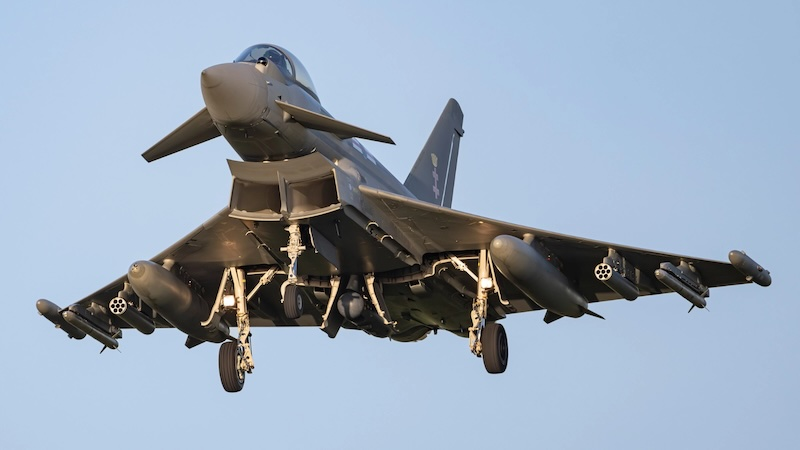
The UK Ministry of Defence has approved additional military support for Saudi Arabia, including RAF Typhoon flights intended to protect cities and critical infrastructure against aerial attack. The 20 October decision expands an existing British defensive contribution amid continued Houthi missile and drone attacks in the region.
Under the arrangement, Typhoons will undertake defensive counter-air missions, while an RAF A400M transport aircraft will help move defence materiel within Saudi Arabia. British military advisers will support Saudi staff officers, and existing air-to-air refuelling assistance for Saudi defensive operations will be extended. The government has not disclosed the number of Typhoons involved or their basing arrangements.
The Ministry of Defence expressly rules out offensive strikes against the Houthis by the British Typhoons assigned to the mission. Its announcement describes the wider refuelling assistance separately, including support for Saudi defensive air operations directed at Houthi military targets in Yemen considered to pose a threat. Those commitments must be distinguished rather than treated as a single restriction on every supported mission.
Typhoon is a multirole combat aircraft used by the RAF for air policing, air defence and other operations. In defensive counter-air service, its crews must identify and track objects assessed as potential threats, establish whether an engagement is authorised, and operate within the limits of the aircraft and weapons available for the task.
Identification can depend on information gathered beyond the fighter itself. Aircraft sensors, command networks and ground-based surveillance can contribute to the understanding of an airspace, while controllers coordinate aircraft movements and allocate tasks. The specific sensors, communications arrangements and engagement procedures used for the Saudi mission have not been made public.
Protecting an area against missiles and uncrewed aircraft presents a varied set of challenges. Targets can differ considerably in speed, size, trajectory and the amount of warning available. A fighter aircraft may be useful against suitable airborne targets, but the government has not stated that Typhoons will form the sole defensive layer or be able to engage every type of incoming weapon.
The effectiveness of any airborne response depends on having aircraft available at the required location, crews able to act on reliable information, and appropriate weapons and fuel. Weather, mission duration and the characteristics of the threat can influence operations, although no performance measurements or engagement outcomes were provided in the government statement.
Britain already supplies air defence equipment intended to help counter missile and drone attacks in Saudi Arabia. The latest announcement adds aircraft missions and supporting resources to that established contribution; it does not identify a new procurement award, additional production order or fresh contract for British-made air defence systems.
The A400M has a separate logistical role. Its transport capability allows military cargo and personnel to be moved between suitable airfields, subject to load characteristics and operating conditions. In this deployment, the stated task is moving defence materiel within Saudi Arabia, not flying defensive patrols or providing air-to-air refuelling.
Moving materiel is one stage in maintaining operational equipment. Supplies must be prepared, loaded, transported and delivered to the appropriate users, while items requiring inspection or repair need suitable facilities and qualified personnel. An airlift aircraft can shorten certain movements without removing the supporting ground logistics needed before equipment is ready for use.
The extension of refuelling assistance addresses another constraint on air activity. Transferring fuel while airborne can help compatible aircraft remain available for longer periods or support operations that would otherwise require a return to an airfield. Actual mission duration depends on aircraft requirements, tanker availability and the conditions under which refuelling is authorised.
The government has not specified the additional tanker aircraft, number of refuelling sorties or precise level of support to Saudi forces. Existing refuelling arrangements should not be interpreted as evidence of a newly purchased aircraft fleet, nor does the October statement quantify how much defensive flying the extension will enable.
Military advisers provide another form of assistance, with British personnel designated to work with Saudi staff officers. Their announced role concerns support and coordination. It does not establish that UK personnel will operate every Saudi defence system, direct all engagements or control decisions taken by Saudi forces.
Defence Secretary Wes Streeting linked the decision to attacks on civilian locations, particularly the airport in Riyadh. The government also cited the potential consequences of regional disruption for transport, energy supplies and the British economy, identifying the protection of Saudi infrastructure as part of its security rationale.
For the RAF, the commitment places demands on aircraft availability, trained crews, technical support and the supply of replacement parts. Equipment configured for sustained overseas operations must be maintained to approved standards, but the announcement contains no additional availability target, flying-hour commitment or information about engineering resources assigned to the deployment.
The decision provides additional British defensive capacity without announcing a new equipment development programme. Confirmation of the precise deployment size, duration or any operational interceptions will require subsequent Ministry of Defence information. Until then, the verified changes are the assigned Typhoon missions, the A400M transport role, advisers and extended refuelling support.