IN Brief:
- Safran Electronics & Defense has been selected for three French inertial-navigation programmes involving submarines, missiles, and combat aircraft.
- HRG Dual Core technology will support compact M51.4 guidance equipment and Rafale F4 aircraft, while the SNLE 3G programme requires prolonged autonomous navigation.
- Safran has invested €120 million in French industrial capacity during 2026 and plans to increase annual HRG production from 10,000 to 30,000 by 2032.
Safran Electronics & Defense has been selected for three French military inertial-navigation programmes covering third-generation nuclear-powered ballistic missile submarines, M51.4 missiles, and Rafale combat aircraft. The programmes will use the company’s hemispherical resonator gyroscope (HRG) technology, extending its role in navigation equipment supporting France’s strategic defence capabilities.
Safran confirmed the programme selections on 2 November, alongside plans to increase production of its precision gyroscopes in France. The company has invested €120 million in domestic industrial capacity during 2026 and expects annual HRG output to rise from approximately 10,000 units to 30,000 by 2032.
The three programmes share a requirement for accurate movement and orientation information, although their operating conditions differ. A submerged submarine must navigate for extended periods without continuous satellite positioning, while a ballistic missile requires a compact guidance reference capable of operating during flight. A combat aircraft needs navigation information integrated with its flight and mission systems.
Inertial navigation uses sensors to measure movement without depending continuously on an external positioning signal. Gyroscopes measure rotation, while accelerometers detect acceleration along defined axes. A navigation computer combines these measurements with an established starting reference to calculate changes in orientation, velocity, and position.
The quality of the resulting position estimate depends on sensor accuracy and the processing of measurements over time. Small errors can accumulate during prolonged operation, making stability and calibration particularly important when external position updates are unavailable. These characteristics determine the suitability of inertial equipment for applications requiring extended autonomous navigation.
Safran’s HRG technology uses a resonating hemispherical element to measure angular motion. Its operating principle differs from traditional spinning mechanical gyroscopes, with changes in the resonator’s vibration pattern providing information about rotation. The technology supports precision measurement within equipment designed for demanding aerospace and defence applications.
The first programme concerns the Global Navigation System for France’s third-generation nuclear-powered ballistic missile submarines, known as SNLE 3G. This equipment will replace the SGN-3EV system installed aboard the existing Triomphant-class submarines. Safran intends the new architecture to support very long periods of autonomous navigation without requiring recalibration from Global Navigation Satellite System signals.
Underwater navigation places particular demands on inertial equipment because satellite radio signals cannot be received continuously at a submarine’s operating depth. The vessel must maintain its navigation reference using onboard sensors and associated processing while remaining submerged. Preserving accuracy over extended periods requires precise measurements and careful management of accumulated errors.
The navigation system also contributes to the submarine’s strategic missile capability. A ballistic missile requires an accurately established initial reference when preparing for launch, connecting the submarine’s navigation information with the missile’s guidance equipment. Safran identifies this relationship as an important element of its role within the SNLE 3G programme.
For the M51.4 missile, Safran will develop the CI4 inertial unit using HRG Dual Core technology. The equipment is intended to provide greater precision within a significantly smaller installation than the preceding configuration. The M51.4 is planned for deployment aboard both second- and third-generation French ballistic missile submarines.
Missile guidance equipment must operate within tightly controlled physical and electrical constraints. The inertial unit has to maintain accurate measurements despite the dynamic conditions associated with launch and flight, while fitting within the missile’s available installation space. Its sensors, processing electronics, and mechanical assembly must therefore be developed as a qualified system rather than independent components.
Reducing equipment dimensions also affects manufacturing and assembly. Smaller components require appropriate mechanical tolerances and reliable electrical interfaces, while the complete unit must withstand its intended operating environment. The CI4 development combines these packaging requirements with the improved measurement capability Safran is targeting through HRG Dual Core technology.
The third selection brings HRG Dual Core equipment into the Rafale combat aircraft. Safran expects the technology to equip the majority of aircraft in the fifth production tranche, using the F4 standard. The programme extends the application of its precision inertial sensors into a further generation of French military aviation equipment.
Aircraft navigation involves combining inertial measurements with other available information to maintain a reliable navigation solution. During operations in which satellite signals are degraded or unavailable, inertial equipment continues providing movement and orientation data. Its accuracy and stability influence how effectively the aircraft can maintain its navigation reference between external updates.
Safran also supplies naval aviation navigation equipment used aboard the aircraft carrier Charles de Gaulle. The ship’s navigation reference supports alignment of the Rafale’s onboard navigation system before missions. The process takes account of the carrier’s position and motion, allowing embarked aircraft to establish a suitable initial reference before departure.
Expanding HRG production will support the company’s growing equipment requirements across these programmes and its wider navigation business. Safran’s stated increase to 30,000 units annually represents a threefold expansion of current output, requiring additional capacity throughout the precision manufacturing and testing process.
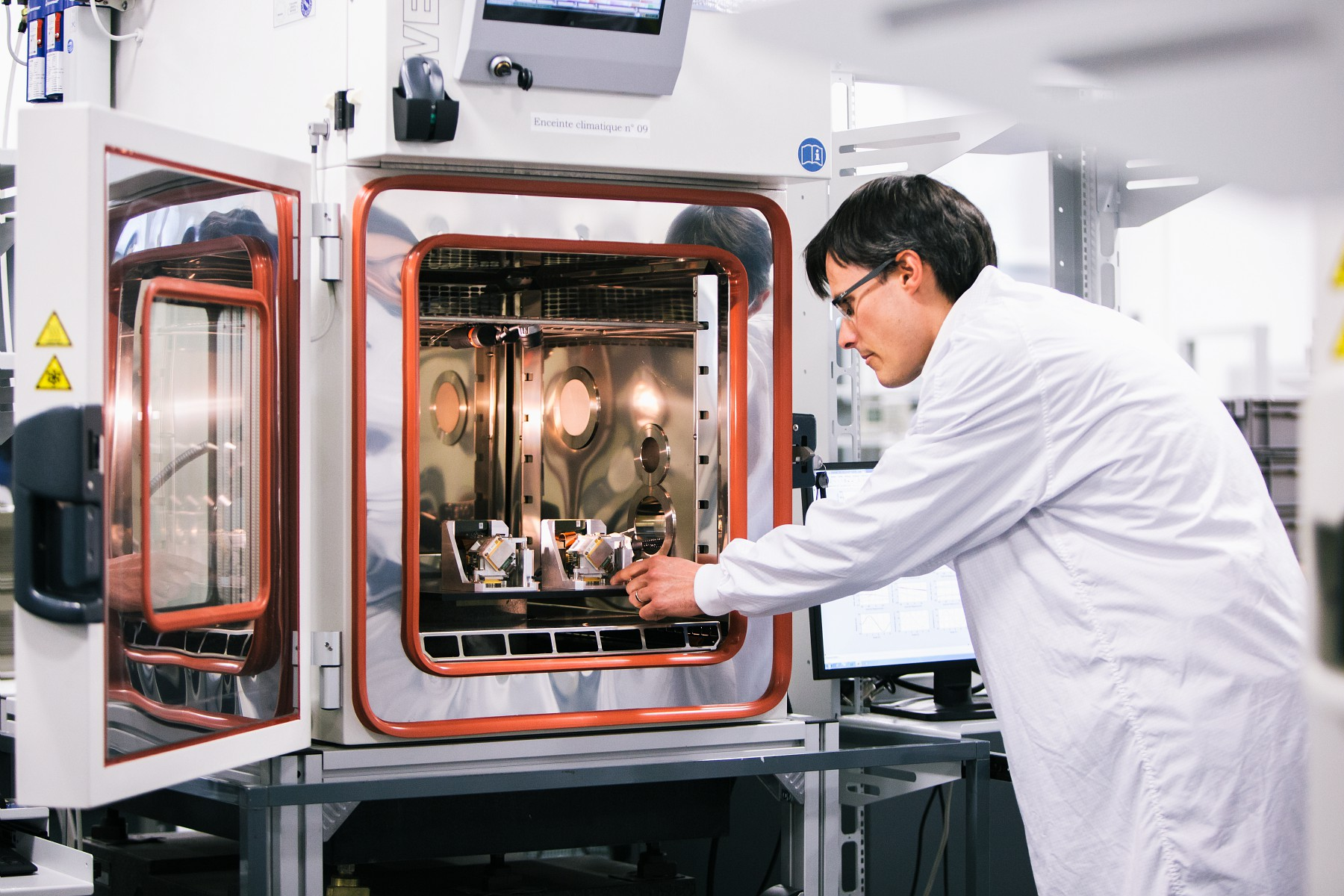
Gyroscope production depends on consistent component characteristics because small manufacturing variations can affect measurement behaviour. Precision fabrication, assembly, calibration, and inspection must therefore support the larger production volumes. Increasing capacity involves maintaining those technical controls while producing substantially more units across successive manufacturing cycles.
France’s existing M51 programme provides an established industrial application for Safran’s equipment. The company already designs and manufactures inertial units used in current missile variants, creating a technical and manufacturing basis for development of the new CI4 configuration. Its work on submarine navigation similarly builds on equipment already operating aboard the Triomphant class.
The three selections extend those established capabilities into the next generation of strategic navigation equipment. Production investment will support development and manufacturing activity through the remainder of the decade, with the 2032 HRG capacity target providing a defined industrial milestone alongside the individual submarine, missile, and aircraft programmes.