IN Brief:
- French defence officials signed an FDI weapons-capacity implementation agreement with Naval Group and MBDA at Euronaval.
- The agreed work concerns expansion from 16 to 32 vertical-launch cells for Aster surface-to-air missiles across the French frigate programme.
- The higher-capacity configuration has been planned previously; the new development concerns its contractual implementation and ship integration.
Naval Group and missile manufacturer MBDA have signed an agreement with French defence authorities at Euronaval 2026 to implement expanded air-defence armament on France’s Frégate de défense et d’intervention (FDI) warships. The work concerns increasing the ships’ vertical-launch capacity for Aster surface-to-air missiles from 16 cells to 32, including changes to vessels already in the programme and future construction.
The higher-capacity FDI configuration was already planned before the exhibition. Plans made public before Euronaval already provided for 32 cells on later hulls and retrofits for ships entering service with 16. Accounts differed over whether the third French ship would receive the larger installation during construction. The agreement reported on 3 November therefore concerns implementation with the shipbuilder and missile manufacturer rather than a newly chosen missile capacity.
The FDI is a 122-metre, approximately 4,500-tonne frigate designed for anti-air, anti-surface, and anti-submarine warfare. Its air-defence system brings together the Thales Sea Fire fixed-panel radar, the ship’s combat management functions, Aster interceptors, and the Sylver vertical-launch equipment from which those missiles are fired. The baseline French configuration provides 16 launch cells, arranged in two eight-cell modules. Expanding that number to 32 materially increases the missile inventory that a ship can carry ready for launch.
Increasing the ready-launch missile inventory gives the commander more interceptors to allocate during successive engagements. It does not change the detection range of the ship’s radar or, by itself, establish a higher simultaneous-engagement capacity. The Sea Fire radar, combat management system, missile interfaces, and launcher controls must continue to work together as they do with the existing installation.
A frigate may need to respond to several aircraft or missile tracks over time, with a finite number of weapons available before replenishment. Additional cells provide more magazine depth for that sequence, but the usable load depends on the approved missile arrangement and on other shipboard combat-system capabilities. The agreement concerns launcher positions rather than a separately disclosed new radar or missile development.
Aster 15 and Aster 30 are the established surface-to-air missiles associated with the French FDI’s Sylver launch installation. These interceptors operate within a layered air-defence system using the ship’s sensors and combat management functions. The Euronaval agreement increases the planned vertical-launch capacity within that existing architecture; France’s separate VL MICA and land-based SAMP/T NG procurement activities have different equipment and contracting arrangements.
Adding vertical-launch modules requires structural support, maintenance access, electrical and control-system connections, and documented safety arrangements. The design must also account for weight and stability, service routes around existing compartments, and the effects of changing a ship’s equipment fit. Those interfaces have to be resolved before installation and followed by integration and acceptance work.
Ships built with the revised configuration can incorporate launcher foundations, cable routes, and access arrangements during normal construction. Retrofitting earlier vessels is a different exercise: installed equipment may need to be removed, structural and electrical work completed, and system tests performed within an available maintenance period. The signed agreement has not established a publicly verified completion date for each hull.
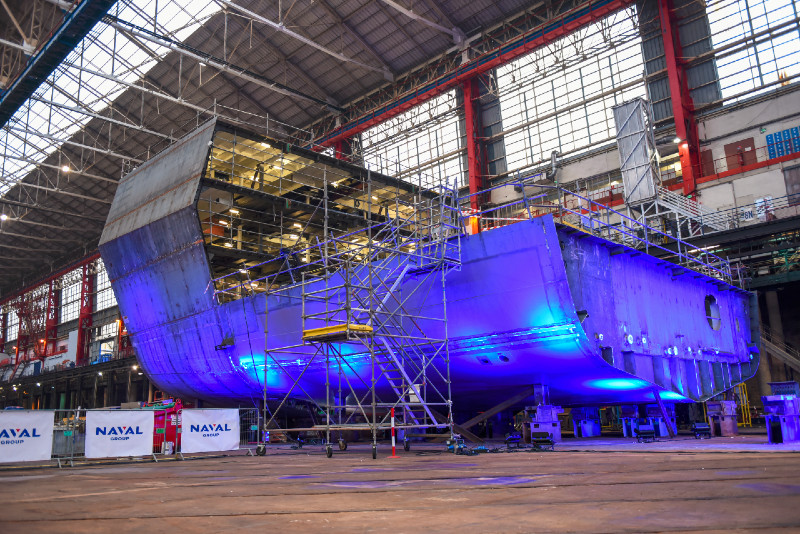
Naval Group constructs the French FDI ships at Lorient and manages the integration of platform and combat-system equipment, while MBDA is responsible for the Aster missile family. Launcher-control interfaces and shipboard sensors involve further suppliers and configuration approvals. Installation and qualification work must therefore be coordinated with the frigate construction programme and the navy’s maintenance schedules.
The French Navy is acquiring five FDIs, while Naval Group is also building versions of the frigate for Greece. The Hellenic configuration has been associated with a 32-cell Aster installation, providing an existing design reference for the higher-capacity arrangement. Export and French ships nevertheless have customer-specific equipment and acceptance requirements, so the presence of a similar launcher count does not make the retrofit programme an automatic copy of another navy’s installation.
Acceptance activity must establish that launcher controls, command functions, and missile interfaces operate correctly in the modified ship configuration. The testing also covers responses to faults, safety requirements, and maintainability, alongside the system’s ability to receive an authorised firing command. Production documentation for later ships and retrofit instructions for earlier ones will have different installation dependencies.
The agreement reported at Euronaval identifies Naval Group and MBDA as the industrial partners for an increase from 16 to 32 cells. No contract value or complete hull-by-hull installation schedule has been confirmed. Previous accounts disagree over the treatment of the third French ship, making an exact division between retrofits and new-build installations premature.
France’s five-ship FDI programme consequently moves towards a common 32-cell Aster arrangement through two production routes: fitting the equipment during construction and converting ships built to the earlier standard. Subsequent shipyard, combat-system test, and naval acceptance milestones will establish the actual delivery sequence under the agreement.