IN Brief:
- France announced a naval-drone industry pact at Euronaval on 3 November, linking defence procurement, naval users, and manufacturers.
- Current work covers mine-countermeasure robots, deep-sea remotely operated vehicles, long-endurance surface craft, and unmanned underwater platforms.
- The programme is intended to move demonstrators towards deployable fleets and scalable industrial production, with acquisition milestones planned from 2027.
France’s Ministry of the Armed Forces has launched a naval-drone industry pact intended to bring manufacturers, the Directorate General of Armaments (DGA), and the French Navy into a closer development and procurement process. Minister Catherine Vautrin introduced the arrangement on 3 November at Euronaval in Paris, where France outlined its approach to acquiring uncrewed systems for surface and underwater missions.
The pact connects requirements development and industrial preparation within a naval-drone acquisition programme established in June 2026. French officials want the DGA, the fleet, and suppliers to work from compatible operational and technical priorities as experimental craft advance towards equipment that can be maintained and produced at scale. The 3 November measure is a new coordination arrangement within that established programme, rather than the launch of the programme itself.
The existing programme groups requirements into tactical, endurance, and specialist action platforms. Fast tactical craft are envisaged for escort and protection missions, while endurance systems would carry sensors over longer surveillance and reconnaissance sorties. Specialist systems include remotely operated naval munitions. Propulsion, payload, communications, navigation, and operator control must be specified against each role before a common support framework can be planned.
Mine countermeasures provide one of the most developed applications for uncrewed naval equipment. Locating an underwater object requires acoustic or other sensing, repeated examination, and classification before an operator can decide whether it is hazardous. Separating those stages from a crewed minehunter can keep personnel farther from suspected minefields, but vehicles and sensors must still maintain accurate position information and reliable transfer of survey data. The ministry has described plans to acquire eight A18 mine-countermeasure robots from Exail as part of its broader work.
Deep-sea work adds a separate set of equipment requirements. Under a contract placed in September 2024, LD Travocean developed ROV-DeepSea for operations down to 6,000 metres. The DGA tested it off Toulon in July 2026 and then at depths exceeding 5,000 metres off Greece in September. On 29 October, the DGA said it was preparing an order for a second system. That potential acquisition therefore predates the Euronaval pact.
At depths of several thousand metres, instruments, enclosures, and cables must withstand pressure while a surface vessel provides launch, recovery, and operational support. Tethered control allows a remotely operated vehicle to carry tools, inspect infrastructure, and perform interventions under continuous supervision. This differs from an untethered underwater surveillance system, whose operating endurance and communications constraints follow a different design path.
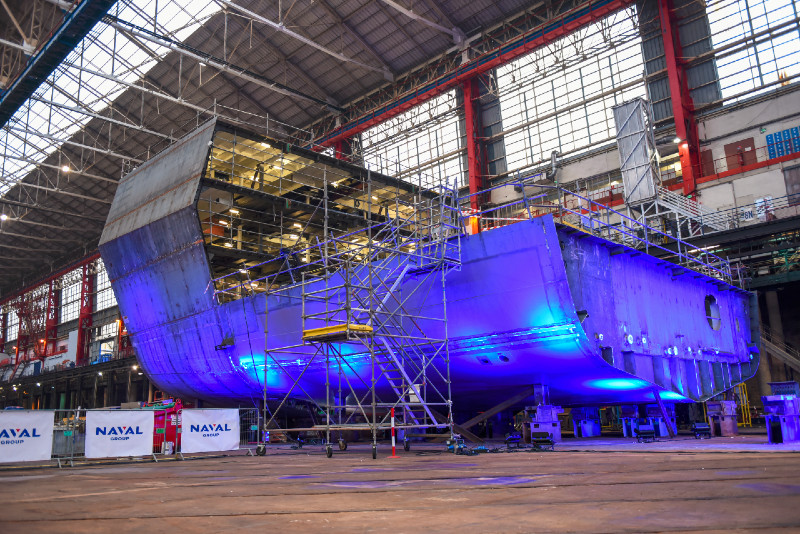
The French Navy also intends to acquire another large unmanned underwater vehicle from Naval Group, building on the company’s earlier extra-large demonstrator. Officials described the proposed follow-on craft as longer than ten metres and heavier than ten tonnes, with missions lasting weeks. The additional vehicle remains a procurement and development plan; the reported characteristics do not establish an operational combat-submarine fleet.
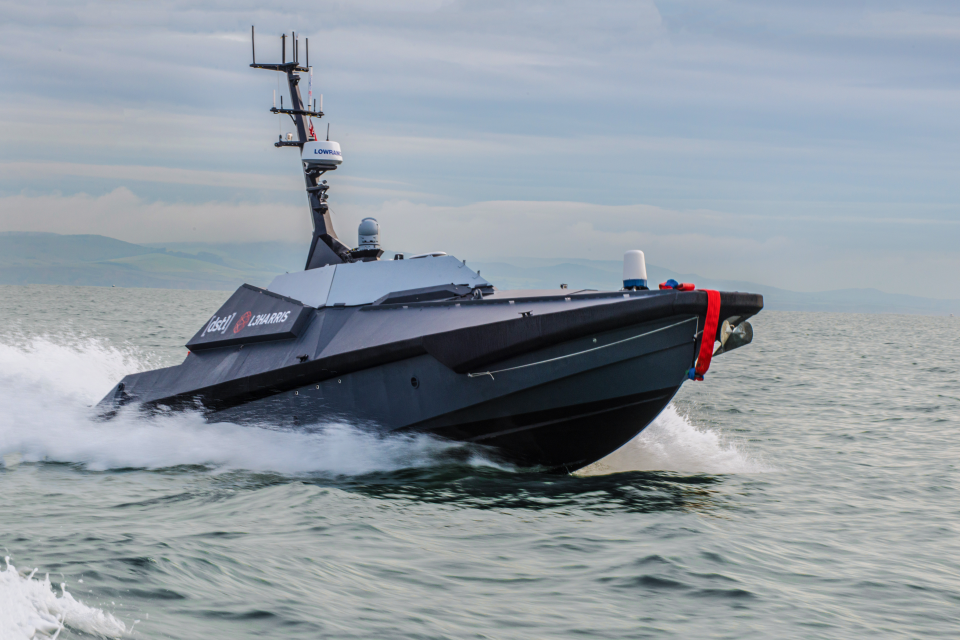
Surface autonomy follows another route. The French Navy and DGA have been evaluating endurance craft at Toulon, with multiple campaigns intended to expose navigation, communications, and maintenance problems before an acquisition configuration is fixed. Existing programme plans envisage a first implementation increment in 2027, including embarked endurance drones and industrialisation of the SMOKERS remotely operated naval munition. Further work planned for 2028 encompasses the DANAÉ autonomous surface-vehicle programme and command-and-control arrangements.
Bringing these platforms into naval operations requires information from different control and sensing systems to reach the right operators. A surface craft may send sensor observations over radio or satellite links, whereas underwater equipment has much more limited means of transferring data while submerged. Mine-contact classification, surface surveillance, and seabed inspection also produce different data products, all of which require suitable interfaces with existing naval command systems.
The ministry has also identified the need to assess autonomous behaviour when satellite navigation is degraded, radio links are jammed, or a platform works beyond direct observation. Navigation performance, operator authority, collision avoidance, and recovery procedures form part of the qualification problem, along with the software and sensors themselves. Trials therefore have to establish more than whether a vehicle can complete a demonstration route in favourable conditions.
Scaling from trials to fleet equipment requires repeatable manufacturing, component availability, software configuration control, crew training, and maintenance capacity. The naval-drone programme’s emphasis on open architectures and incremental acquisition is intended to reduce the work needed to fit updated sensors and control software as requirements change. Those provisions have to be carried into supplier contracts and acceptance tests rather than left solely in demonstrators.
The pact creates a formal channel through which the navy, DGA, and manufacturers can reconcile such requirements. France has not disclosed an overall contract value or unified delivery schedule for the different classes of system. Separate orders and qualification milestones will establish which designs progress into production, and in what quantities.
The next specified acquisition milestone is the first naval-drone programme increment planned for mid-2027, covering embarked endurance systems and industrialisation of the SMOKERS remotely operated munition. Further work planned for 2028 includes the DANAÉ surface platform and command-and-control capability. The industrial pact signed on 3 November is intended to support those existing delivery stages.