IN Brief:
- Saab has flight-tested its own AI agents on Gripen E in beyond-visual-range scenarios.
- Its AI Fighter Pilot Academy combines simulation, model training, evaluation, and direct aircraft integration.
- The company plans broader flight scenarios and potential applications in crewed and uncrewed platforms.
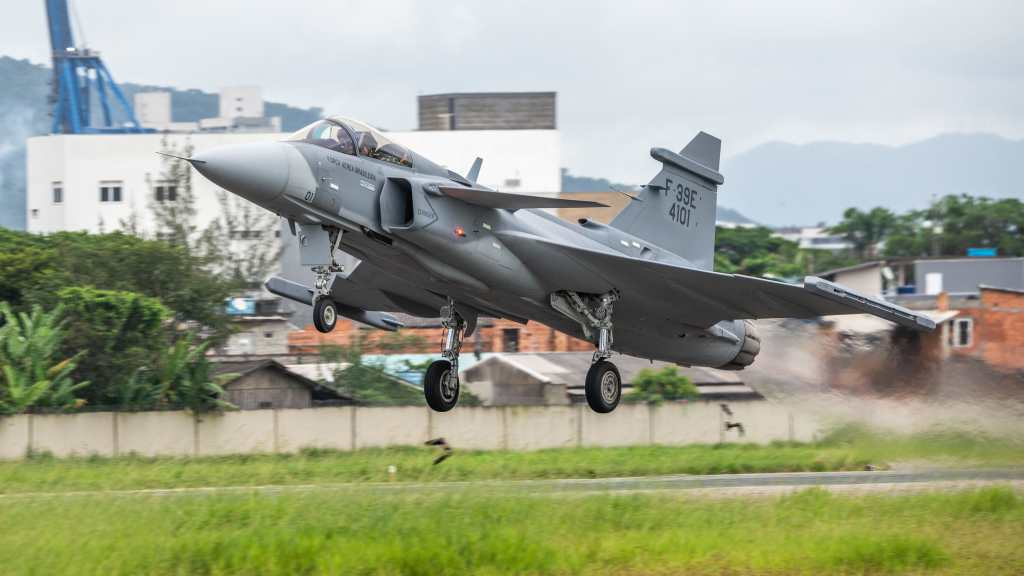
Saab has flown artificial intelligence agents of its own design aboard Gripen E, demonstrating autonomous aircraft control during beyond-visual-range combat scenarios. The Swedish defence manufacturer disclosed the work on 3 November as part of an expanded effort to develop, train and verify AI capabilities for current and future combat aircraft.
The agents have been developed within Saab’s Advanced Programs business unit and flown on an operational fighter type rather than a dedicated experimental aircraft. During the reported trials, an agent controlled the aircraft autonomously in beyond-visual-range scenarios. Saab has not published a complete flight-test programme, engagement success rates or a timetable for operational deployment.
Saab developed the agents alongside their simulation and evaluation tools within its Advanced Programs unit. Keeping those elements under a common development process allows software changes to be tested against defined scenarios before another flight and provides records of model behaviour across successive versions. That is particularly important when an agent’s decisions depend on training data and objectives rather than a fixed sequence of programmed responses.
Beyond-visual-range combat requires decisions based on information from sensors and other sources rather than direct visual contact with another aircraft. Tasks can include interpreting the tactical picture, maintaining awareness of changing aircraft positions, assessing available options and selecting manoeuvres within a defined operating framework. The demonstration establishes autonomous control in this type of scenario, but the company has not disclosed whether any weapons functions were exercised.
The AI Fighter Pilot Academy brings simulation, training and evaluation into the same development programme. In a simulated air combat environment, engineers can vary the starting positions, sensor inputs and behaviour of opposing aircraft without the cost and risk of repeating each encounter in a real fighter. The same environment supports testing successive versions of an agent against comparable scenarios.
Saab describes the training effort as accumulating millions of simulated flight hours across different scenarios. Simulation lets developers change initial positions, sensor inputs, mission objectives and the behaviour of other participants in a controlled way. It also produces records that can be inspected to understand why a system chose a particular action and to identify situations requiring further testing.
Those simulated results still have to be connected to real aircraft behaviour. A fighter operates with physical limits on acceleration, energy, flight envelope and available control authority, while its sensors and communications are subject to delay and uncertainty. Flight testing therefore provides evidence that a trained agent can interact with the actual aircraft architecture under defined conditions, rather than merely performing well in a digital environment.
Gripen E’s software-defined architecture has allowed Saab to integrate and fly new AI software without constructing a dedicated experimental aircraft. That does not remove the need to contain the agent’s authority within the aircraft’s flight-control and safety arrangements. Interface design and flight-test restrictions determine which commands an experimental agent can issue while a real aircraft remains within its operating envelope.
Confidence in autonomous control depends on more than a single successful flight. Developers must test how an agent behaves when sensor data is incomplete, communications degrade, objectives conflict or a situation differs from its training cases. Saab says safety and control requirements are part of the programme from the outset, with continuous evaluation of agent behaviour against defined objectives.
The Academy’s development framework is designed to accept additional scenarios, aircraft and AI capabilities without having to construct a new testing environment each time. Reuse will nevertheless depend on the fidelity of each simulation and the interfaces available on the target aircraft. Saab has not claimed that an agent trained for Gripen E can be transferred unchanged to another platform.
Scaling this evaluation work requires computing capacity and disciplined management of datasets, scenario configurations and model versions. Saab is a founding partner in Sferical AI, a Swedish initiative developing secure large-scale computing resources. It has identified those resources as support for its growing simulation and verification programme.
Maintaining control of the tools and training environment also affects the information that can be retained domestically. Fighter mission data, software configuration and evaluation records may involve sensitive capabilities, making secure development facilities and management of access important parts of the engineering programme. Saab presents its in-house approach as a means of maintaining sovereign control over the relevant technology.
Saab’s plans include agents that assist pilots and agents intended for uncrewed aircraft operating alongside crewed fighters. Applying a common development framework across those uses would still require separate assessments of control authority, communications, sensor access and system behaviour on each platform. The Gripen E flights demonstrate one controlled application of the technology, not a fielded mixed formation.
Saab intends to extend flight testing to additional scenarios as it develops the AI Fighter Pilot Academy. Its published results establish that an internally developed agent autonomously controlled Gripen E during defined beyond-visual-range exercises. Future trials must establish the performance boundaries and repeatability needed before those functions can support wider missions or different aircraft.