

IN Brief:
- EDGE Europe and Novamarine signed an exploratory memorandum at Euronaval covering the potential development of unmanned surface vessels.
- Novamarine would build craft in Olbia, Abu Dhabi Ship Building would integrate systems, and the Technology Innovation Institute would supply autonomy technology.
- Two candidate vessel models are on display, but the companies have not disclosed a production order, customer, or development delivery schedule.
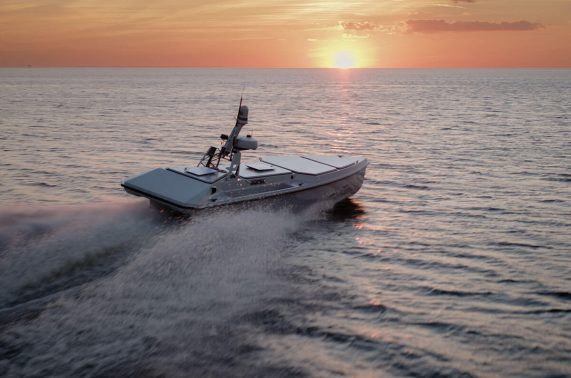
EDGE Europe has signed a memorandum of understanding with Italian boatbuilder Novamarine to examine the joint development of unmanned surface vessels. The agreement, concluded at Euronaval 2026 on 3 November, brings together a European boat production base, maritime integration expertise from Abu Dhabi Ship Building (ADSB), and an autonomous navigation and control system supplied through EDGE by the Technology Innovation Institute (TII).
Novamarine is expected to provide the physical vessels from its production facility in Olbia, Sardinia, while ADSB would carry out the overall systems integration. TII, the applied research organisation within Abu Dhabi’s Advanced Technology Research Council, would provide the autonomy technology. Two unmanned vessel models are being exhibited at Novamarine’s stand during Euronaval, which runs until 6 November in Paris. The partners have not identified those models as contracted production vessels.
Moving from a crewed boat design to an uncrewed vessel requires defined interfaces between navigation, propulsion, steering, and onboard control equipment. The proposed autonomy system would need to receive position and motion data, apply navigational decisions, and pass commands to the craft’s actuators. Remote supervision also requires a response to communication loss, sensor failure, and conditions in which a human operator must take control.
The physical craft and its autonomy package consequently have to be designed together. Hull behaviour in waves, steering response, speed control, electrical distribution, and the arrangement of equipment space can all affect how a controller performs. Hardware integration covers the interfaces between navigation sensors, computing equipment, propulsion controls, communications links, and any mission payload fitted to the vessel. Qualification of these connections is a separate task from building the boat itself.
Novamarine’s work in rigid-hull and professional craft provides the boatbuilding base for the partnership, with Olbia identified as the manufacturing location. The MoU does not specify the length, speed, propulsion, endurance, or payload capacity of the proposed vessels. Performance data from the company’s crewed products cannot be assumed to describe the unmanned models on display.
ADSB already undertakes naval shipbuilding and maintenance in the UAE and has worked on autonomous mine-countermeasure vessels. Its previously described 170 M-DETECTOR programme, involving TII and Exail, is a separate project. The 3 November MoU assigns ADSB integration responsibility for the prospective Novamarine craft but does not identify either exhibited model as a 170 M-DETECTOR derivative.
Mission requirements would determine the equipment carried by any resulting USV. Surveillance, inspection, logistics, and mine-countermeasure work call for different sensor payloads, communications arrangements, and navigation accuracy. In a mine-search role, for example, positional data must be sufficiently consistent with the sonar survey to enable reliable contact investigation. The agreement has not selected a mission payload or identified an initial defence customer.
Communications arrangements will be one of the early design choices. A vessel close to its control station may use a direct radio link, while operations at greater distance could require another means of data transfer. The available bandwidth affects whether a remote operator receives live sensor feeds or selected status and mission information. Under poor link conditions, the autonomy system must have clearly specified limits on what it is permitted to do before control returns to a human supervisor.
Those controls must sit alongside navigation safety. An unmanned craft needs to recognise other vessels and obstacles, assess whether it can maintain a safe track, and respond to changing conditions without assuming that satellite positioning and every sensor will always be available. The choice of radar, camera, other proximity sensors, and onboard processing architecture depends on the operating area and the level of autonomy required. No completed collision-avoidance certification or operational deployment has been announced for the proposed partnership craft.
Integration work will require Novamarine, ADSB, and TII to agree common mechanical, electrical, and software interfaces. Propulsion-control responses and sensor timing must be tested on the actual craft, and changes to software or installed hardware recorded consistently between vessels. Qualification of an operational configuration can begin only when the roles, safety requirements, and acceptance criteria have been defined.
EDGE launched its European subsidiary in Paris in June 2026, with a French headquarters and an engineering and manufacturing base in Bordeaux. The company has separately entered a cooperation framework with France’s DGA. The Novamarine arrangement expands that European industrial network towards Italy and maritime autonomy, although the memorandum does not constitute a French or Italian government procurement award.
The boatbuilder would supply the physical platform, while ADSB and TII would deliver integration and control capabilities. Such a division could support different future missions if the interfaces are designed to accept new sensors and mission equipment. The companies have not yet set out a common product specification or production commitment.
The memorandum contains no disclosed customer order, contract value, production quantity, or sea-trial date. The two models shown at Euronaval are evidence of the companies’ proposed direction, rather than a confirmed fleet programme. A defined vessel configuration and subsequent integrated-water trials would establish the next engineering milestones.
