IN Brief:
- Australia, the United Kingdom, and the United States completed three weeks of integrated maritime autonomy trials near San Diego.
- Uncrewed air, surface, and underwater systems supported surveillance, contested resupply, and anti-submarine warfare activities.
- The trials demonstrated acoustic communications intended to enable cooperation between underwater platforms over greater distances.
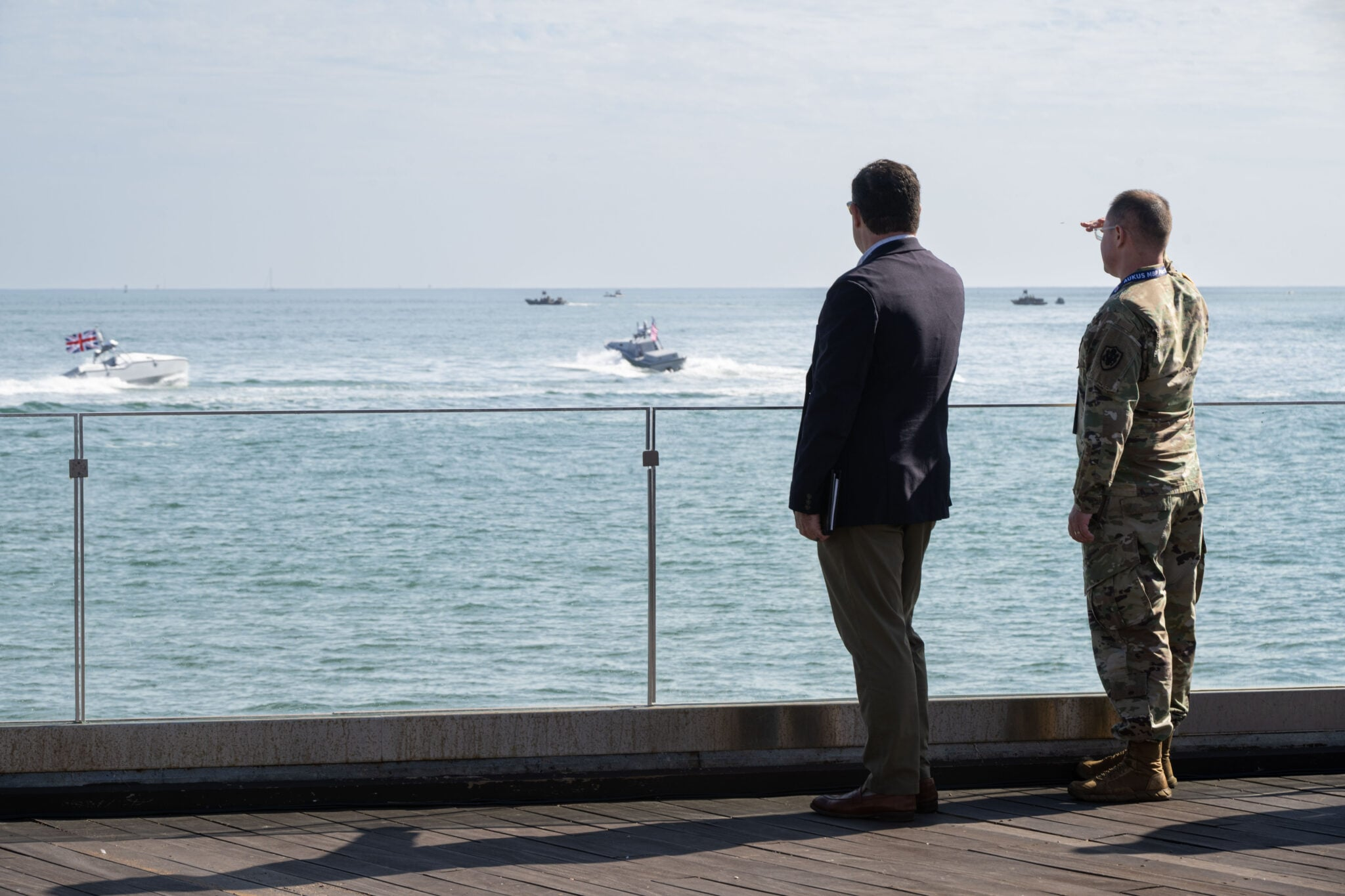
Australia, the United Kingdom, and the United States have completed three weeks of integrated maritime autonomy trials near San Diego, demonstrating the combined operation of uncrewed aerial, surface, and underwater systems during complex naval missions.
The activity, conducted through the AUKUS Pillar II Maritime Big Play initiative, brought together defence personnel, scientists, and industrial partners from all three countries. The Australian Department of Defence confirmed on 9 November that the trials included intelligence, surveillance, reconnaissance, contested resupply, anti-submarine warfare, and underwater experimentation.
Maritime Big Play Pacific concluded three years of joint experimentation under the programme. Earlier activities examined individual autonomous platforms and technologies, while the latest demonstrations concentrated on combining equipment from different sources into representative naval missions. The participating countries have not published a complete equipment inventory, detailed performance measurements, or operational acceptance decisions arising from the exercise.
Among the demonstrated activities was the establishment of an anti-submarine warfare barrier using integrated autonomous capabilities. Such an arrangement involves positioning sensing systems across a maritime area to support the detection and monitoring of underwater activity. The information gathered by individual platforms must be interpreted within a wider surveillance picture, with the effectiveness of the arrangement depending on sensor characteristics, deployment positions, and environmental conditions.
Acoustic propagation is particularly important in anti-submarine surveillance. Underwater sound transmission is affected by water temperature, salinity, depth, background noise, and the relative positions of sensing equipment and potential contacts. These conditions can change across an operating area, influencing the observations available to individual sensors. Integrating multiple platforms provides opportunities to collect information from different positions, although the published trial results do not quantify the coverage or detection performance achieved.
The programme also demonstrated acoustic communications technologies intended to allow uncrewed systems to operate collaboratively over greater underwater distances. Conventional radio-frequency signals are strongly attenuated by seawater, restricting their usefulness for submerged platforms. Acoustic communications offer an alternative, but generally provide lower bandwidth, longer transmission delays, and more variable connection quality than communications links operating above the surface.
Those characteristics influence how autonomous underwater vehicles must be controlled. A submerged platform cannot necessarily receive continuous instructions or transmit all its sensor data while conducting a mission. Instead, onboard systems may need to maintain their assigned tasks between communication opportunities, with mission information exchanged when suitable acoustic connections become available. The AUKUS experiments examined technologies intended to support collaboration under these constraints.
Interoperability between systems developed in different countries introduces further requirements. Autonomous vehicles may use different control software, sensor formats, communications equipment, and approaches to mission planning. Exchanging useful information requires compatible interfaces and agreed methods for representing the position, condition, and tasking of participating platforms. The three nations have not disclosed the precise software or communications standards employed during the latest integrated demonstrations.
Contested resupply was another activity conducted during Maritime Big Play Pacific. Uncrewed transport platforms offer a means of moving supplies without maintaining personnel aboard every delivery vessel, but the practical requirements extend beyond autonomous navigation. Route planning, communications, payload handling, environmental conditions, and the arrangements for receiving cargo all influence whether a resupply mission can be completed. The published results confirm the activity was demonstrated without specifying delivered loads, distances, or the individual systems used.
The trials also involved autonomous aerial and surface platforms working alongside large uncrewed underwater vehicles. These different vehicle classes have distinct endurance, sensing, and communications characteristics. Aircraft can provide observations across wider areas but have their own operating constraints, while surface vessels can support extended maritime activities and provide communications links where equipped to do so. Underwater vehicles operate in a more restricted communications environment but can collect information beneath the surface.
Combining these capabilities requires mission planning that accounts for their different operating limits. A platform’s availability may depend on its power supply, maintenance condition, weather restrictions, or ability to communicate with supervising personnel. Information collected by one system must also be available in a suitable form for others involved in the mission. The latest demonstrations provide evidence that AUKUS partners can coordinate selected capabilities, without establishing that all participating technologies have completed military qualification.
Previous Maritime Big Play activities included modular underwater vehicles and drone-launching platforms, alongside British work on acoustic communications planning and distributed task assignment. That earlier activity provided the technical foundation for the wider programme. The newly reported outcomes concern integrated mission execution, including the anti-submarine barrier and contested resupply, rather than the initial introduction of those individual technologies.
The work supports the three countries’ efforts to introduce autonomous systems alongside conventional naval assets. Crewed ships and submarines will continue to provide command, operational, and support functions, while uncrewed platforms are being examined for tasks that can benefit from distributed sensing or remote operation. Their adoption will require suitable maintenance arrangements, trained operators, reliable interfaces, and procedures for managing equipment when communications are degraded.
Australia described Maritime Big Play Pacific as the largest demonstration of interoperable maritime autonomy conducted under AUKUS Pillar II. The programme did not announce a corresponding procurement contract or operational deployment schedule. Its immediate output is a further body of experimental evidence covering integrated missions, acoustic communications, and cooperation between systems developed across the three partner nations.
Future adoption will depend on converting those results into repeatable equipment configurations and operating procedures. Additional testing will be needed to establish how the systems perform over longer deployments, under different environmental conditions, and within the support arrangements required for routine naval service. No timetable has been published for transferring the complete combination of demonstrated capabilities into an operational task group.