IN Brief:
- CSG's nine-month revenue rose 6.1% to €4.76 billion, with total backlog reaching €18 billion.
- Land Systems represents 57% of backlog, while longer-range ammunition increasingly dominates production.
- Supplier financing, working capital requirements, and changing sales mix have contributed to revised 2026 profitability guidance.
Czechoslovak Group has reported an €18 billion order backlog at the end of September 2026, supported by demand for military vehicles, ammunition, and other defence equipment, while changes to its production mix have prompted a reduction in expected full-year profitability.
The Czech industrial group generated €4.76 billion in revenue during the first nine months of 2026, an increase of 6.1% compared with the corresponding period last year. Revenue from its core Defence Systems businesses rose by 9.5%, reflecting continued demand across its principal military manufacturing activities.
Operating earnings before interest and tax reached €1.10 billion, an increase of 0.4%, giving the group an operating EBIT margin of 23.1%. Defence Systems recorded a higher margin of 27.9%, although the group’s third-quarter results were affected by changing production requirements and delivery schedules.
The total order backlog increased from €15 billion at the end of December 2025 to €18 billion at 30 September 2026. CSG also identified €29 billion in additional potential business under negotiation, bringing its combined backlog and commercial opportunity pipeline to €47 billion.
Those figures represent different levels of commercial certainty. The €18 billion backlog includes €7 billion in fixed contractual commitments, €8 billion associated with framework agreements, and €3 billion categorised as soft backlog involving business that has not yet reached the same level of contractual confirmation.
Framework agreements can establish commercial relationships without fixing every subsequent delivery quantity or requirement. The separate soft backlog reflects business that CSG considers highly likely to materialise, but which has not yet become fully effective contractual work.
The €29 billion pipeline represents further opportunities under negotiation rather than confirmed orders. Accordingly, the combined €47 billion opportunity figure cannot be interpreted as an equivalent amount of guaranteed future revenue or manufacturing activity.
Land Systems accounts for 57% of the group’s total backlog, followed by medium and large-calibre ammunition at 32%. The Ammo+ division represents 8.5%, with aerospace, defence electronics, and advanced systems contributing the remaining 2.5%.
The distribution illustrates CSG’s expansion beyond its established ammunition activities. Military vehicle programmes, propulsion systems, specialist equipment, and other land-defence products now form a substantial part of the company’s future workload.
These activities have different production cycles and commercial characteristics. Vehicle manufacturing can require substantial purchased components and several stages of assembly and integration, while revenue may be recognised according to delivery or contractual milestones rather than the timing of individual manufacturing operations.
CSG generated €1.51 billion in third-quarter revenue, compared with €1.71 billion during the equivalent period of 2025. The company attributes part of the reduction to delivery timing, with approximately €300 million in revenue originally anticipated during the quarter moving into the final three months of 2026.
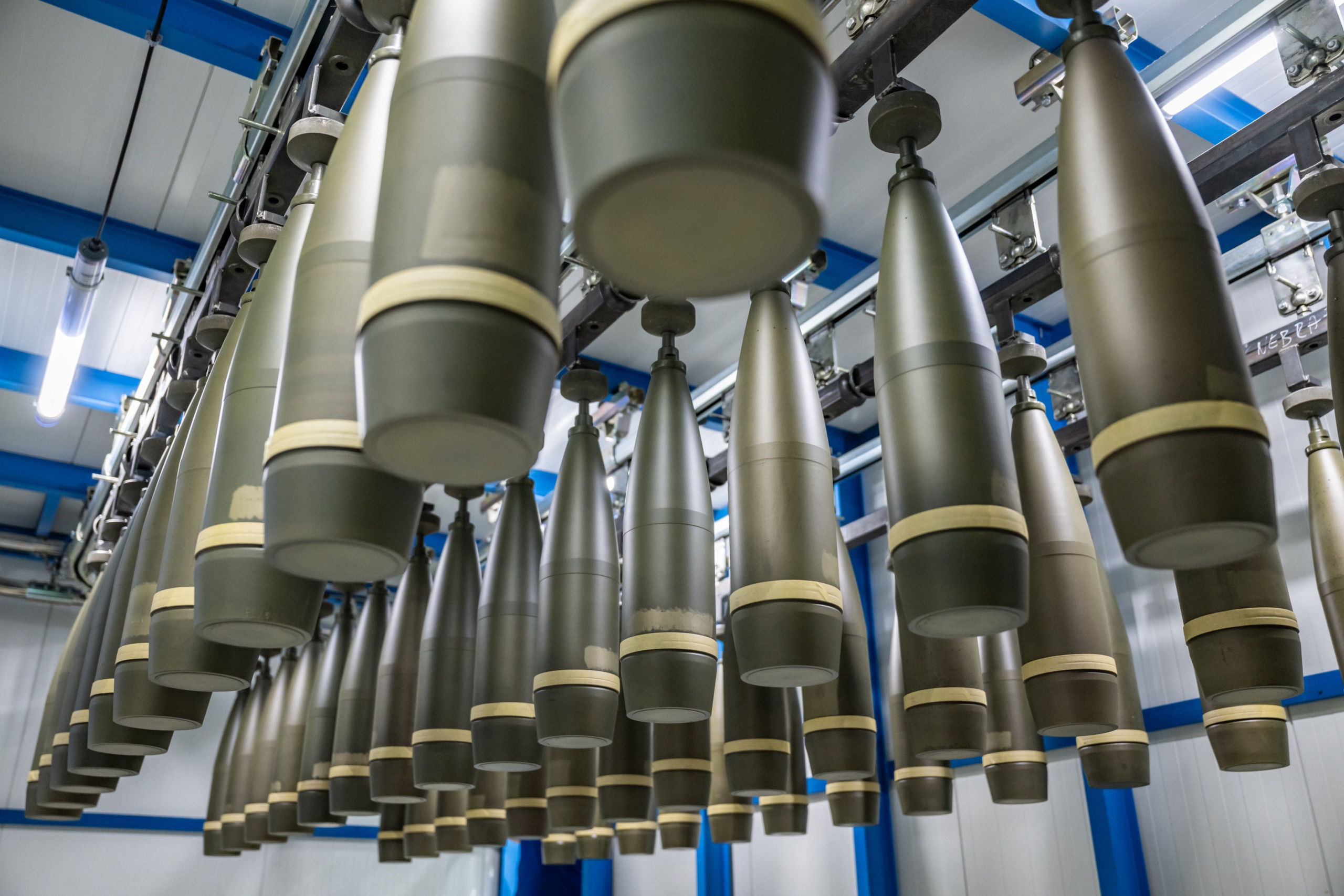
The changing demand profile within its ammunition business has also affected production and inventory management. Customers are increasingly seeking longer-range ammunition, requiring different manufacturing inputs and creating longer lead times for some components.
Extended-range ammunition can impose different engineering requirements on projectile configuration, propellant arrangements, materials, and production processes. Changes in design may require separate qualification and manufacturing controls, while the availability of specialist components can influence the schedule at which production can increase.
CSG reports that longer-range products now account for substantially all of its medium and large-calibre ammunition production. The company is continuing a vertical integration programme intended to bring extended-range production activities within its own industrial operations, with completion targeted for the end of 2027.
During the third quarter, the group accelerated the sale of standard-range ammunition already held in inventory. Those products were sold at lower prices than in earlier periods, contributing to a reduction in profitability despite continued demand across its defence businesses.
The growing contribution from Land Systems also affected margins. Several programmes remain in their production ramp-up phase, during which manufacturing capacity, material purchases, staffing, and other costs may increase before the full anticipated level of deliveries is reached.
CSG has consequently reduced its expected operating EBIT margin for 2026 to approximately 21%, compared with previous guidance of 24–25%. The group has maintained its full-year revenue forecast of €7.4 billion to €7.6 billion, with significant Land Systems delivery milestones expected during the fourth quarter.
Working capital requirements have increased alongside the production expansion. The company has been accumulating critical components for extended-range ammunition and building inventories for land systems, while some deliveries and associated cash generation have moved into 2027.
Pre-tax operating cash flow for the first nine months was negative €200 million, although the third quarter generated positive operating cash flow. The group now expects net working capital to remain below 35% of annual revenue, compared with its earlier target of below 20%.
Supplier financing forms another substantial part of the expansion strategy. CSG has extended approximately €700 million to important subcontractors to support additional manufacturing capacity for components with lengthy production lead times.
The financing is intended to strengthen the company’s supporting industrial network. Increasing final assembly output requires a corresponding supply of specialist materials and components, meaning production expansion can be restricted when an individual supplier cannot deliver at the required volume or pace.
CSG has also deployed €731 million into joint ventures and strategic shareholdings intended to broaden its technology capabilities and supply base. These investments have contributed to higher borrowing, with net debt reaching 2.4 times trailing operating EBITDA.
The company calculates that leverage would be approximately 1.6 times without the effects of those strategic investments and supplier financing arrangements. The figures reflect different adjustments to the group’s financial position and should not be interpreted as equivalent measures of actual borrowing.
Capital expenditure reached €255 million during the first nine months, equivalent to 5.3% of revenue. Full-year capital expenditure guidance remains approximately 8.5% of revenue as CSG continues investing in industrial equipment, facilities, and production capability.
Recent commercial activity includes contracts worth more than €250 million in Poland for vehicle chassis and ammunition components. The group’s land systems operations are also participating in international artillery, military vehicle, and specialist engineering programmes.
The company’s order backlog provides a substantial base of potential future manufacturing activity, although delivery timing and profitability will depend on the conversion of frameworks and other commercial commitments into completed work. Its revised financial guidance reflects the immediate costs of expanding production and changing the mix of equipment being manufactured.
CSG continues to target completion of its extended-range ammunition vertical integration programme by the end of 2027. In the nearer term, fourth-quarter deliveries, supplier capacity, and the release of working capital will determine how much of the group’s enlarged order book translates into revenue and cash generation during the remainder of 2026.