IN Brief:
- A $14.893m US Air Force contract modification covers MIDS JTRS Upgrade terminals for Japanese E-767 aircraft.
- Georgia Tech Applied Research will deliver terminals under an existing contract, with completion expected in September 2028.
- The programme sits within a wider Link 16 tactical data-link modernisation and Foreign Military Sales arrangement.
Georgia Tech Applied Research Corporation has received a $14.893 million modification to an existing US Air Force contract for tactical radio equipment intended for Japan’s E-767 airborne warning and control aircraft. The 12 November award covers delivery of Multifunctional Information Distribution System Joint Tactical Radio System Upgrade, or MJU, terminals for integration into the aircraft. The work will be performed in Atlanta, Georgia, and is expected to be completed by 30 September 2028, according to the US contract notice.
The modification, numbered P00011, applies to contract FA8730-23-F-0045. It increases the cumulative face value from $40,443,133 to $54,761,205, according to the 12 November US contract disclosure. Foreign Military Sales funds of $14,318,072 were obligated when the modification was awarded, a lower figure than the action’s $14,893,202 stated value. Japan is the overseas customer, and the Air Force Life Cycle Management Center at Hanscom Air Force Base, Massachusetts, is the US contracting activity. The notice does not specify a terminal quantity or divide the award into separate equipment and support line items.
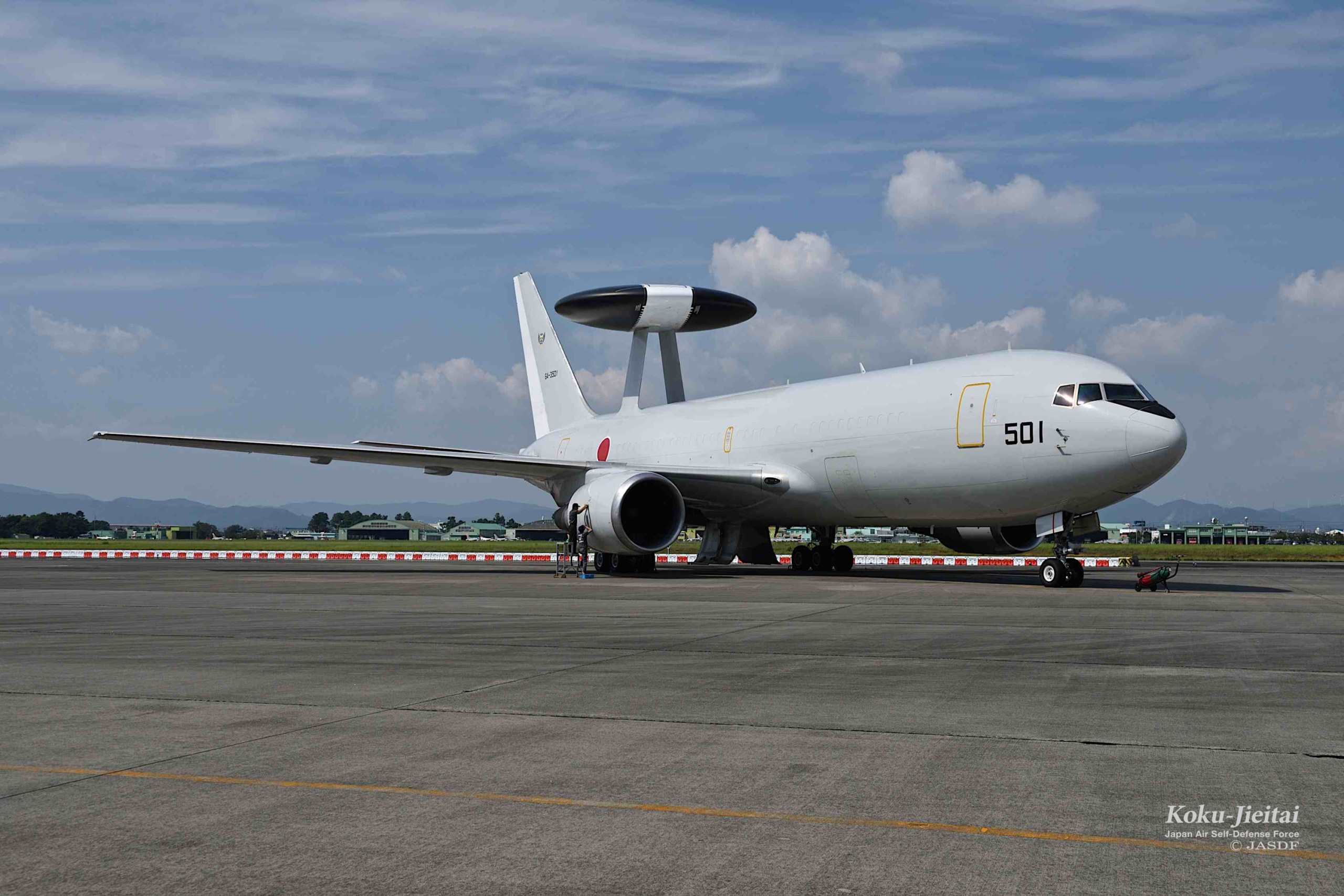
Japan’s E-767 aircraft combine the Boeing 767 airframe with an airborne warning and control mission system. Their role involves airborne surveillance and the distribution of operational information, making external data links an essential part of their integration with other aircraft, surface units, and command centres. Although the aircraft’s surveillance equipment collects and processes information, that information must also be shared over networks whose access, message format, timing, and security arrangements are compatible with those of the receiving systems. Modernising the communications terminal addresses a different technical layer from replacing the surveillance radar itself.
The MIDS family supports Link 16, the tactical data link through which US and allied platforms exchange structured operational information. The US Navy describes the MIDS Joint Tactical Radio System as a software-defined, multichannel development of the earlier MIDS Low Volume Terminal. Software-defined radio architecture can accommodate approved waveforms and network functions, but the capabilities available aboard a specific aircraft depend on its installed configuration, interfaces, and certification. The contract does not disclose the software load or verified operational performance of Japan’s future E-767 installation. Technical descriptions of the wider MIDS programme cannot establish the throughput, resistance to interference, or network availability of terminals that have not yet completed aircraft-level acceptance.
Aircraft integration extends beyond physically mounting a radio. The terminal has to connect to the mission computer and other onboard systems, use suitable antennas and power supplies, and be incorporated into the platform’s existing communication architecture. Installation also requires attention to electromagnetic compatibility, cooling, cable routing, maintenance access, and flightworthiness documentation. These are normal engineering considerations for airborne electronics; the public award specifies delivery of terminals but does not identify which contractor will carry out every stage of aircraft installation or acceptance testing.
An earlier US contract awarded to Boeing in September 2025 covered support for the same Japanese E-767 MIDS JTRS modernisation programme, including laboratory access, testing, engineering support, and aircraft-related activities. The separate Boeing and Georgia Tech awards indicate that platform support and radio equipment delivery are being managed through distinct contractual activities. This division of responsibilities makes interface control and configuration management important, particularly where a communications system must interoperate with mission equipment that was developed and certified through different contracts.
Link 16 interoperability across airborne, surface, and ground platforms depends on more than common radio hardware. Network management, cryptographic authorisation, correctly formatted messages, and matching aircraft interfaces govern whether information received by one system is usable by another. The Japanese equipment order provides a funded delivery milestone under an established multinational communications programme. Production acceptance, installation on the aircraft, and operational evaluation remain distinct activities. No completed E-767 integration trial or operational acceptance date was disclosed in the latest award, and the contract does not establish which of those milestones will be finished by each interim delivery.
Georgia Tech’s terminal delivery work is scheduled to continue until 30 September 2028. The US Air Force has not stated how many terminals the modification covers, how many Japanese aircraft will receive them under this action, or when any aircraft will return to service with the upgraded equipment. Boeing has a separate support role under an earlier contract covering the E-767 modernisation. The relationship between equipment delivery, aircraft installation, and the fleet’s operational schedule will become clearer as the contracting authorities disclose further implementation milestones.