IN Brief:
- The 4,500-square-metre site at Fontanes near Cahors was formally inaugurated on 13 November.
- The first 15 AR3 systems are expected for French forces during 2026 under a seven-year DGA agreement.
- TEKEVER has outlined investment of up to €200m in France through 2030, distinct from the cost of this individual factory.
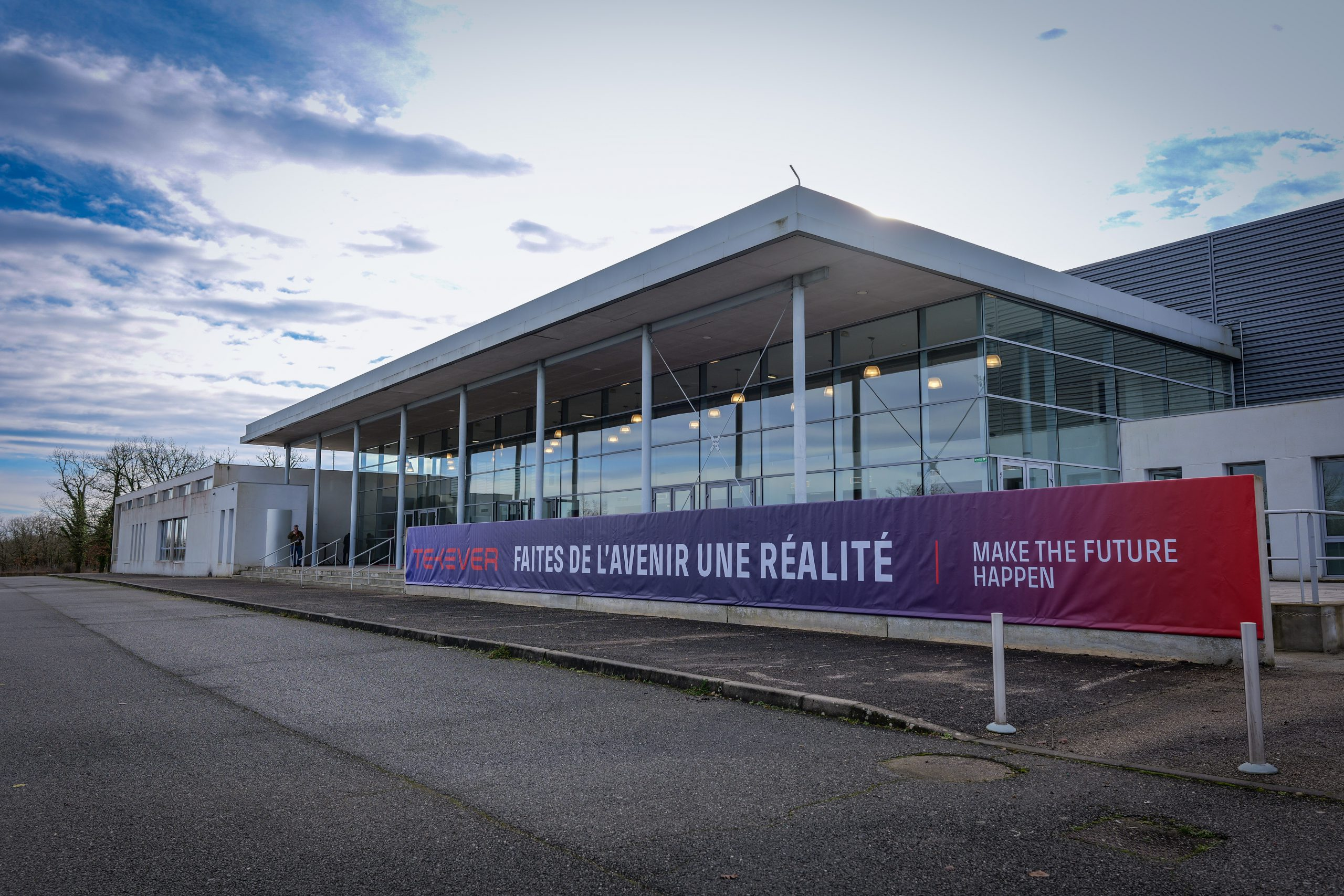
TEKEVER has formally inaugurated its unmanned aircraft production facility at Fontanes, near Cahors in south-west France, marking a further stage in its plans to establish a French manufacturing and systems integration base. The 13 November ceremony followed work earlier this year to convert a former exhibition site into a 4,500-square-metre operation serving the company’s defence and security programmes.
Production is under way at the factory, with the first 15 AR3 systems intended for French forces before the end of 2026 under a seven-year agreement with the Direction générale de l’armement (DGA). The first French system was displayed at the ceremony. Reporting identifies involvement by French equipment suppliers MERIO and AVANTIX, although neither the contract value nor the full integration configuration has been disclosed.
French Armed Forces Minister Catherine Vautrin and Industry Minister Sébastien Martin attended the 13 November opening. TEKEVER had identified the Cahors site and outlined conversion work in February, when it described a phased route towards production. The ceremony now coincides with active work on military systems, establishing a manufacturing operation rather than another proposed factory location.
The Cahors plant forms part of TEKEVER’s stated investment programme of up to €200 million in France through 2030; that figure does not describe the cost of the individual building. Contemporary reporting puts employment across the company’s French expansion at approximately 100, against a stated ambition of more than 200 jobs. The eventual allocation of those posts between manufacturing, engineering and other functions has not been fully disclosed.
Assembly, system integration and testing are being brought together at Cahors, with the company seeking to increase the share of work performed locally as the operation develops. An unmanned aircraft delivered to a military customer consists of more than an airframe: flight controls, mission sensors, navigation, communications and ground equipment must operate as a defined system. Integrating those elements into a repeatable factory configuration is a separate task from assembling the underlying structure.
Integration testing must establish that equipment exchanges data correctly, stays within available electrical and thermal capacity and operates within the environmental limits expected in service. A sensor change can alter aircraft mass, balance, power demand and endurance, requiring fresh configuration checks. Both AR3 and AR5 production have been associated with the French site; the specific systems due for initial French military delivery are AR3s.
AR3 aircraft carry intelligence, surveillance and reconnaissance payloads for missions over land and sea. TEKEVER gives the AR3 EVO an endurance range of about 14–22 hours, depending on equipment and conditions. Additional sensor mass, changes to communications hardware and the way an aircraft is operated can affect that endurance. The specification therefore cannot be treated as a guaranteed duration for every French customer configuration.
French companies contribute to the announced AR3 configuration. MERIO provides imagery-related equipment and AVANTIX specialises in signals intelligence technology; the exact division of integration work has not been published. Aircraft systems engineers must accommodate different sensor power budgets, data formats and timing requirements while providing information usable by the ground crew. The configuration must then be documented so later aircraft can be built and tested consistently.
Cahors Sud lies close to the Cahors-Lalbenque aerodrome, allowing flight testing to be planned within reach of the production and integration teams, subject to airspace and operating permissions. That proximity can shorten the cycle between identifying a defect in flight, altering a system and verifying the revised configuration. TEKEVER has not provided a complete timetable or approval status for every planned test activity.
The surrounding Occitanie aerospace and engineering sector offers access to specialist suppliers and potential recruits. Military aircraft manufacturing requires controlled documentation, traceability, repeatable inspection and approval of any component or software changes that affect the accepted configuration. TEKEVER has not yet quantified the proportion of French-produced components that will enter each aircraft built at Cahors.
French defence authorities are considering further unmanned aircraft requirements alongside the AR3 deliveries. Reporting from the inauguration describes a separate DGA process that could involve the larger AR5, but no executed AR5 order or confirmed quantity has been announced in connection with that process. Production plans for an additional model would therefore require their own contract and configuration evidence.
The first French AR3 systems are due before the end of 2026, with factory assembly and integration already taking place at Cahors. Deliveries against the existing DGA agreement and further expansion of qualified work will provide firmer measures of industrial capacity than the broader investment plan alone. Recruitment targets and any additional AR5 contract remain subject to subsequent company and customer decisions.