IN Brief:
- Instagrid says NATO and EU military customers have collectively purchased thousands of its portable power units, without providing a customer breakdown.
- Germany’s Bundeswehr selected GO MIL for a 2kW-class tactical power set earlier in 2026; the selection was not newly announced in November.
- GO MIL stores 2,074Wh and delivers 3.6kW continuous output, while LINK MIL provides distribution and battery swapping in supported configurations.
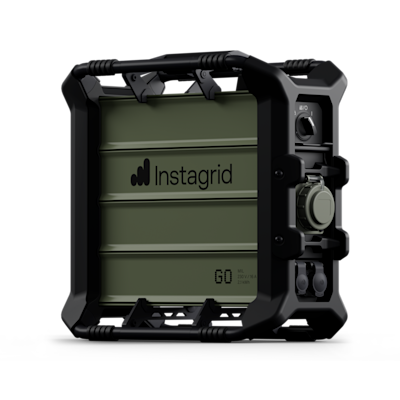
German portable power company Instagrid has detailed military demand for its GO MIL battery, reporting sales totalling thousands of units to NATO and EU armed forces without disclosing orders by country. In a supplier interview published on 13 November, the company described deployments and technical features of its 21kg tactical power system. Germany’s Bundeswehr had already selected GO MIL for its 2kW-class portable power set earlier in 2026; that selection is not a new contract award.
The Bundeswehr configuration combines GO MIL with the LINK MIL distribution unit and a Zarges transport case, according to Instagrid. The battery stores 2,074 watt-hours and is rated to deliver 3.6kW continuously, with brief peaks up to 18kW. The set’s 2kW designation describes a German equipment class, not a limit on the individual pack’s advertised output. No independently verified Bundeswehr order quantity, contract value or delivery schedule has been disclosed.
GO MIL is intended to run radios, sensors, communications terminals and maintenance equipment without an engine operating beside the user. It provides electrical power from stored energy rather than local combustion, eliminating generator exhaust at the point of consumption. Charging the pack still requires access to electricity, so field power planning must account for available stored energy, the daily duty cycle and the means of replenishing discharged units.
A battery’s watt-hour rating describes its energy capacity; its watt rating describes how quickly it can deliver power. The advertised 2,074Wh store could theoretically run a 100W load for approximately 20 hours before inverter losses and usable reserve are considered. Instagrid claims around a day of operation for some satellite terminals and approximately five hours for a 420W work light. Neither example is a verified endurance figure for a standard Bundeswehr mission.
Signature reduction is one reason the company promotes the military version. Instagrid describes fanless cooling, operation below 30 decibels, a covered indicator panel and the removal of Bluetooth and other wireless links. These features limit sources of acoustic noise, visible light and some electronic emissions associated with the equipment. They do not eliminate thermal output or guarantee that a deployed power source cannot be detected.
The supplier’s distributed power-conversion design uses smaller inverter modules rather than relying on one large fan-cooled unit. Its brief 18kW peak rating is intended to accommodate starting currents from equipment whose initial demand exceeds steady running power. Such peaks cannot be sustained indefinitely: available energy, thermal limits, protection circuitry and connected loads determine practical use.
LINK MIL adds protected distribution and arrangements for maintaining a supply while exchanging battery packs. Instagrid describes configurations that combine up to three GO MIL units and allow a replacement to be inserted without an intended interruption. Actual continuity depends on connecting the equipment correctly, keeping a charged replacement ready and remaining within the permitted output and protection settings. The manufacturer lists LINK MIL at 230V AC with a rated 3.6kW output in the standard specification.
The manufacturer specifies IP65 protection for the battery, an operating range from minus 32°C to 60°C and use at altitudes up to 4,000 metres. These are product ratings, not published results from independent acceptance tests for every military task. Charging limits and the effect of temperature on usable battery energy also matter when equipment is taken into cold or hot environments.
The 21kg pack can be carried by one person without dedicated lifting equipment, but its mass still forms part of the load transported with radios, spare batteries and other mission stores. Removing the need for a generator at the operating position can reduce local noise and fuel handling. A comparison of total logistics burden must also include how many charged packs are needed, where they are replenished and the power consumed over a deployment.
Instagrid specifies charging from a 230V connection in less than two hours under its stated conditions. The company also says that the product has a NATO Stock Number and that several allied forces have purchased its equipment, with cumulative military sales in the thousands. The customer count, shipment dates and distribution between GO MIL and other equipment have not been independently audited. These company claims do not establish additional Bundeswehr procurement during November.
Power systems for uncrewed aircraft and field electronics must accommodate both low continuous consumption and intermittent loads from charging, tools or sensors. Inverter output, safe distribution and the ability to swap packs can therefore be as important as a battery’s headline energy capacity. High-demand devices quickly consume a finite store, while uninterrupted links and other critical equipment require suitable reserve capacity and electrical protection.
The supplier’s latest account provides more detail on military users, but the scale and configuration of individual contracts remain undisclosed. Sustainment would require replacement batteries, service procedures, testing of ageing packs and suitable charging arrangements. The NATO Stock Number supports standardised identification for supply channels; it should not be interpreted as a blanket procurement decision by every member state.
Instagrid’s new disclosures indicate broader military uptake of portable battery systems, alongside a Bundeswehr selection first described earlier in 2026. Customer-specific order figures and evidence of sustained field performance remain limited. Further contract notices or service evaluations would establish how widely GO MIL has replaced engine-driven equipment and what support obligations accompany those deployments.