IN Brief:
- Intelic integrated Saab’s Giraffe 1X surveillance radar with its NEXUS command-and-control platform in a reported 30 minutes at a Dutch military base.
- The field exercise demonstrated transfer of aerial tracks and target assessment within a single operator interface, including discrimination between birds and relevant targets.
- The companies have not announced a purchase order, live interception result, integration protocol, or formal operational certification.
Intelic has integrated Saab’s Giraffe 1X surveillance radar with its NEXUS command-and-control platform during a field test at a military base in the Netherlands. The Dutch defence technology company says the two systems were connected in 30 minutes, allowing radar tracks to appear on a common operator display for assessment and possible counter-drone response. Its account, published on 16 November, describes a technical integration exercise rather than a procurement or operational deployment announcement.
Saab engineers worked with Intelic during the field exercise, which involved targets flying at different heights and speeds, including manoeuvring contacts. Intelic reports that the Giraffe 1X distinguished relevant aerial tracks from birds and that selected target information appeared in NEXUS. Operators could then assess the contact and initiate a response through the same interface. The published account does not establish that an interceptor was launched, that any target was defeated, or that the combined system passed operational acceptance testing.
NEXUS is designed to connect surveillance sensors, uncrewed systems, interceptors, and personnel within a shared command picture. A radar track must first be transmitted in a format the receiving software can interpret; the command platform then has to preserve the target’s coordinates, timing, movement, and identity without introducing misleading associations. Intelic has not identified the interface specification, adaptor software, or cybersecurity arrangements used in this integration, so the claim can be assessed as a demonstrated connection between two named systems rather than a verified universal plug-and-play standard.
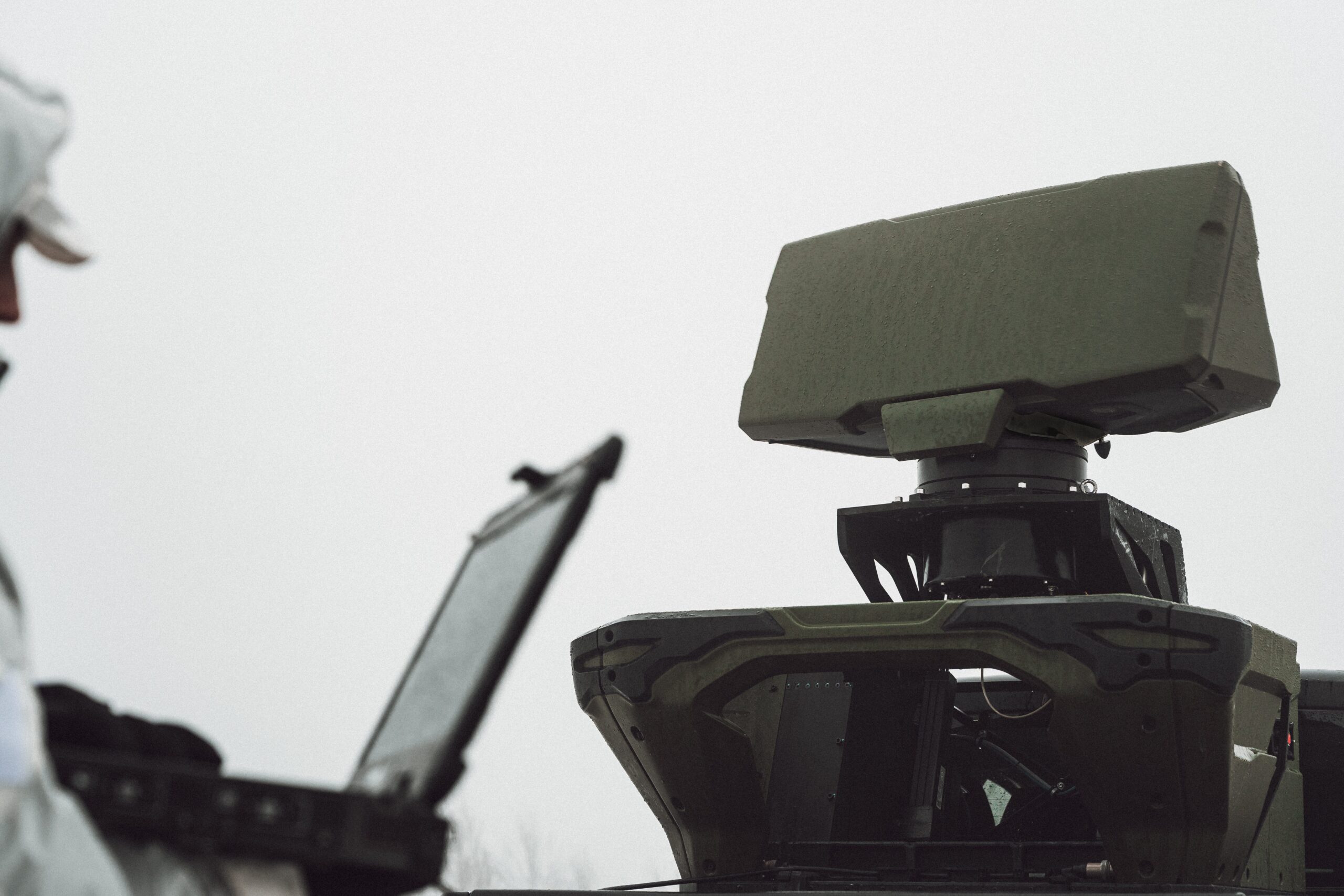
Saab’s Giraffe 1X is a compact three-dimensional radar intended for air surveillance, short-range air defence, and counter-uncrewed aircraft applications. Saab says the system scans its complete search volume every second and can be installed on suitable vehicles or fixed structures. Saab has described different instrumented range figures across versions and technical updates; neither maximum search-range claim establishes the detection distance for a small drone. Radar cross-section, altitude, terrain masking, clutter, and interference all affect the practical surveillance picture.
Radar detection alone does not establish which action an operator should take. Giraffe 1X processes reflected signals into tracks, while NEXUS presents selected information alongside other available sensor inputs. Coordinate references, latency, time synchronisation, and the handling of duplicate tracks all affect whether different systems describe the same object reliably. In a counter-drone installation, that information must also be assessed against friendly aircraft, civilian traffic, and applicable engagement controls before an effector can be authorised.
Intelic says the demonstration included the radar’s ability to reject birds from the relevant target display. Classification is particularly important when systems operate around low-flying aircraft, civilian drones, and wildlife, where false alarms can consume operator attention. That reported filtering performance belongs to the test as described; the company has not supplied the number of test targets, the environmental conditions, a measured false-alarm rate, or independent validation data. No broader detection-accuracy percentage can be calculated from the statement.
The reported 30-minute connection is a specific integration result achieved during this exercise. Intelic has not disclosed the preparation required before the teams arrived, the number of interfaces tested, or whether the equipment operated on accredited military networks. Replicating the connection elsewhere could require configuration changes, software assurance, cybersecurity testing, and acceptance by the receiving force. The time quoted for the demonstration is therefore not a measured timetable for deployment or certification.
The field test also stops short of demonstrating a successful physical engagement. Intelic says NEXUS can bring sensors and interceptors together and let personnel initiate an interception response from a common screen, but it has not said that an interceptor was launched or a target destroyed during this demonstration. Nor has it identified a purchaser, order value, installation programme, or deployment date arising from the integration. The announced result is interoperability between a specified radar and the command platform.
Saab’s Giraffe 1X has an established procurement history beyond the November integration exercise. In April 2026 the company reported a UK Ministry of Defence order worth approximately £24m, with production at its Centre of Radar Excellence in Fareham. The earlier order concerns radar equipment and is not a NEXUS procurement. It does, however, illustrate why sensor integration has to account for existing military fleets, customer-specific configurations, and continuing support obligations.
Interoperability can reduce dependence on a single equipment supplier when a force needs to connect existing sensors with new command software or add other effectors later. Achieving it at scale still requires documented interfaces, configuration control, testing across equipment versions, and procedures for dealing with lost or inconsistent tracks. The importance of those less visible engineering tasks grows as radar, electronic sensing, and uncrewed systems are assembled into larger protection networks. Nothing in the current disclosure establishes that every Giraffe 1X installation can be connected in the same time.
The demonstrated result is a radar-to-command data connection tested at a military site in the Netherlands. A repeatable interface specification, trials across additional configurations, published assurance evidence, or an identified purchasing programme would establish how far that result can be extended. None has been disclosed with the 16 November account, and no operational interception should be inferred from the ability to display and assess tracks in NEXUS.