IN Brief:
- Four F-35 full mission simulators at Naval Air Station Lemoore connected with six live F/A-18 aircraft in a reported training first.
- The demonstration used US Navy Continuous Training Environment and Link-Inject-to-Live ground station systems to connect virtual and airborne participants.
- The event establishes a successful integration trial, while wider fleet availability, performance limits and routine deployment have not been disclosed.
Lockheed Martin has connected four F-35 full mission simulators to six F/A-18 aircraft flying from Naval Air Station Lemoore in California. The 17 November demonstration used the US Navy’s Continuous Training Environment and Link-Inject-to-Live ground station systems to connect synthetic and airborne participants during a joint training event. The company identifies it as a first for this configuration; it has not published measured latency, detailed exercise results, or a timetable for broader deployment.
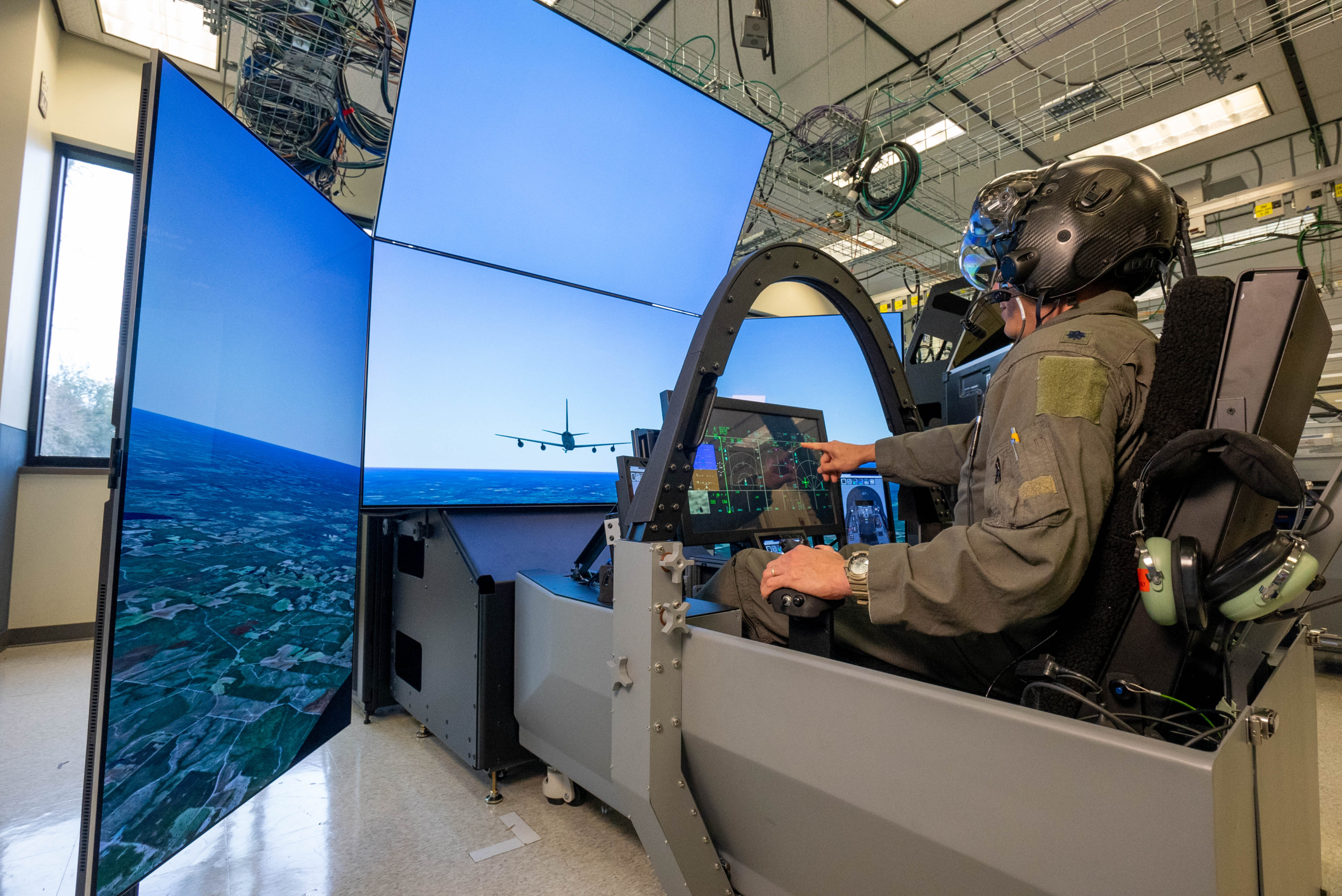
The arrangement combines two forms of training that are often managed separately. A full mission simulator represents an aircraft cockpit, sensors and mission environment, allowing a crew to rehearse a scenario on the ground. An airborne training sortie puts pilots in a physical aircraft, subject to actual aircraft handling, weather, fuel constraints and acceleration. Connecting the two means an exercise can involve virtual and live participants at the same time, rather than requiring every represented aircraft or threat to be physically present in the training area.
The Navy’s Link-Inject-to-Live system can introduce simulated tactical entities into training scenarios experienced by participating aircraft. Previous Navy descriptions include representative air and surface threats presented to F/A-18E/F and EA-18G crews. A mixed live and synthetic exercise requires consistent track identity, position, and timing so that the participating crews respond to the same sequence of events. The relevant integration work therefore extends beyond connecting a simulator to a communications network.
At Lemoore, the named Navy training infrastructure carried information between four ground-based F-35 mission simulators and six live F/A-18s. Lockheed did not identify the exact F/A-18 variants involved, the route taken by tactical data, or the duration of the event. The verified result is simultaneous connectivity in the exercise configuration, giving engineers an integration milestone rather than a published assessment of every training scenario or network operating condition.
Timely, coherent track information is essential when aircraft are moving quickly and training scenarios include simulated participants. Delayed updates can shift an entity’s represented location or change the apparent sequence of events, while inconsistent identities can undermine tactical decisions. The system must therefore distinguish real from simulated data and present an exercise picture that remains aligned across participants. Lockheed has not supplied the measured latency or availability thresholds used during this demonstration.
A connected live and virtual exercise can include simulated aircraft and threats that would otherwise be expensive, unavailable, or impractical to deploy in the air. A unit can represent additional friendly formations, opposing aircraft or threats within a synthetic environment while its live participants still operate their real aircraft. A simulator crew can repeat parts of a mission without incurring another flight, while the airborne crews retain the physical demands of flying and operating their own equipment. The value depends on the realism and fidelity of the representations rather than the number of synthetic objects alone.
Full mission simulators reproduce cockpit and mission-system functions beyond the scope of desktop training. They allow crews to practise procedures, information presentation, and aircraft behaviour in a structured training environment. When those simulators are connected to a live training network, their outputs must be compatible with the tactical information exchanged elsewhere in the exercise. Differences in aircraft types add a further integration challenge because fifth-generation and legacy fighters do not necessarily present identical sensor data, displays or aircraft capabilities.
An October 2026 Lockheed demonstration connected F-35 simulator crews at several locations for distributed mission rehearsal. The new Lemoore event adds actual airborne Navy fighters to the training network, creating an additional interface between simulation infrastructure and aircraft in flight. This new live-airborne element is the material change from the earlier trial; it also introduces aircraft-specific and flight-safety constraints absent from a rehearsal conducted entirely between simulators.
Keeping the configuration available for repeat exercises will require compatible simulator hardware, aircraft interfaces, ground stations, secure network connections, and maintenance of the represented mission-system software. Different fighter types may present sensor or tactical information differently, and updates to aircraft software can require corresponding changes in the simulation environment. The company has not identified the modifications, if any, needed to roll out the configuration at other training sites.
Lockheed expects the approach to broaden joint mission rehearsal by allowing synthetic participants to join exercises alongside real aircraft. A fleet-wide equipment requirement, procurement value, or quantified saving in flight hours has not been disclosed. Such outcomes would depend on repeatable exercises, support arrangements, and validation of how the integrated environment performs across the scenarios required by the Navy.
The confirmed achievement is a joint event linking six airborne fighters with four F-35 simulators through the Navy’s training environment. Further work will need to establish repeatability, exercise coverage, interoperability as software standards change, and the support necessary for routine use. No subsequent qualification date or deployment schedule accompanied the 17 November result.