IN Brief:
- A Spanish decree published on 20 November provides for €744m in repayable financing for the national C-UAS programme.
- Indra Sistemas and Escribano Mechanical & Engineering are the named consortium beneficiaries, with proposed work spanning radar, electro-optics, command systems, and countermeasures.
- The loans are scheduled across 2026–2031, and their grant procedures and programme milestones still govern actual disbursement.
Spain has established the rules for up to €744 million in repayable, interest-free industrial loans supporting its national counter-drone programme, identifying a consortium of Indra Sistemas and Escribano Mechanical & Engineering as the intended beneficiaries. Royal Decree 1014/2026, dated 18 November and published in Spain’s Official State Gazette on 20 November, covers the development and production of systems for detecting, tracking, identifying, and countering unauthorised drones. The instrument finances an existing defence modernisation effort, while the delivery and acceptance of equipment remain separate milestones.
The named undertaking is the UTE CUAS NACIONAL consortium, formed by the two Spanish companies for the direct-management programme called Development and Production of C-UAS for National Territory. The measure forms part of a wider €6.402 billion package of industrial pre-financing arrangements covering several military programmes. The €744 million figure belongs to this counter-drone programme only; it should not be confused with the larger package or with the total procurement value of all systems that could eventually be ordered.
The decree allocates the counter-drone financing over six calendar years: €110 million in 2026, €150 million in each of 2027, 2028, and 2029, €90 million in 2030, and €94 million in 2031. These are scheduled financing amounts rather than a record of funds already paid. The loans carry a fixed zero interest rate and are generally structured without guarantees for individual payments, subject to specified conditions when the underlying defence contract has yet to be formalised.
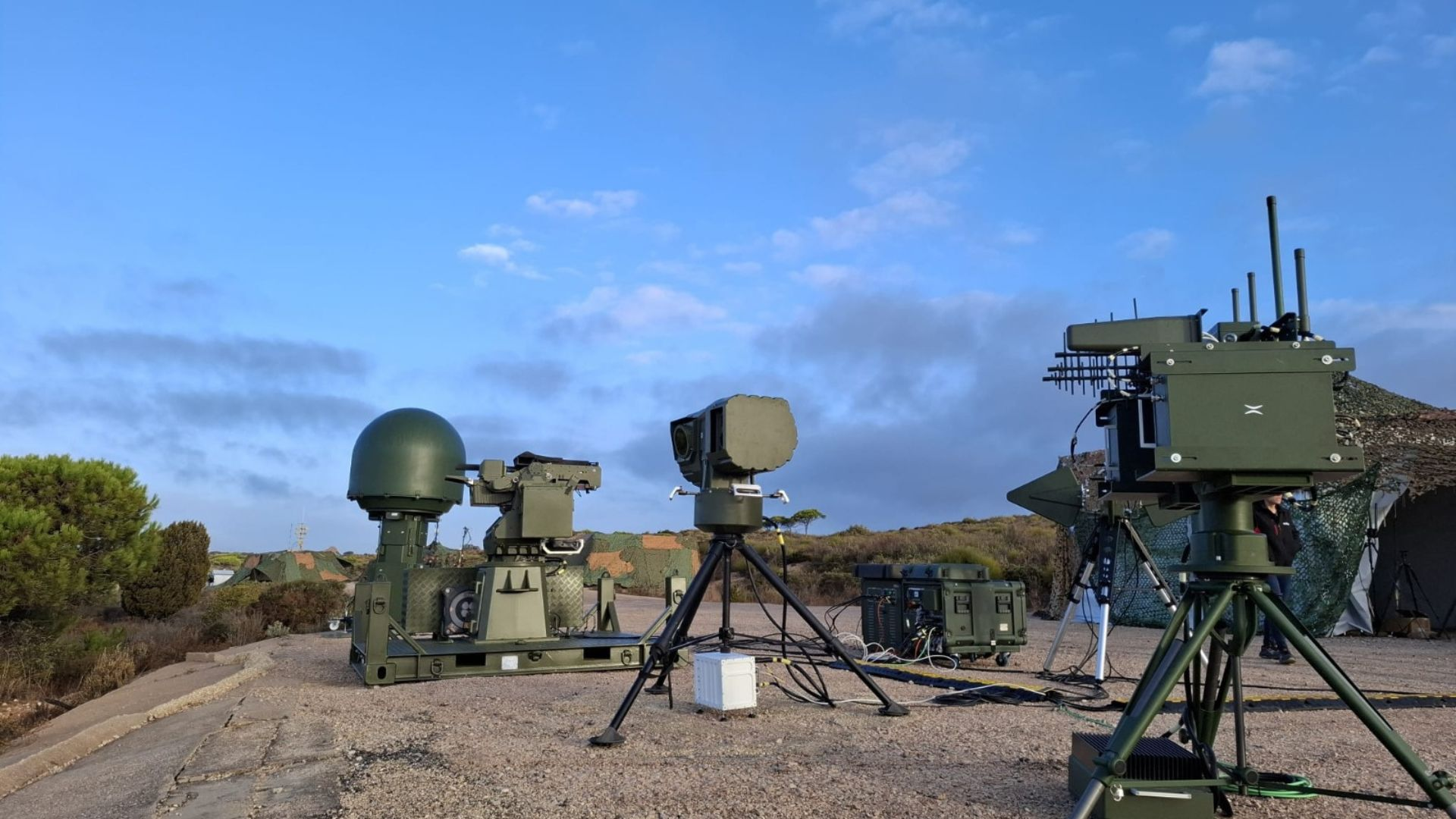
Annex V of the decree defines a counter-drone system that can be adapted for fixed installations, vehicles, and ships. Its components include active electronically scanned array radar, radio-frequency sensing, visible-light and thermal cameras, command-and-control software, simulation equipment, and kinetic and non-kinetic countermeasures. The specification calls for detection, tracking, classification, and identification at distances of several kilometres using active and passive sensors. That is a programme requirement, not a tested performance figure for a delivered system or proof that every installation will share an identical equipment configuration.
The proposed command-and-control component would present information and support decisions on available defensive responses. Spain identifies interfaces for managing detection and neutralisation areas, assessing threats, and exchanging information with higher-level command systems using NATO-compatible standards. These are programme requirements; the text does not confirm that any specific configuration has already passed acceptance tests. Integrators will have to establish how sensor data, software, operator interfaces, and platform equipment work together under the applicable procurement and qualification processes.
The specified defensive options range from radio-frequency and satellite-navigation jamming to weapon stations and other physical interceptors. Their effects, operating restrictions, and safety requirements differ, particularly on a ship or at a protected fixed site. The programme also covers simulators, vehicle integration, support, and future updates. Manufacturing and acceptance will therefore extend beyond radar or effector supply to involve interfaces between subsystems, commissioning tests, operator training, and maintenance arrangements across several installation types.
Receipt of financing is not automatic following publication of the decree. Beneficiaries must submit the required material to Spain’s Ministry of Industry and Tourism, which assesses eligibility before issuing individual concession orders. Drawdowns are connected to milestones certified by the Ministry of Defence, although the rules permit some advance payments. Where the associated defence contract has not been formalised, such advance payments require a guarantee equal to 10% of the relevant amount. The decree also requires repayment if the underlying contract is still unsigned after the specified deadline of 31 October 2027.
The requirement for nationally supportable counter-drone systems covers design authority, sensor integration, command software, and continued maintenance. Annex V explicitly identifies Spanish industrial capability in simulation, command and control, sensors, and uncrewed systems as programme objectives. Production of every component within Spain is not specified, however, and an individual semiconductor or electro-optical assembly may still depend on international suppliers. The proposed national contribution can therefore be assessed more precisely through integration responsibilities, domestic manufacturing workshare, maintenance capacity, and control over later system changes.
Spain approved an earlier industrial-financing instrument for counter-drone capabilities in 2025, so the 20 November publication should not be presented as the first decision to pursue the technology. Royal Decree 1014/2026 adds a defined €744 million pre-financing allocation to the Indra–Escribano undertaking, within a €6.402 billion set of loans for several defence modernisation programmes. Its financial schedule and technical annex give the present decision a distinct basis for coverage, while subsequent orders and concession instruments will determine the precise work to be delivered.
The annual loan schedule runs through 2031, but equipment acceptance will follow the separate terms of Spain’s defence contracts. Those contracts must establish quantities and configurations, while system testing will have to demonstrate that the specified sensors, command software, and effectors operate together in the intended installations. No number of systems already delivered or accepted is stated in the decree. Concession orders, qualification results, and deliveries will provide the evidence that the financing arrangements have translated into equipment and supporting industrial capability.