IN Brief:
- Chromalloy and Global Turbine Services received a multiple-award F108 sustainment framework on 20 November.
- The $871m figure is a shared maximum for remanufacturing low-pressure turbine modules 13/15 and 14.
- Work can extend to 19 November 2031; future orders will establish funded volumes and actual contractor revenue.
Chromalloy Component Services and Global Turbine Services have been selected for a US Air Force engine sustainment contracting arrangement with a combined maximum value of $871 million. Announced on 20 November, the indefinite-delivery, indefinite-quantity contracts provide for remanufacturing low-pressure turbine modules of the F108 engine used in US military aircraft. The stated maximum is shared across both awardees and future orders, rather than representing $871 million committed to each company or money already spent by the government.
The statement identifies low-pressure turbine module 13/15 and module 14 as the units to be remanufactured for Air Force and Navy requirements. Chromalloy Component Services of San Antonio holds contract FA8122-27-D-B002, while Global Turbine Services of Doral holds FA8122-27-D-B001. The government describes these as competitively awarded, firm-fixed-price, multiple-award indefinite-delivery contracts; two offers were received. Work is scheduled at each contractor’s facilities through 19 November 2031, with the Air Force Sustainment Center at Tinker Air Force Base administering the procurement. No allocation of module quantities between suppliers has been disclosed.
The F108 is a military variant of the CFM56-2 turbofan family, long used to power the US Air Force’s KC-135 tanker fleet. Related engine support also serves the Navy’s E-6B Mercury aircraft, which performs airborne communications functions. Although the platforms have different operational roles, overlapping engine technology creates common needs for specialist inspection, approved components, and repair documentation. The new award is specifically for designated low-pressure turbine modules; it does not order complete new engines, modify the aircraft missions, or establish an aircraft replacement programme.
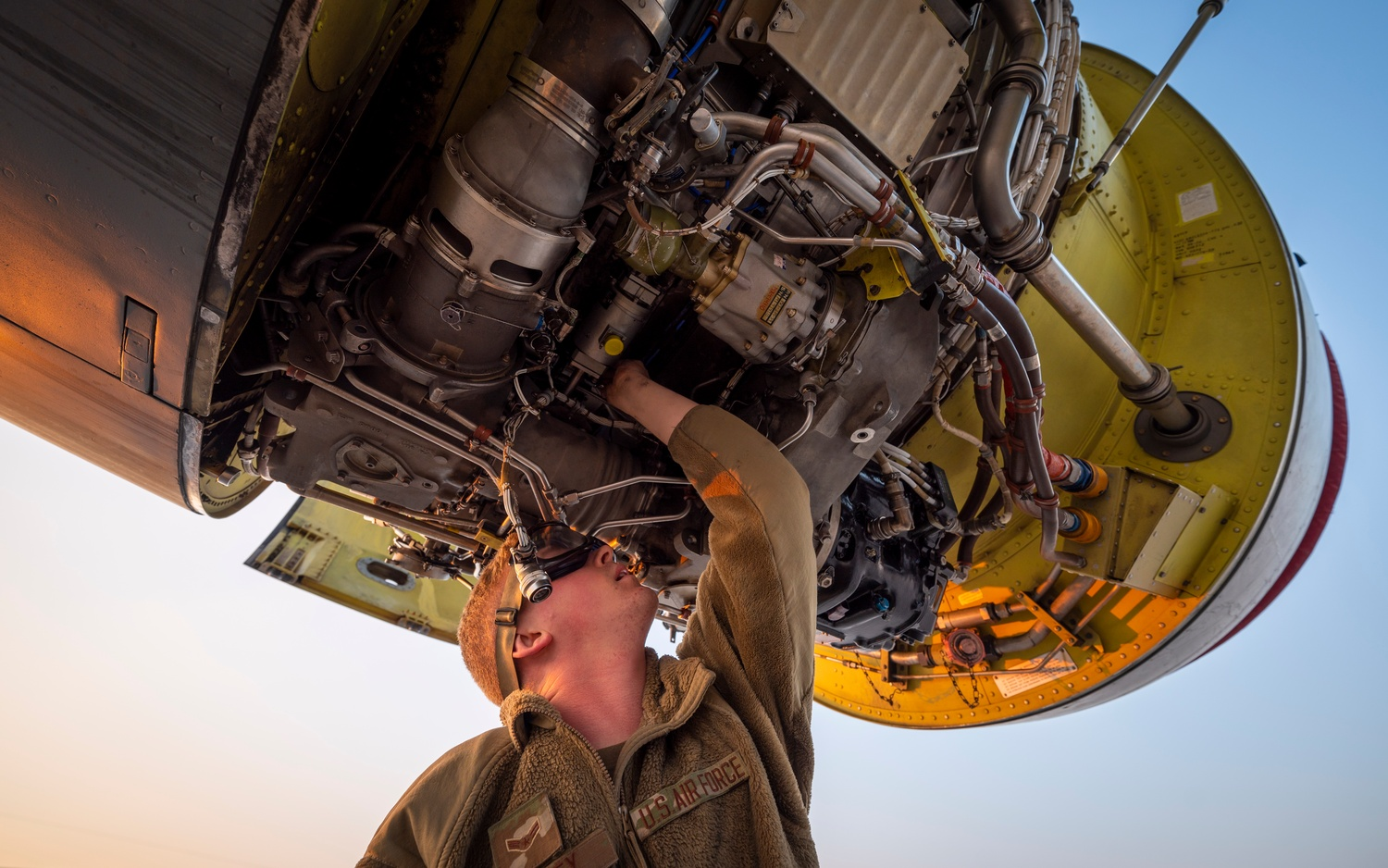
A low-pressure turbine extracts useful energy from the gas stream downstream of the engine core and drives the low-pressure rotating assembly through a shaft. Turbine parts face repeated heat cycles, centrifugal loads, and vibration, making component condition and dimensional accuracy central to a successful overhaul. A remanufacturing process can include disassembly, cleaning, non-destructive inspection, approved repairs or part replacement, and reassembly with acceptance checks. The award notice does not specify which repair technologies each company will use or the condition of the modules that will be delivered for work.
Restoring a serviceable module requires more than renewing visibly worn hardware. Repair limits and replacement decisions must follow an approved configuration, with records connecting parts, processes, and inspection results to the returned assembly. Different incoming damage levels can change labour requirements, replacement-part demand, and the time needed before a module can be accepted. Neither annual throughput nor unit pricing is stated in the announcement. The $871 million maximum therefore cannot support a reliable calculation of turbine modules, completed engines, or flight hours returned to service.
The multiple-award arrangement creates two potential sources of the same category of maintenance service. Task orders will determine how work is distributed between the contractors, subject to the terms of the procurement. There is no basis for assuming an equal financial split, guaranteed workload, or simultaneous expansion at both plants. The significance for fleet maintenance will depend on actual order volumes and whether the suppliers can meet agreed turnaround, inspection, and delivery requirements under the applicable acceptance standards.
Engine availability can be affected by a single component awaiting inspection or a replacement part. The remanufacturing process therefore depends on access to serviceable material, specialised tooling, trained technicians, and the required test capacity. Configuration control is especially important for established powerplants that have accumulated modifications over years of operation; an approved repair on one configuration may not automatically be valid for another. The government has not reported an expected reduction in depot turnaround, engine downtime, or tanker fleet availability as a consequence of the framework.
Chromalloy has undertaken F108 turbine work before, so this contract should not be characterised as introducing remanufacturing capability for the first time. A new framework can nevertheless change the means by which the Air Force orders work and maintains alternative sources of industrial capacity. Comparing its five-year ceiling with a single earlier order would be misleading without the actual volume and scope of each action. The programme’s measurable output will be defined by subsequent orders and accepted remanufactured modules, rather than the maximum advertised value.
The KC-135 remains dependent on continued engine support while fleet renewal proceeds, and the Navy’s E-6B has its own long-term maintenance requirements. The 2031 completion date gives the contracting arrangement an extended period in which modules can be ordered as necessary; it does not guarantee an unchanged fleet size or annual overhaul rate. The services’ operational planning will influence the demand placed on the suppliers, but no forecast of that demand is included in this contract record.
Chromalloy and Global Turbine Services can now receive orders for a defined set of F108 turbine-module repairs under a combined $871 million cap. The Air Force and Navy will still need to issue funded requirements that identify work quantities and delivery expectations. Those actions, followed by accepted module returns, will show how much of the framework is used and whether it achieves the required maintenance capacity. The 20 November award establishes a remanufacturing procurement route, not $871 million of expenditure already committed or an assured production volume.