IN Brief:
- Airbus Defence and Space and SkyFall have signed an MoU at ILA Berlin.
- The alliance combines Ukrainian unmanned-system production with Airbus air-defence integration expertise.
- The work supports Europe’s shift toward scalable, layered, and combat-informed air defence.
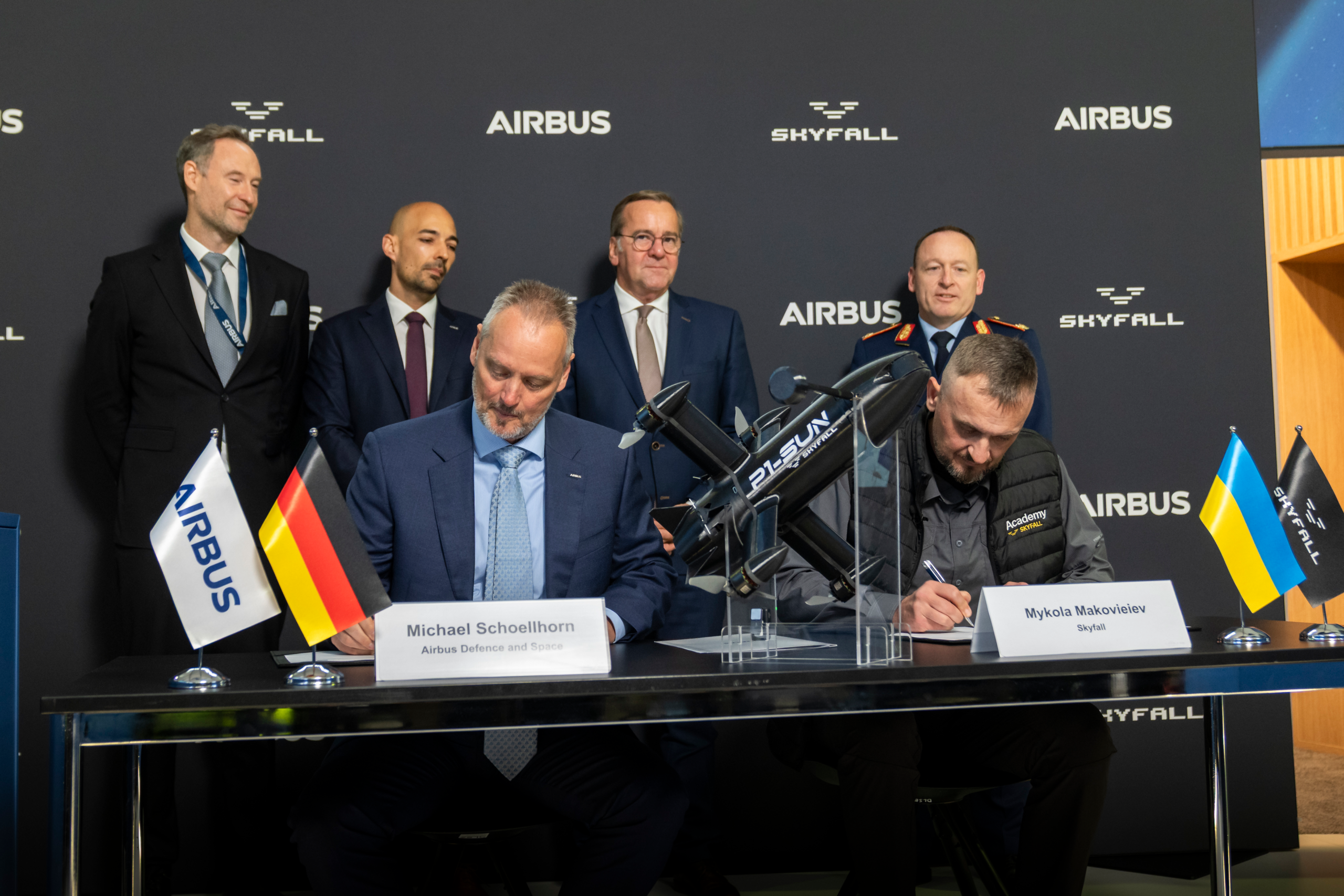
Airbus Defence and Space and Ukrainian defence technology company SkyFall have signed a memorandum of understanding to launch a strategic partnership focused on European and Ukrainian air-defence innovation.
The agreement brings together SkyFall’s rapid prototyping and serial manufacturing experience in unmanned systems with Airbus’ system-of-systems, command-and-control, and integrated air and missile defence expertise. SkyFall has developed unmanned aerial systems for combat missions, logistics, reconnaissance, and interception, while Airbus brings the architecture needed to connect sensors, effectors, and command networks across a layered defensive environment.
Ukraine’s battlefield experience has accelerated a form of defence manufacturing that Europe is now trying to absorb without losing qualification discipline. SkyFall’s interceptors have been credited with neutralising more than 10,000 Russian drones in combat environments, creating a large base of operational feedback on target behaviour, failure modes, electronic interference, weather, operator workload, and repair needs.
That feedback has value only when it can be translated into production. Drone and interceptor systems evolve quickly because adversaries adapt quickly. Airframes, datalinks, navigation methods, sensors, power systems, warheads, launch methods, and software can all require changes within short cycles. European procurement systems have historically struggled with that pace, particularly where certification, interoperability, and multi-national coordination are involved.
Airbus has already been building several counter-drone and air-defence layers, including work with Alta Ares and helicopter-linked drone interceptor concepts. SkyFall adds a Ukrainian production and battlefield-iteration route to that ecosystem, reinforcing the lower and middle layers of European air defence.
The manufacturing requirement is broad. A layered air-defence system needs interceptors, launchers, sensors, command software, targeting data, communications, operator interfaces, identification tools, spare parts, field maintenance, and training systems. A single effective interceptor cannot protect European airspace if it cannot be integrated, produced in numbers, and connected into wider engagement architecture.
Saturation attacks have changed the economics of air defence. High-end interceptors remain essential against missiles and advanced aircraft, but they cannot be the only answer to low-cost drones or mixed salvos. Europe needs cheaper effectors that can be manufactured quickly, deployed widely, and allocated intelligently by command systems that understand cost, availability, target priority, and risk.
Airbus’ value sits in that orchestration layer. Command-and-control systems have to fuse sensor data, classify threats, assign effectors, manage engagements, and connect national or coalition networks. Without that integration, counter-drone systems remain local point solutions. With it, they can form a multi-layered air shield that can protect military sites, cities, logistics nodes, air bases, and industrial infrastructure.
SkyFall’s production experience raises another question for European industry: how to scale Ukrainian technologies without slowing them into conventional programme cycles. NATO customers need safety, assurance, interoperability, and maintainability, but excessive process can erase the speed that made the systems valuable. The alliance will have to combine rapid engineering changes with controlled configuration management, supplier qualification, and field support.
The European Sky Shield Initiative provides the policy backdrop, but the industrial task is more granular. Motors, batteries, electronics, composite structures, radio modules, warheads, sensors, launch hardware, and secure software all require supply chains that can absorb demand. Ukrainian designs may also need European production partners for scaling, export control, certification, and long-term sustainment.
For defence manufacturers, the Airbus-SkyFall agreement shows how the air-defence market is being pulled toward mixed production cultures. Traditional primes bring integration discipline, qualification systems, and programme reach. Battlefield-driven companies bring speed, data, and design evidence from live threat environments. The strongest future systems are likely to come from combining those strengths without forcing one to imitate the other.
Contracts, workshare, production investment, qualification, and customer requirements still have to follow. Europe’s air-defence capacity will increasingly depend on scalable lower-cost effectors connected into high-grade command systems, and Airbus and SkyFall are now formalising that connection for the European market.