IN Brief:
- The additional US Army delivery order is valued at more than $50 million.
- Mistral and UVision will provide further HERO 120 systems and ancillary equipment through domestic production.
- Quantities, delivery dates, production rates, and the equipment breakdown have not been disclosed.
Mistral Inc. and UVision have received an additional US Army delivery order valued at more than $50 million for HERO 120 loitering munitions and ancillary equipment.
The award sits within the Army’s Lethal Unmanned Systems programme and supports the Capability Portfolio Executive for Mission Autonomy and Precision Strike Reconnaissance Systems. It will increase the quantity of HERO 120 equipment available for training, readiness, and operational preparation.
The companies have not disclosed the number of munitions ordered, the value assigned to supporting equipment, the delivery timetable, or the production rate. The announcement establishes a funded expansion of the programme without showing how rapidly the additional systems will reach Army units.
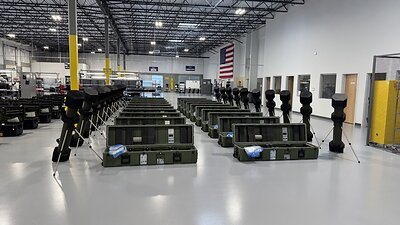
Under the existing arrangement, Mistral acts as the US prime contractor and systems integrator, while UVision remains the HERO 120 design authority and participates in development, manufacturing, delivery, training, and sustainment. The programme is being supported through domestic production.
HERO 120 is a man-portable and platform-integrated loitering munition intended to combine surveillance, target confirmation, and precision strike functions. UVision publishes a mass of 14.5kg, a 4.5kg warhead, range of up to 60km, and endurance of up to 60 minutes.
Those specifications describe the marketed platform rather than the precise configuration covered by the new order. The announcement does not identify the launcher, payload option, communications arrangement, software baseline, or command-system interfaces being supplied.
A loitering munition differs from a conventional missile because an operator can use its electro-optical and infrared sensor during flight to search for, identify, and track a potential target. Engagement remains dependent on the approved operating procedure, communications link, and command authority.
The air vehicle is only one part of the deployable capability. Army units also need launch equipment, fire-control systems, communications, training devices, power support, storage arrangements, transport equipment, software management, spares, and technical publications.
The term “ancillary equipment” may cover some of those elements, although Mistral and UVision have not published an itemised breakdown. Its inclusion is nevertheless important because an increase in munition numbers without sufficient launchers, training equipment, or support capacity would not produce a proportionate increase in readiness.
Domestic manufacturing is the main industrial element in the award. Recurring loitering-munition demand places pressure on airframes, propulsion units, seekers, electronics, warheads, launch containers, batteries, test equipment, and acceptance capacity.
The companies have not identified the production location, domestic-content percentage, or supplier workshare. As a result, the announcement confirms that US production is under way without showing how deeply the supporting supply chain has been localised.
Increasing output will depend on more than final assembly. Every production lot requires configuration control, component traceability, safe handling, environmental assurance, launcher compatibility, software integrity, and repeatable performance against the approved technical baseline.
Lot-acceptance testing can become a limiting stage when production expands. A line may assemble more vehicles while remaining constrained by test ranges, specialist inspection, warhead assurance, environmental chambers, or the availability of qualified personnel able to approve the finished system.
Supply continuity poses a similar problem. Seekers, navigation electronics, propulsion components, and energetic materials can depend on specialised suppliers with limited spare capacity. A single delayed component can hold several otherwise complete systems in work in progress.
The broader Army Lethal Unmanned Systems contracting vehicle has a stated ceiling of $982 million. That figure represents the maximum contractual capacity rather than guaranteed expenditure, making individual delivery orders the more reliable indication of funded demand.
The latest award therefore provides a stronger near-term production signal than the programme ceiling alone. It also follows completion of the first lot-acceptance tests, suggesting that the programme has moved beyond initial contracting into repeated manufacture and acceptance.
Training demand will shape how the additional equipment is used. Operators must learn mission planning, sensor interpretation, communications management, target confirmation, handover, abort procedures, and coordination with external intelligence and command systems.
Maintainers and ammunition personnel require separate procedures for launchers, electronics, inspection, storage, fault isolation, and live-round handling. Enough training equipment must be available to build proficiency without consuming an excessive proportion of the operational stock.
UVision’s role as design authority remains important as domestic production evolves. Substituting components, changing suppliers, updating software, or modifying production methods can create configuration differences unless each change is assessed and approved against the established system baseline.
The more than $50 million order expands a funded Army programme and gives Mistral and UVision further demand against which to organise production. The next useful measures will be quantities accepted, delivery tempo, fielding progress, and evidence that domestic suppliers can maintain output without loosening technical control.