IN Brief:
- The two-week Scottish trial exercised the complete BATS sense, decide and effect counter UAS chain.
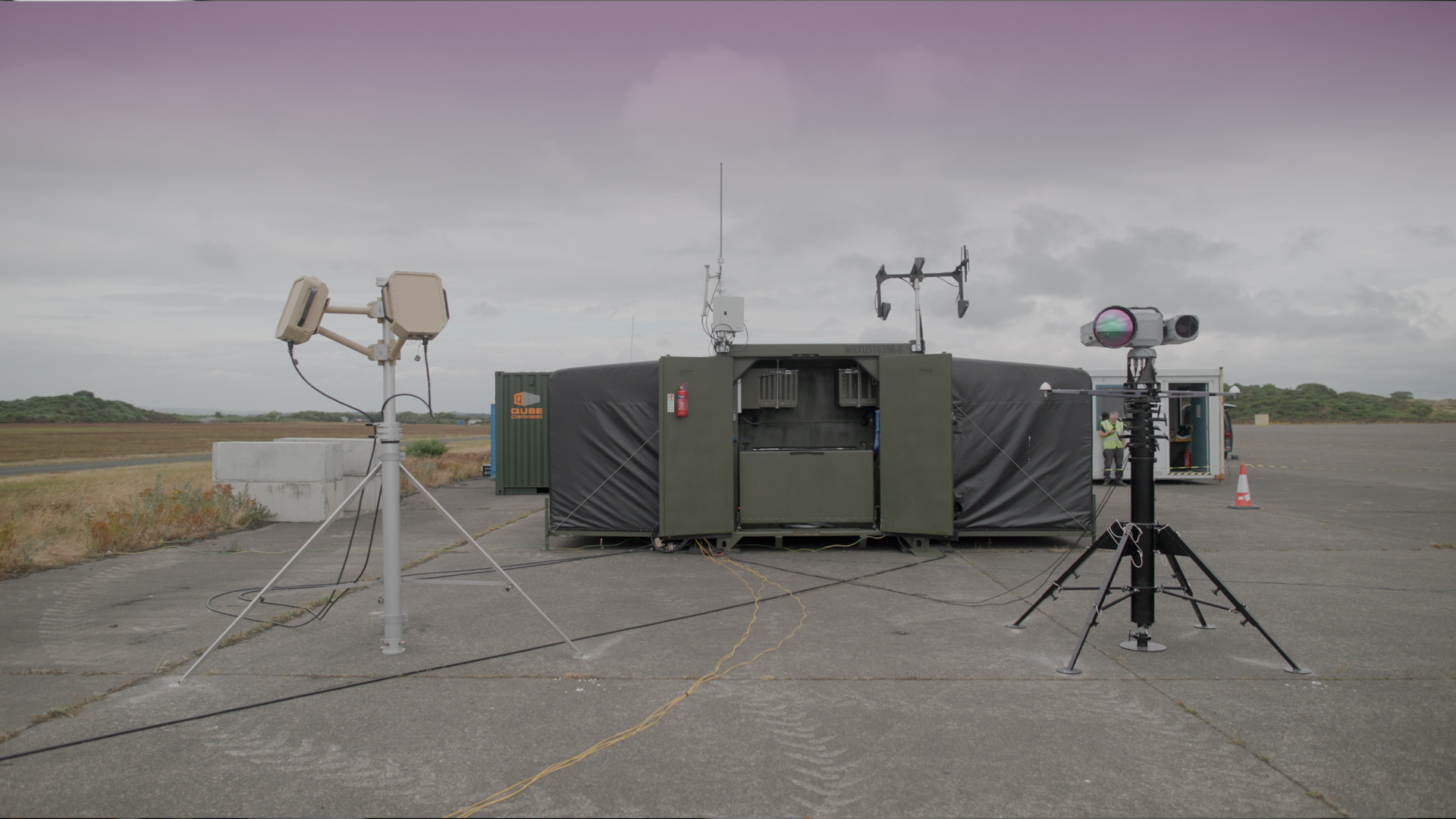
- BATS integrates multiple sensors, command and control, electronic warfare and a gun system within a modular architecture.
- BAE Systems is progressing the platform towards operational deployment while expanding its sensing and countermeasure functions.
BAE Systems has completed two weeks of live trials in Scotland of its Anti Threat System, or BATS, demonstrating an integrated counter UAS chain combining detection, command and control, electronic warfare and a gun effect.
The trials exercised the full sense, decide and effect workflow against uncrewed aerial threats. Operators used BATS to coordinate multiple sensors and effectors through a common command architecture, creating a shared operating picture before identifying targets and selecting an appropriate response.
BAE Systems divided the activity into three scenarios. The first concentrated on detection and situational awareness, combining information from several sensors to detect, identify and track aerial objects while separating threats from benign activity.
The second demonstrated a non-kinetic response using electronic warfare and software defined radio technology. The third combined the complete chain in a more complex scenario, allowing operators to confirm different categories of drone and apply separate effects through the same command environment.
An integrated gun system provided a kinetic option alongside the electronic warfare path. The configuration reflects the wider direction of counter UAS development, where operators increasingly require several sensors and defeat methods rather than a fixed pairing between one detector and one weapon.
BATS is intended to provide the integration layer between those elements. Its modular architecture can connect BAE Systems equipment and third party sensors or effectors, allowing configurations to change as operational requirements, platforms or target types develop.
That architecture places substantial emphasis on track management and software integration. Detecting a small aircraft is only the first stage of an engagement: sensor data has to be combined, identification confidence maintained and targeting information passed to an appropriate effector quickly enough to deal with a moving target.
Electronic warfare may be suitable where an aircraft depends on vulnerable command or navigation links, while guns and other kinetic systems remain relevant against targets that cannot be disrupted electronically. Future architectures are also expected to accommodate interceptors, directed energy and additional passive or active sensors, increasing the integration burden on the command layer.
The Scottish programme also examined distributed operation. BAE Systems used the trials to explore how threat data could be shared securely between locations so that separate sites could contribute to a broader understanding of the airspace rather than operating as isolated defensive positions.
That networked approach becomes more useful as protected areas grow and individual sensors encounter terrain, range or line-of-sight limits. Sharing tracks can extend warning time and allow effectors at one location to benefit from detections generated elsewhere, although it also increases requirements around communications resilience, latency and data quality.
Human oversight remains part of the BATS architecture. BAE Systems says the system is designed to reduce operator workload while retaining context-appropriate human decision-making, with automation supporting detection, fusion and response selection rather than removing engagement authority from the operator.
The programme sits alongside a broader UK push towards integrated counter UAS systems. In September, UK Defence Innovation opened a £5 million autonomous counter UAS acquisition pathway seeking architectures able to cover detection through defeat while supporting open interfaces, modular effectors and greater autonomy.
BATS is separate from that competition, but both programmes expose similar engineering demands. Sensors, computing, electronic warfare equipment, weapons, power systems and communications have to operate as one system without creating an operator workload that grows faster than the number of threats being tracked.
The live trial also moves BATS beyond a laboratory integration exercise. Repeated operation over two weeks across several scenarios provides a broader test of interfaces, operator workflow and effect selection than a single scripted intercept, although BAE Systems has not announced an operational customer, production quantity or deployment date.
Louise Heywood, Head of Strategy at BAE Systems Digital Intelligence & Land, said the activity demonstrated the ability to combine sensing, decision-making and response options while reducing the burden on individual operators. The team also used the event to examine future networked operation across distributed sites.
BAE Systems is now progressing BATS towards operational deployment and plans further work on sensors, countermeasures and threat intelligence. Customer adoption and configuration choices will determine whether the same modular architecture demonstrated in Scotland can be transferred into a repeatable deployable system across different operating environments.