IN Brief:
- BlackThorn covers 40mm, 70mm, and 120mm warheads with blast, fragmentation, multi-purpose, and anti-armour effects.
- Common interfaces are intended to reduce repeated integration and qualification work across different weapon families.
- Frankenburg Technologies has selected BlackThorn for its Mark I short-range air-defence missile.
BAE Systems has unveiled BlackThorn, a configurable family of 40mm, 70mm, and 120mm warheads intended for missiles, one-way effectors, counter-drone systems, autonomous aircraft, and uncrewed ground vehicles.
Blast, fragmentation, multi-purpose, and anti-armour effects can be selected within the family, allowing weapon developers to begin with an established architecture rather than designing every warhead as an isolated programme. Frankenburg Technologies has chosen the technology for its Mark I short-range air-defence missile.
Seekers, propulsion, and autonomy tend to dominate the public discussion around new weapons, although the warhead can become one of the most demanding parts of the integration programme. Its casing, explosive fill, fragmentation material, fuze, initiation train, safety devices, and structural interfaces must perform as a single qualified assembly.
That assembly has to survive years of storage, transport vibration, temperature changes, moisture, shock, handling, and launch loads before functioning within a tightly controlled period at the target. Small alterations to casing geometry or mounting arrangements can change fragmentation behaviour, structural loads, centre of gravity, and the force transferred into the host weapon.
A shared warhead family can reduce repeated engineering across several effectors, provided common components and processes survive customer-specific requirements. Designers still need to prove structural compatibility, safe separation, fuze logic, terminal performance, and integration with the guidance system.
Digital modelling can narrow the number of physical designs taken into destructive trials, but it cannot remove the need for explosive testing. Environmental qualification, fragment measurement, safety assessment, proof, and batch acceptance remain physical manufacturing activities with limited facility capacity.
BlackThorn’s common interfaces could allow several weapon programmes to use related housings, energetic fills, fuzes, and manufacturing processes. Longer component runs would improve purchasing leverage, simplify staff training, and reduce the number of unique items held across production and support inventories.
Scaling energetic production safely
Demand for lower-cost missiles and autonomous effectors is increasing faster than the industrial base that supplies warheads, motors, fuzes, and energetic materials. These components cannot be expanded through the same methods used for ordinary electronics or machined structures.
Explosives production depends on licensed facilities, strict segregation, environmental controls, specialist equipment, skilled personnel, and controlled transport. New capacity takes time to approve and commission, while a fault in filling or initiation can carry consequences far beyond the loss of a single product.
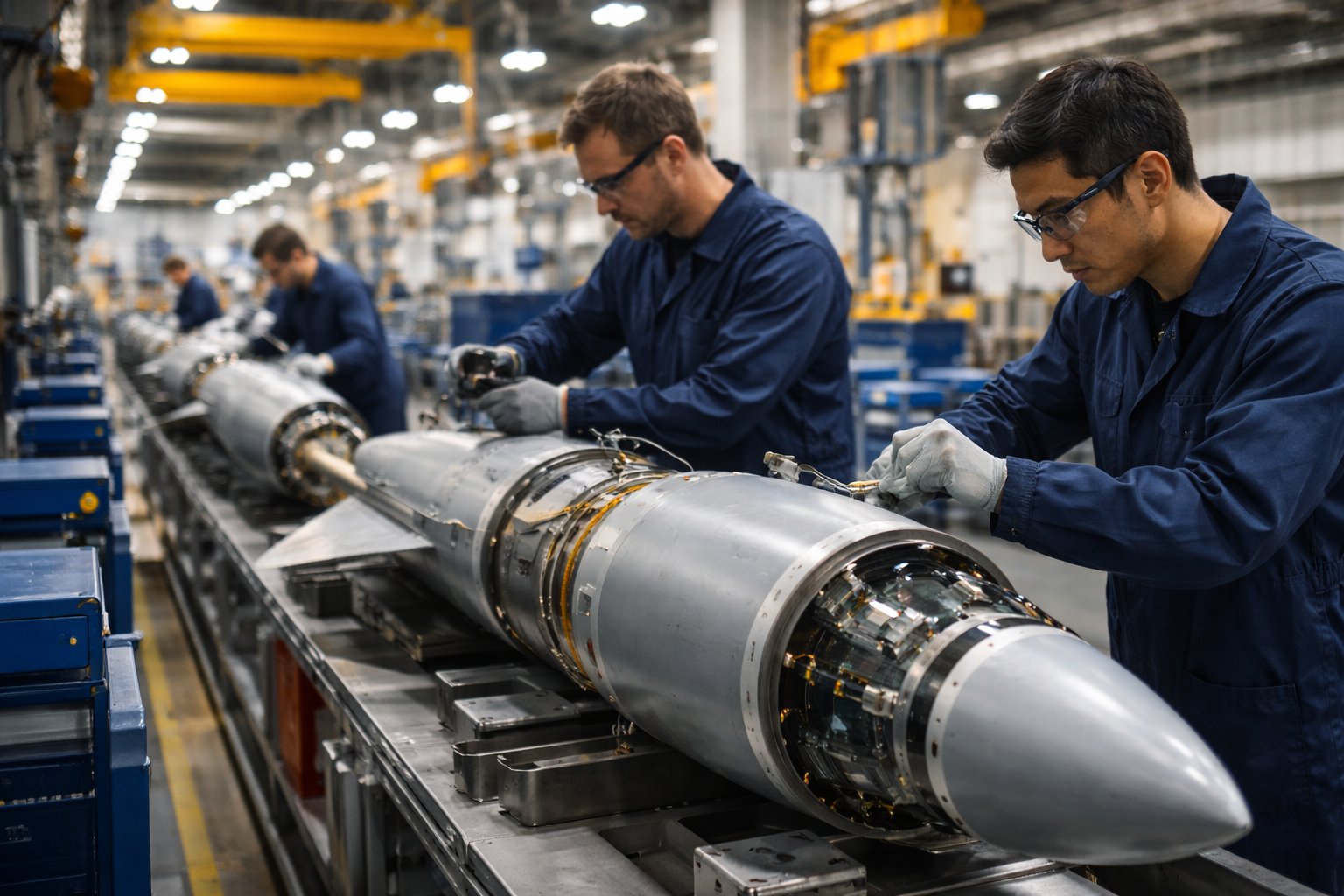
Common warhead architectures allow investment to be concentrated around repeatable filling, inspection, and assembly processes. The same production cells may support several variants when material compatibility, tooling, and safety rules permit.
Modularity can nevertheless hide complexity inside the factory. Each combination of casing, fragmentation material, explosive fill, fuze, and software setting requires a controlled bill of materials and an approved manufacturing route.
Preventing the wrong component from entering the wrong configuration becomes essential when several variants share similar external dimensions. Digital travellers, component marking, automated checks, and complete batch traceability must follow every warhead from material receipt through final acceptance.
Counter-drone weapons impose particularly severe cost pressure. An interceptor designed to destroy an inexpensive unmanned aircraft cannot routinely carry the warhead and fuze economics of a premium surface-to-air missile, yet inconsistent terminal performance would force operators to fire more rounds.
Britain’s low-cost interceptor production drive has already exposed the interdependence between seekers, motors, warheads, launchers, testing, and factory output. A cheap airframe provides little advantage when one specialist component remains scarce or expensive.
BlackThorn extends the commonality argument across multiple sizes. Compact 40mm variants can support smaller interceptors and ground systems, while 70mm and 120mm versions provide greater volume for heavier autonomous weapons and missiles.
The commercial test will come when several integrators request different fragment patterns, safety devices, target effects, and national components. Excessive customisation would break commonality and return the supply chain to multiple low-volume products.
Export customers may also seek local assembly or filling, although energetic-material technology is more tightly controlled than ordinary mechanical production. Transferring empty structures is relatively straightforward; establishing safe, repeatable, and licensed explosive manufacture requires a deeper industrial relationship.
Long-term storage performance will influence production economics as well. Warheads manufactured rapidly during a procurement surge may remain in magazines for years, so material ageing, seal performance, fuze batteries, and inspection intervals need to be understood before large inventories are built.
Common families can simplify surveillance and recertification when the same materials and processes appear across several weapons. They can also amplify a defect if a shared component proves unreliable, placing additional weight on supplier qualification and batch control.
BlackThorn moves modularity into the final part of the weapon chain, where commonality is harder to establish than on a launcher or software interface. If the architecture remains stable across multiple customers, BAE Systems can turn several small weapon programmes into a more coherent production workload.