IN Brief:
- KNDS France has advanced demonstration work tied to ASCALON and the CAPINT tank concept.
- CAPINT is intended as an intermediate French armoured capability before MGCS.
- The concept brings unmanned turrets, autoloading, large-calibre growth, and networked survivability into the production debate.
KNDS France has moved its CAPINT tank concept further into practical engineering discussion, with demonstration work tied to ASCALON firing-on-the-move capability and future heavy armour requirements.
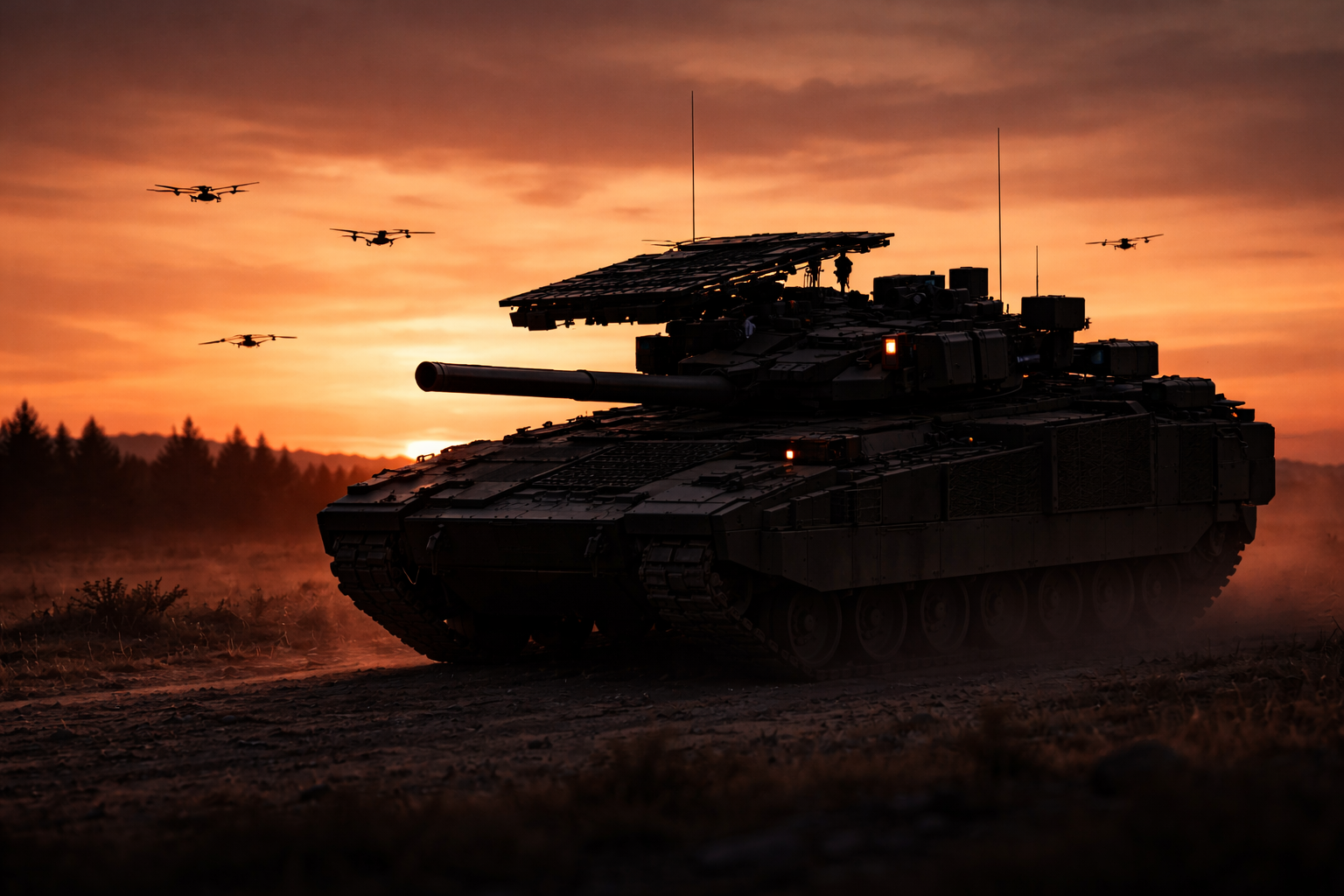
CAPINT, short for capacité intermédiaire, is positioned as a bridge between France’s upgraded Leclerc XLR fleet and the future Main Ground Combat System. The concept pairs a Leopard 2A8-derived chassis with a KNDS France unmanned ASCALON turret architecture, giving France a possible interim route before MGCS reaches operational maturity.
The demonstration activity has centred on ASCALON technology, including firing-on-the-move work linked to a 140mm demonstrator turret. CAPINT itself has been shown around a 120mm ASCALON gun configuration, while the wider ASCALON family is designed to scale toward larger calibres as armour threats evolve. The distinction is useful because it separates a near-term vehicle concept from a longer-term gun and ammunition path.
The most difficult work sits in integration. A large gun on a demonstrator does not create an operational tank. Stabilisation, recoil management, autoloading, ammunition handling, turret power, sensors, fire-control software, crew displays, diagnostics, and maintainability all have to function under movement, shock, dust, heat, cold, and battle damage. Firing while moving tests several of those layers together.
The unmanned turret remains the clearest design signal. European tank concepts are increasingly moving crew members out of the turret and into protected hull positions. That can reduce turret volume, improve crew survivability, and allow more aggressive weapon and sensor packaging. It also transfers risk into automation, crew-machine interface design, remote diagnostics, and autoloader reliability. With no crew inside the turret, the system has to tell operators what is happening and recover from faults without direct human access.
CAPINT sits inside a crowded European armour debate. The Leclerc fleet is ageing, MGCS remains politically and industrially complex, and other European designs are pushing 120mm upgrades, 130mm options, heavier protection, and active defensive systems. The war in Ukraine has changed the tank conversation by forcing manufacturers to account for drones, top-attack weapons, loitering munitions, mines, electronic warfare, and faster sensor-to-shooter cycles.
A future tank will not be judged only by armour thickness and gun calibre. It will need active protection, counter-UAS awareness, resilient communications, electronic protection, software-defined systems, and enough electrical capacity to support sensors and defensive aids. KNDS has framed ASCALON and related demonstrators around that wider architecture, including sensor fusion, protection, cyber resilience, and robotic teaming. The production challenge is to turn those layers into a supportable vehicle rather than a stack of promising technologies.
Europe’s difficulty is not a shortage of ideas. Demonstrators can be built with specialist teams and limited runs, while production vehicles require frozen requirements, supplier qualification, technical manuals, spares, training packages, repair procedures, quality systems, and funded upgrade paths. A tank designed to bridge Leclerc and MGCS must avoid becoming too temporary for serious investment or too ambitious for timely delivery.
Calibre choice will carry industrial consequences. A 120mm configuration offers NATO ammunition compatibility and a more manageable sustainment route. Larger-calibre growth promises future overmatch but brings ammunition production, storage, autoloader design, safety testing, barrel wear, and logistics pressure. Scaling gun size changes the entire ammunition and support ecosystem, not only the weapon barrel.
The production base behind heavy armour is also being rebuilt. KNDS has already been reshaping industrial capacity in Europe, including work to turn rail-related manufacturing space at Görlitz into an armoured vehicle hub. That conversion reflects a broader demand signal: European land systems have moved from low-volume peacetime programmes to higher-tempo production, upgrade, and repair cycles.
The requirement for credible interim solutions is becoming harder to ignore. MGCS remains central to the long-term Franco-German tank project, but armies cannot wait indefinitely for a perfect future system while legacy fleets age and threats evolve. CAPINT gives KNDS France a way to combine mature chassis logic with future turret technology, provided the design avoids becoming an over-complex bridge.
Supportability will determine whether the concept can leave the test track. Every sensor upgrade, software change, ammunition type, protection-system update, or robotic-teaming interface creates configuration work. Armoured fleets are maintained by soldiers, depots, and field technicians, not demonstrator teams. A vehicle that cannot be repaired, diagnosed, or upgraded at scale will struggle regardless of its gun performance.
CAPINT does not settle Europe’s tank future, but it moves the debate into a more useful space. The question is no longer whether a larger weapon looks impressive on a demonstrator. It is whether Europe can manufacture a supportable heavy armoured system that brings protected crews, unmanned turrets, scalable firepower, and digital survivability into service before legacy fleets run out of margin.