IN Brief:
- South Korea’s Cheonryong air-launched cruise missile has completed a powered flight test from an FA-50 aircraft.
- The missile is being developed for indigenous deep-strike roles, with future integration expected on the KF-21 Boramae.
- Production pressure will sit across propulsion, guidance, warhead integration, airframe manufacture, and aircraft weapons-clearance work.
South Korea’s Cheonryong air-launched cruise missile has moved through a significant development milestone, completing a powered flight from an FA-50 light combat aircraft after earlier attempts exposed engine-start and flight-stability problems.
The latest test confirmed a sequence that is central to air-launched missile integration: safe separation from the aircraft, in-flight engine ignition, and stable powered flight. Those events move the programme beyond captive-carry and separation work toward the harder qualification path required before the missile can become a reliable fleet weapon.
Cheonryong is being developed as a long-range precision-strike weapon for South Korea’s future combat-air force, with the KF-21 Boramae expected to be a key launch platform. Testing from the FA-50 gives engineers a practical route to collect flight data, while also opening the possibility of giving the light fighter a more credible standoff-strike role. For Korea Aerospace Industries, LIG Nex1, Hanwha Aerospace, and the wider supplier base, the programme sits directly at the intersection of aircraft export ambition, missile sovereignty, and domestic weapons integration.
Turning a successful powered flight into an operational missile will require more than further demonstrations. The propulsion system must ignite consistently after release, aerodynamic surfaces must behave predictably across aircraft carriage conditions, guidance electronics must survive vibration and temperature stress, and mission systems must interface cleanly with launch aircraft. Warhead safety, fuzing, thermal behaviour, storage life, and maintenance access all have to be settled before serial production can begin with confidence.
The FA-50 route carries additional industrial value because the aircraft family has become one of South Korea’s most visible export products. A domestically produced cruise missile compatible with that ecosystem would strengthen the platform’s strike credentials, provided certification, export controls, and customer requirements can be managed. A light combat aircraft paired with a national standoff missile gives buyers a different proposition from a trainer-derived jet dependent on imported weapons.
Aircraft weapons integration remains one of the least forgiving branches of aerospace engineering. A missile has to clear the host aircraft safely across speed, altitude, manoeuvre, and load conditions, while producing no unacceptable aerodynamic or structural effects. Software interfaces, cockpit controls, mission computers, release units, pylons, and ground-handling equipment all need configuration control. A successful flight test provides evidence, but clearance campaigns are built from repeated data points, not one launch.
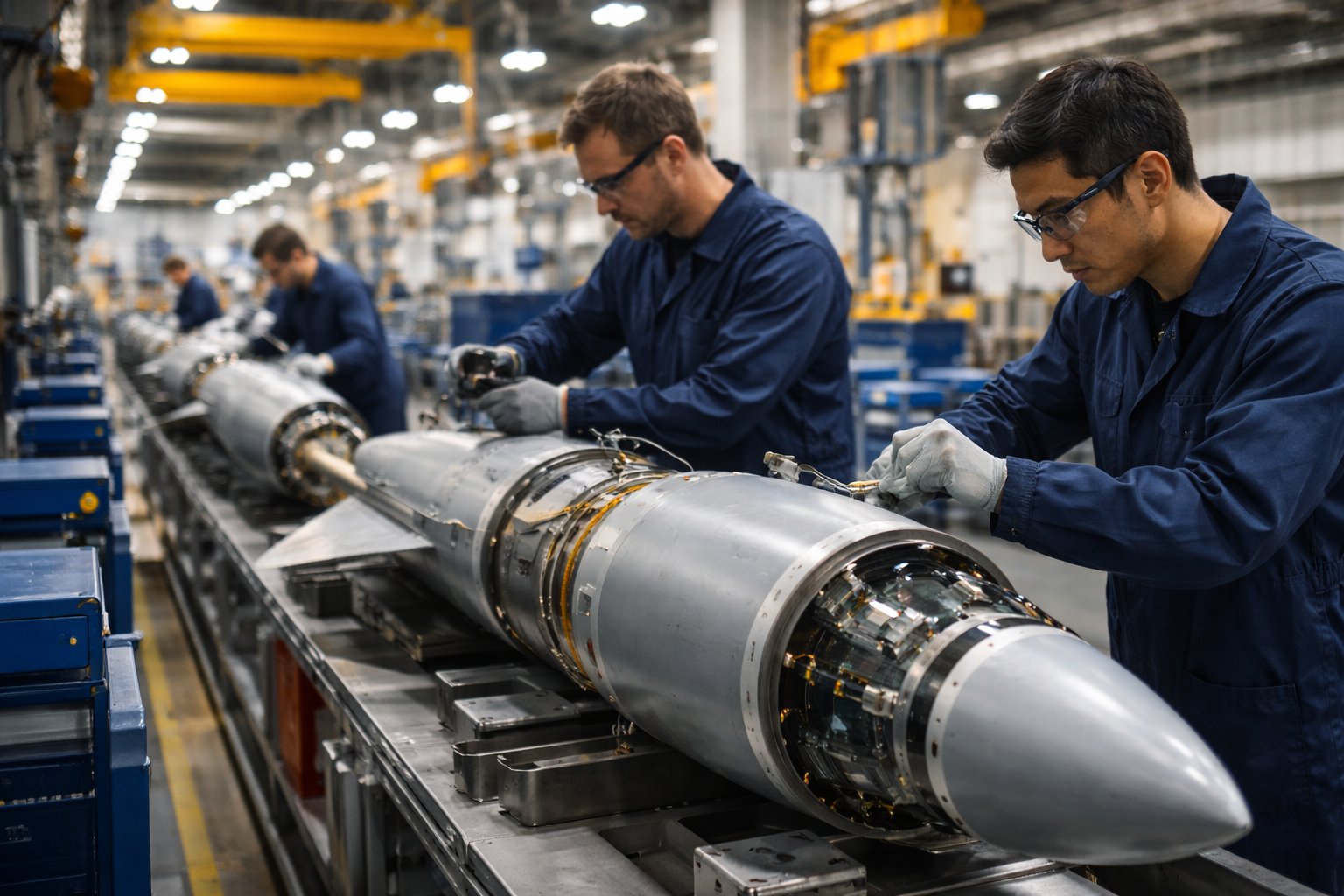
The manufacturing load behind Cheonryong is likely to spread across turbofan components, fuel systems, actuation, sensors, navigation units, processors, wiring, datalinks, warhead sections, and metallic or composite structures. Each subsystem brings inspection, traceability, and acceptance requirements, and the missile’s value will ultimately depend on whether South Korea can build enough of them at a useful rate. Long-range strike capability is now judged by stock depth as much as technical reach.
The wider regional pattern is moving in the same direction. Japan’s early fielding of a boost-glide strike weapon has already shown how quickly Asian defence planners are moving toward domestically controlled long-range fires, with the production problem sitting behind every new weapon concept. South Korea’s approach is different, centred on an air-launched cruise missile rather than a ground-launched hypersonic glide system, but both programmes reflect the same strategic requirement: national control over precision-strike supply.
The KF-21 connection will be the next major industrial test. A new fighter’s operational value depends heavily on the weapons available during its early service life and through planned upgrades. Pairing KF-21 with Cheonryong would give Seoul a domestic aircraft-and-missile combination, strengthening both operational resilience and export credibility. That pairing will need careful flight clearance, mission-system integration, and production synchronisation, because aircraft and missile programmes rarely mature at identical speeds.
South Korea’s defence-industrial model has been built through incremental domestic mastery across ships, armoured vehicles, aircraft, missiles, electronics, and exportable systems. Cheonryong fits that model. The missile has not completed its development path, but the latest powered flight gives the production system a clearer target: move from successful separation and ignition into repeatable manufacture, certified integration, and a stockpile large enough to shape deterrence.