IN Brief:
- A Chinese cruise missile design has been shown with dimensions suited to J-20 and J-35 internal bays.
- The concept combines subsonic flight, low-observable shaping, and infrared suppression.
- Internal carriage places tight production demands on airframe geometry, propulsion, thermal control, and release safety.
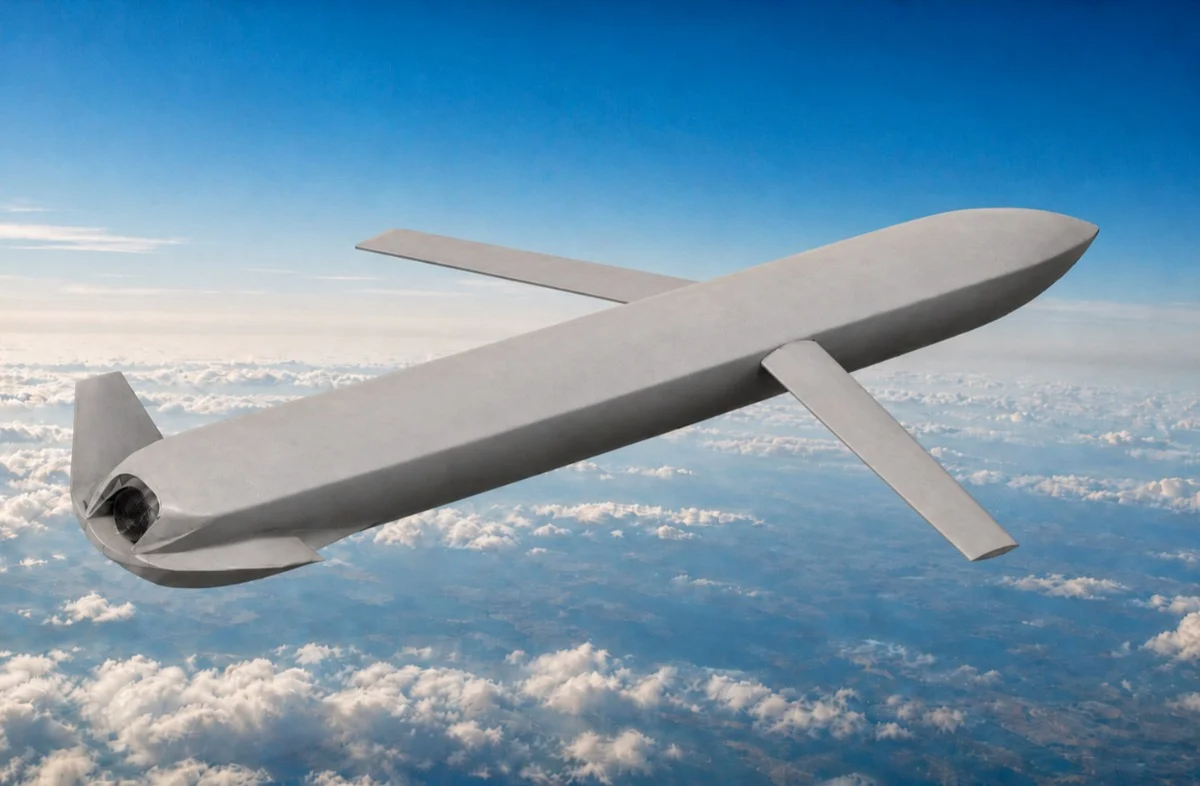
Chinese design material has shown a compact stealth cruise missile concept sized for internal carriage by J-20 and J-35 fighter aircraft.
The weapon is presented as less than four metres long and less than 0.85 metres in diameter, with a reported range of 1,330 km. Those dimensions are central to the design. Internal weapons-bay carriage allows a stealth aircraft to preserve its low-observable profile during the approach to launch, avoiding the radar penalty created by external stores.
The missile uses a blended body, fixed wings, a V-tail, a serrated exhaust nozzle, and thermal-management features intended to reduce radar and infrared signatures. Cooling nozzles around the exhaust and insulation around the engine point to a design in which propulsion and survivability are developed together.
Subsonic speed gives designers more room to prioritise range, shaping, and thermal control. The trade-off is flight time, but a compact low-observable missile carried inside a stealth aircraft creates a different threat profile from a larger externally mounted weapon.
Manufacturing inside the weapons-bay envelope
A missile designed for internal carriage is governed by stricter dimensional control than a weapon carried underwing. Folding or fixed surfaces, inlet treatment, exhaust geometry, launch separation, and structural margins must all fit inside the aircraft bay while allowing safe release.
That places pressure on repeatable composite structures, controlled surface finish, compact actuation, and accurate final assembly. Small deviations in panel fit, shaping, or exhaust treatment can alter the weapon’s signature and affect compatibility with the aircraft.
Thermal control is another production challenge. A compact missile body with a shielded engine and low-observable exhaust path creates difficult packaging requirements around ducts, insulation, materials, and heat-resistant structures.
The design underlines a wider shift in aerospace weapons manufacturing. Fifth-generation aircraft now shape missile architecture from the outset, forcing weapon designers to work around bay volume, release mechanics, signature control, mission software, and integrated strike planning rather than treating aircraft compatibility as a later integration task.