IN Brief:
- Diehl Defence and Elbit Systems are partnering to offer SkyStriker loitering munitions to Germany.
- The system offers autonomous precision strike, reconnaissance, a 10kg warhead, more than two hours’ endurance, and more than 200km range.
- Local manufacturing and qualification would strengthen Germany’s sovereign loitering-munition production base.
Diehl Defence and Elbit Systems are partnering to offer the SkyStriker loitering munition system to the German Armed Forces, with production, assembly, integration, and qualification planned in Germany if the companies secure future programmes.
SkyStriker is an autonomous, long-range loitering munition designed to locate, track, and engage operator-designated targets. The system can carry up to a 10kg warhead, remain airborne for more than two hours, and reach beyond 200km. It can be launched from several platform types, including land vehicles, the EuroPULS rocket launcher, naval vessels, containers, and aircraft.
The German offer brings together Elbit Systems, Elbit Systems Deutschland, and Diehl Defence. By pairing an existing loitering munition with local industrial participation, the companies are addressing Germany’s demand for precision strike while reducing reliance on imported finished systems.
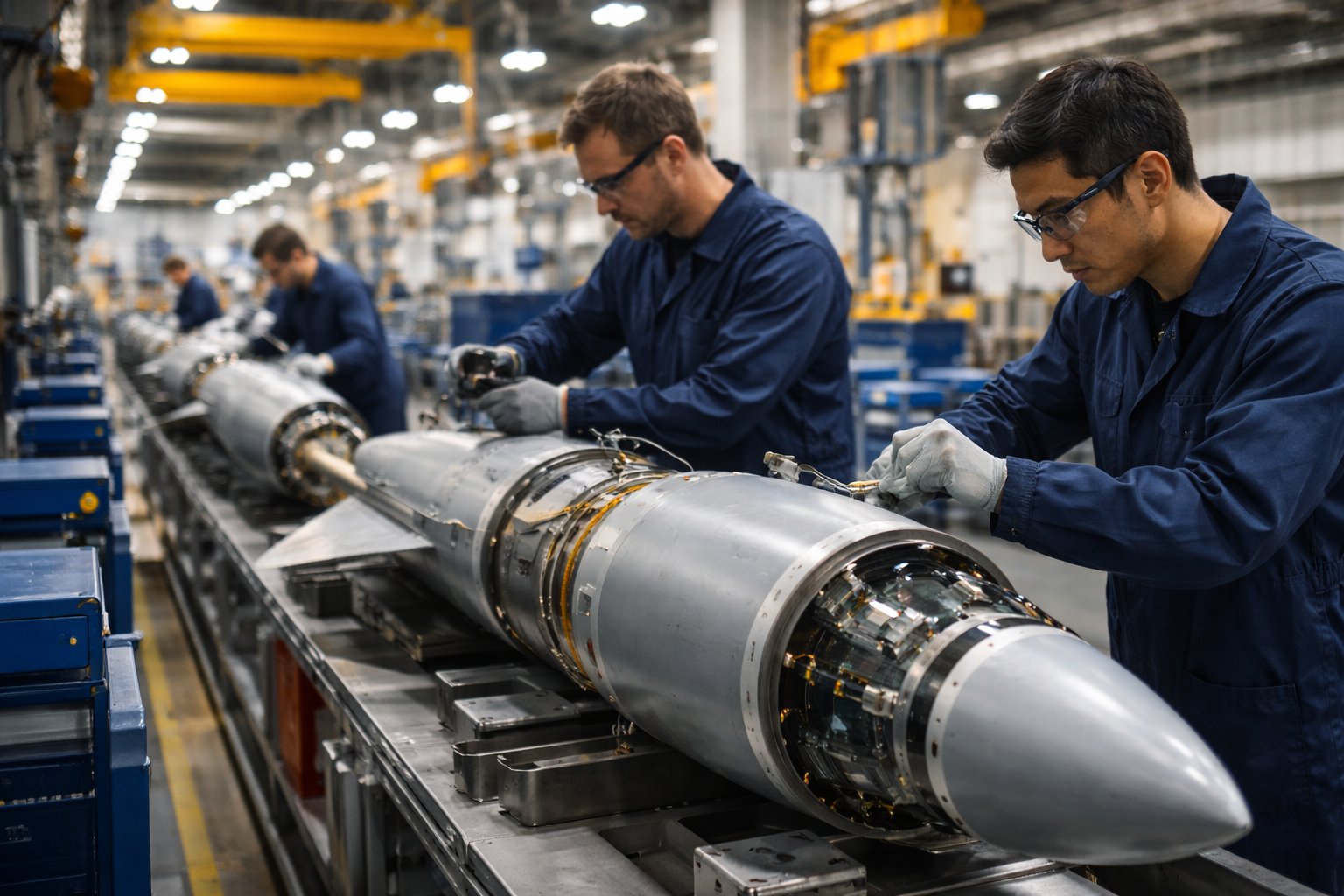
Loitering munitions sit between drones, missiles, and artillery effects. They offer persistence, target confirmation, and precision engagement, often at a lower cost than high-end guided missiles. That hybrid role is attractive to armies, but it creates a demanding manufacturing profile because the munition must combine airframe production, propulsion, sensors, datalinks, autonomy software, warhead integration, launch equipment, and safe handling procedures.
The German production element is therefore more than an offset. Local assembly and qualification would shape how SkyStriker is adapted to German requirements, integrated with national launchers and command systems, supported in service, and upgraded over time. It would also give Germany greater control over test evidence, software changes, training, storage, and maintenance.
European demand for loitering munitions has accelerated as Ukraine has shown how attritable precision systems can influence battlefield tempo. The lesson for industry is blunt: small stocks do not create sustained capability. Loitering munitions need reliable output, field support, spare parts, battery or fuel-system supply, warhead production, secure software updates, and operators trained to use them alongside artillery, drones, and reconnaissance assets.
Germany’s wider air-defence and precision-effects market is already moving toward more mobile, distributed systems. Diehl’s mobile IRIS-T SLS MK 4 work shows the same industrial direction from the air-defence side, where established missile technology is being adapted for more flexible launch and deployment models.
SkyStriker adds an offensive and reconnaissance layer to that landscape. Its ability to launch from different platforms could make it attractive across land and naval applications, but every launch mode brings additional integration work. Container launch, vehicle launch, naval launch, and air launch all require separate safety cases, physical interfaces, command links, and training packages.
The market is also becoming crowded. European strike-drone development, including STARK’s expanding portfolio, and transatlantic loitering-munition work such as Palladyne and IAI’s production partnership, point to a sector where range and payload alone will not decide procurement outcomes. Buyers will look for production rate, local workshare, system integration, software resilience, and credible support.
For Diehl, the partnership offers entry into a loitering-munition segment that complements its missile and air-defence portfolio. For Elbit, German localisation gives SkyStriker a stronger route into a major European customer while helping answer sovereignty questions that often shape German procurement. The partnership also gives the Bundeswehr a potential path to capability without waiting for a purely domestic clean-sheet system.
Manufacturability will remain central. Loitering munitions must be affordable enough for repeated use, but they cannot be so simple that they fail against jamming, weather, camouflage, or moving targets. That balance affects sensor choice, navigation design, airframe materials, propulsion, software, and test procedures. A system that is too exquisite risks becoming too expensive to use at scale; one that is too basic may not survive the battlefield.
German qualification would also determine how quickly the munition could be brought into service. National test and acceptance processes can be demanding, particularly where weapons integration, autonomous functions, flight safety, and explosive handling meet. Local industry involvement can reduce friction if it gives German authorities, users, and engineers direct access to data and configuration control.
SkyStriker’s German offer reflects a larger change in European defence manufacturing. Precision strike is moving toward systems that can be produced in volume, localised for national requirements, and updated quickly as electronic-warfare conditions change. Diehl and Elbit are offering Germany a route into that market with a mature system and domestic production pathway.