IN Brief:
- Diehl Defence and BAAINBw have signed an adaptation development contract for IRIS-T SLM on Germany’s F125 frigates.
- Diehl will manufacture prototypes and conduct comprehensive firing trials to validate integration with the existing ship architecture.
- The work follows a 2025 demonstration in which a navalised IRIS-T SLM module progressed from concept to firing in less than ten months.
Diehl Defence has received a contract to adapt IRIS-T SLM for the German Navy’s F125 frigates, moving the missile system from a temporary shipboard demonstration into prototype manufacture and formal integration testing.
The agreement with the Federal Office of Bundeswehr Equipment, Information Technology and In-Service Support requires Diehl to produce prototypes and conduct comprehensive firing trials. The objective is to make IRIS-T SLM operate as part of the frigate’s established architecture rather than as a stand-alone module installed solely for demonstration.
That changes the engineering requirement substantially. A temporary installation can show that a missile can be fired from a ship, but an operational configuration has to address electrical power, combat management interfaces, communications, structural loads, safety, electromagnetic compatibility, environmental protection, maintenance, and configuration control.
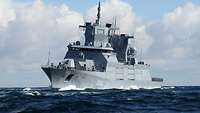
Diehl already has a practical baseline for the work. During Germany’s Maritime Firing Exercise 2025, a navalised IRIS-T SLM module was installed on the frigate Baden-Württemberg and taken from initial concept to a successful firing in less than ten months.
The new contract turns that rapid demonstrator into the starting point for a controlled development programme. Hardware built for prototype trials can now be designed around repeatability, documented interfaces, and the engineering evidence required before a fleet installation can be considered.
IRIS-T SLM was developed as a medium-range ground-based air defence system. Diehl lists an effective intercept range of up to 40 kilometres and altitude coverage of up to 20 kilometres, with the missile using an imaging infrared seeker, thrust-vector control, and an in-flight data link.
In land service, a firing unit distributes functions between launchers, radar, tactical operations equipment, and support vehicles. A frigate integration cannot simply reproduce that arrangement on deck. Functions have to be connected to the ship’s existing sensors, command architecture, power system, and available volume.
Naval operation also introduces a different physical environment. Equipment must tolerate saltwater exposure, vibration, ship motion, temperature variation, and the electromagnetic conditions created by other high-power sensors and communications systems operating from the same platform.
Prototype manufacture provides the hardware through which those issues can be resolved. At this stage, production remains closely connected to engineering because launcher arrangements, interfaces, software, or support equipment may change as test results expose problems.
The planned firing campaign will then provide evidence that the completed configuration functions as a system rather than proving only that the missile itself performs correctly. Test activity can examine launch behaviour, target data flow, communications with the missile, command sequences, and interaction with the host ship’s sensors and combat management equipment.
For the F125 class, the project represents a significant change from the ships’ original mission emphasis. The frigates were designed primarily around long-endurance stabilisation and presence operations rather than dense area air defence.
Introducing a medium-range surface-to-air missile gives Germany a route to enhance the class using a weapon already supported by an active European production line. That avoids the cost and time associated with developing an entirely separate naval interceptor while retaining commonality with existing land-based IRIS-T SLM customers.
The industrial benefit of that commonality lies mainly in the missile itself. Existing propulsion, seeker, electronics, control hardware, and other qualified components can continue to move through an established manufacturing chain while the naval programme concentrates its investment on launcher adaptation, ship interfaces, and integration.
The naval configuration will still require unique equipment. Shipboard storage, installation, reload arrangements, environmental protection, maintenance access, and software interfaces differ from the vehicle-mounted land system and have to be engineered accordingly.
Any eventual fleet installation would also need to fit within frigate maintenance schedules. Warships cannot remain indefinitely unavailable while new missile systems are installed, so the design must eventually support repeatable work packages that can be completed during planned maintenance periods.
Diehl is expanding IRIS-T production as European demand for the ground-based system increases. A naval variant could add another demand stream to that industrial base if the adaptation progresses from prototypes into series procurement.
That outcome remains dependent on the development programme. The current contract does not establish a fleet quantity or series production schedule and should not be treated as though an operational installation has already been ordered.
The immediate task is narrower and more technical: manufacture representative hardware, integrate it with the F125 architecture, and prove the resulting configuration through controlled firings.
The results will determine whether the rapid 2025 demonstrator can become a repeatable naval product. Success would give Germany a qualified route from land-based IRIS-T production into shipboard air defence without creating a separate missile family, while failure would expose precisely where the existing system requires deeper redesign before it can enter fleet service.