IN Brief:
- GDOTS has completed static testing of 4.75-inch rocket motor prototypes for DSFT.
- The company has also delivered a 30-round DSFT launch pod prototype designed by DEVCOM AvMC.
- Production capability has been established in Lincoln, Nebraska, and Camden, Arkansas, within 15 months.
General Dynamics Ordnance and Tactical Systems has completed static testing of 4.75-inch rocket motor prototypes for the U.S. Army’s Direct Support Fires Technology programme, advancing a rapid prototyping effort focused on lower-cost artillery rockets and increased launcher magazine depth.
The work supports the U.S. Army Combat Capabilities Development Command Aviation & Missile Center. GDOTS has also built and delivered a 30-round DSFT launch pod prototype designed by DEVCOM AvMC, which was delivered for the Army’s Concept Focused Warfighting Experiment in March. The systems are also expected to support a Massed Fires Demonstration scheduled for September.
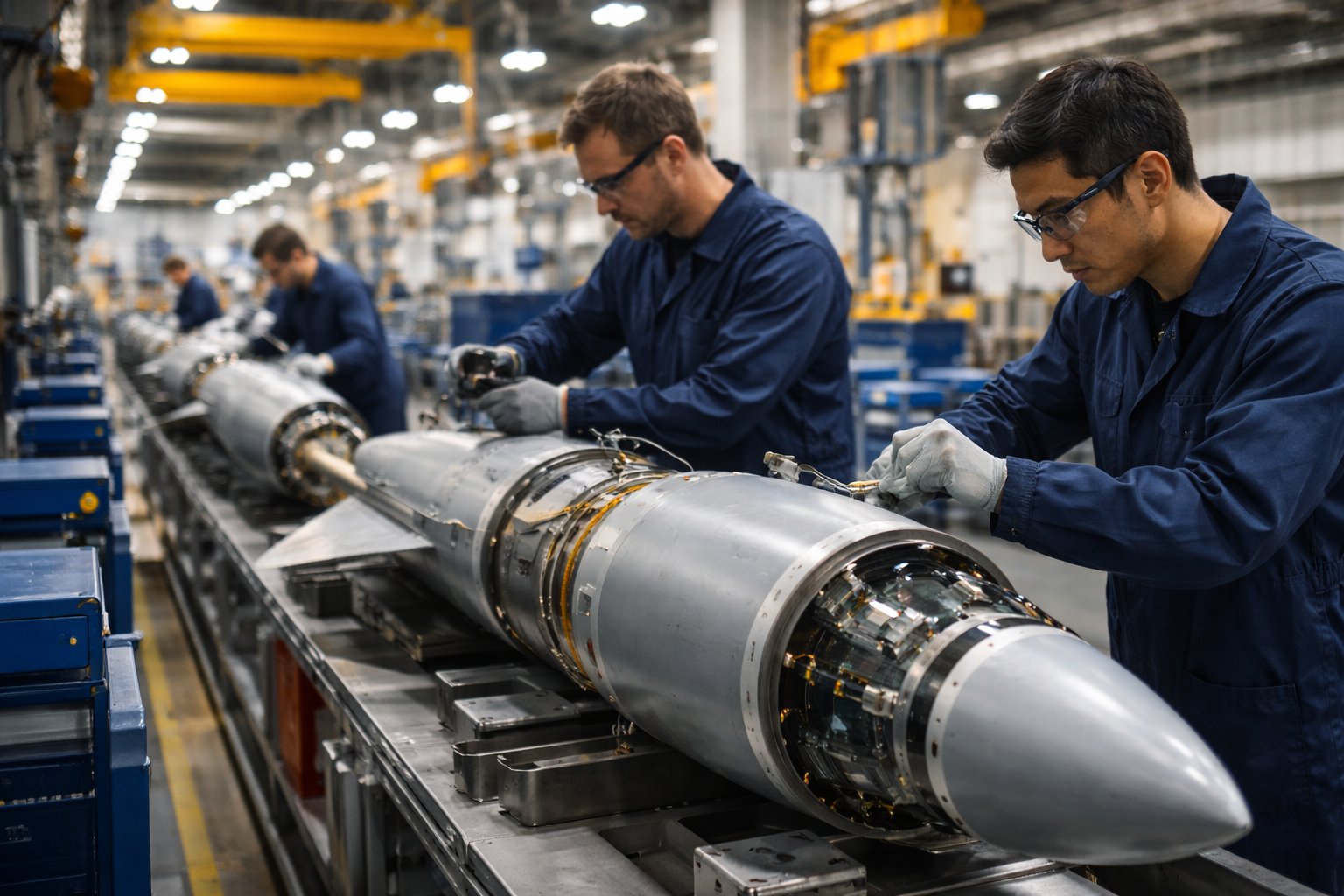
The industrial pace is notable. GDOTS established production capabilities in Lincoln, Nebraska, and Camden, Arkansas, within 15 months, delivering rocket motor prototypes to DEVCOM AvMC and multiple industry partners during that period. The earlier first firing of the 4.75-inch solid rocket motor took place at GDOTS’ Camden facility and delivered results within one per cent of analytical predictions.
The target is a low-cost artillery rocket compatible with current launchers, produced in large quantities, and able to increase the volume of fires available from existing launcher footprints. That places the programme directly inside the U.S. and allied effort to rebuild munitions depth without relying only on expensive, low-volume precision weapons.
A 4.75-inch form factor changes the magazine-depth equation. A launcher able to carry more rounds can generate greater volume without adding more vehicles, crews, transport assets, or launcher production. The trade-off is that smaller rockets must still deliver useful range, accuracy, effects, safety, and reliability. The production system has to make that balance work at scale.
The same pressure appears across allied fires programmes. Estonia’s Chunmoo expansion illustrates how launcher procurement depends on rocket stocks, reloads, supply routes, and sustained production. DSFT reflects the U.S. side of that equation: launchers are only as valuable as the munitions base behind them.
Rocket motor production remains a difficult industrial discipline. Solid motors require controlled propellant formulation, casting, curing, inspection, bonding, case integrity, nozzle performance, ignition reliability, safe storage, and repeatable output. Facilities handling energetics are expensive, highly regulated, and difficult to surge quickly. A short development cycle increases the need for disciplined process control rather than reducing it.
The DSFT effort also highlights the value of close government-industry collaboration in rapid prototyping. DEVCOM AvMC designed the motor and launch pod concept, while GDOTS built and tested hardware and set up production capabilities. That approach can shorten the route from concept to demonstration, provided the transition into production is planned early rather than treated as a later procurement problem.
Affordability will shape the next phase. Low-cost rockets only remain useful if the cost target survives qualification, procurement, storage, training, and production expansion. Initial prototypes often benefit from focused teams and urgent funding. Series production exposes supplier lead times, tooling needs, workforce shortages, quality yields, environmental compliance, and test capacity. The industrial model must hold together when the customer moves from demonstration rounds to large orders.
The Army’s interest in massed fires also sends a signal to the broader supply base. Guidance units, launch containers, composite motor cases, warheads, propellants, fuzes, electronics, and packaging suppliers could all be pulled into future production. If the 30-round pod concept moves forward, suppliers will need to support both rocket output and launcher-compatible container production.
Modern ground forces need precision, but they also need volume. Expensive missiles are not always the right answer for every target. A lower-cost guided or precision-capable rocket could give commanders more options against dispersed, time-sensitive, or lower-value targets while preserving higher-end munitions for more demanding missions.
The programme’s production locations add another industrial dimension. Camden already has a strong role in missile and rocket activity, while Lincoln adds another point in the manufacturing base. Distributed production can reduce bottleneck risk, but it requires common standards, shared process control, and tight quality management. Two sites do not double output unless materials, labour, documentation, inspection, and test infrastructure can move in step.
GDOTS’ motor testing signals a U.S. attempt to solve a munitions maths problem: more ready rounds, more launcher depth, and more affordable fires without waiting years for a wholly new system. The next test will be whether rapid prototyping can become controlled, economical, high-volume production.