IN Brief:
- Saab’s GlobalEye has re-entered focus as NATO evaluates options to replace its ageing E-3A Sentry airborne surveillance fleet.
- The aircraft combines the Bombardier Global 6000/6500 family with Erieye ER radar, passive sensors, and multi-domain command-and-control systems.
- Any NATO selection would create major demand for mission-aircraft conversion, radar integration, training, and long-term support infrastructure.
Saab’s GlobalEye remains in focus as NATO continues work on replacing its ageing E-3A Sentry airborne early warning and control fleet.
No NATO contract has been announced for the system, and the Alliance Future Surveillance and Control programme remains under evaluation. GlobalEye’s position in the debate has strengthened as NATO reassesses future surveillance options and European governments place greater emphasis on regional defence industrial capacity.
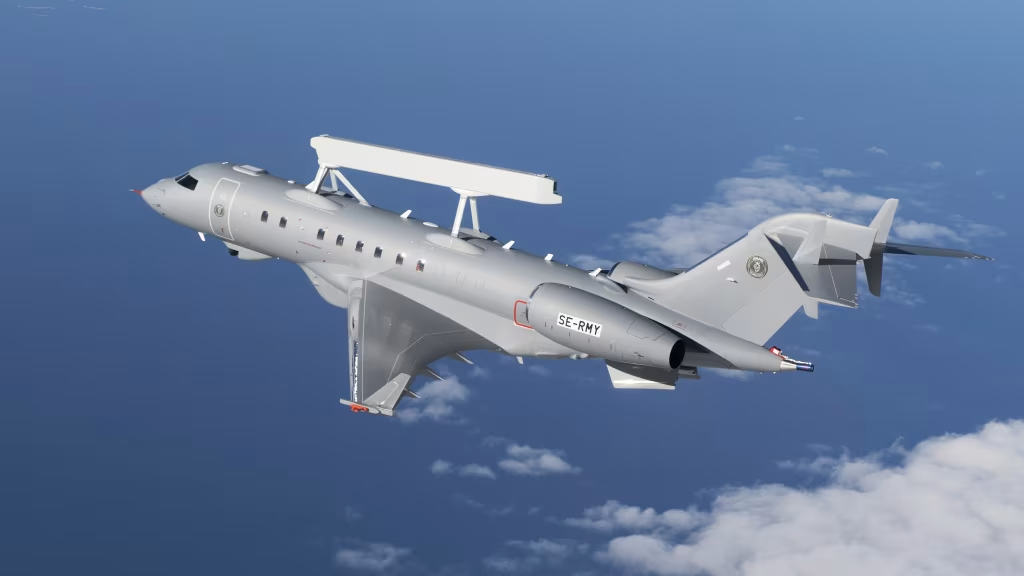
GlobalEye is built around the Bombardier Global 6000/6500 aircraft family and integrates Saab’s Erieye Extended Range radar with additional sensors and a multi-domain command-and-control system. The platform provides long-range surveillance of air, sea, and land targets from a single aircraft, with real-time information sharing for national or coalition command structures.
The aircraft has already moved beyond concept status, with systems delivered or ordered for several operators. That maturity gives NATO an option with an active production and support base as the E-3A fleet becomes more expensive and difficult to sustain.
Mission-aircraft conversion
GlobalEye production depends on the conversion of a long-range business jet into a military surveillance aircraft. That work includes structural modification, sensor integration, electromagnetic compatibility, power and cooling provision, communications equipment, operator workstations, ground-support systems, and certification.
The use of a commercial aircraft family may reduce some operating costs compared with larger legacy AWACS platforms, but the military conversion work remains demanding. Classified mission systems must be integrated without compromising aircraft performance, maintainability, or certification.
Surveillance architecture
NATO’s future requirement extends beyond a direct replacement for a radar aircraft. Modern airborne surveillance must support cruise-missile warning, drone tracking, maritime awareness, and wider multi-domain command-and-control.
That shifts production weight toward software-defined mission systems, secure data links, radar processing, and coalition interoperability. A NATO GlobalEye selection would create a long-term pipeline across airframe conversion, radar manufacture, simulation, training, maintenance, and mission-system upgrades.