IN Brief:
- The Grille X4 has completed its maiden flight near Munich.
- The aircraft is part of a five-unit pre-series production run.
- Design changes include a distributed parachute system, lighter structure, and manufacturing process improvements.
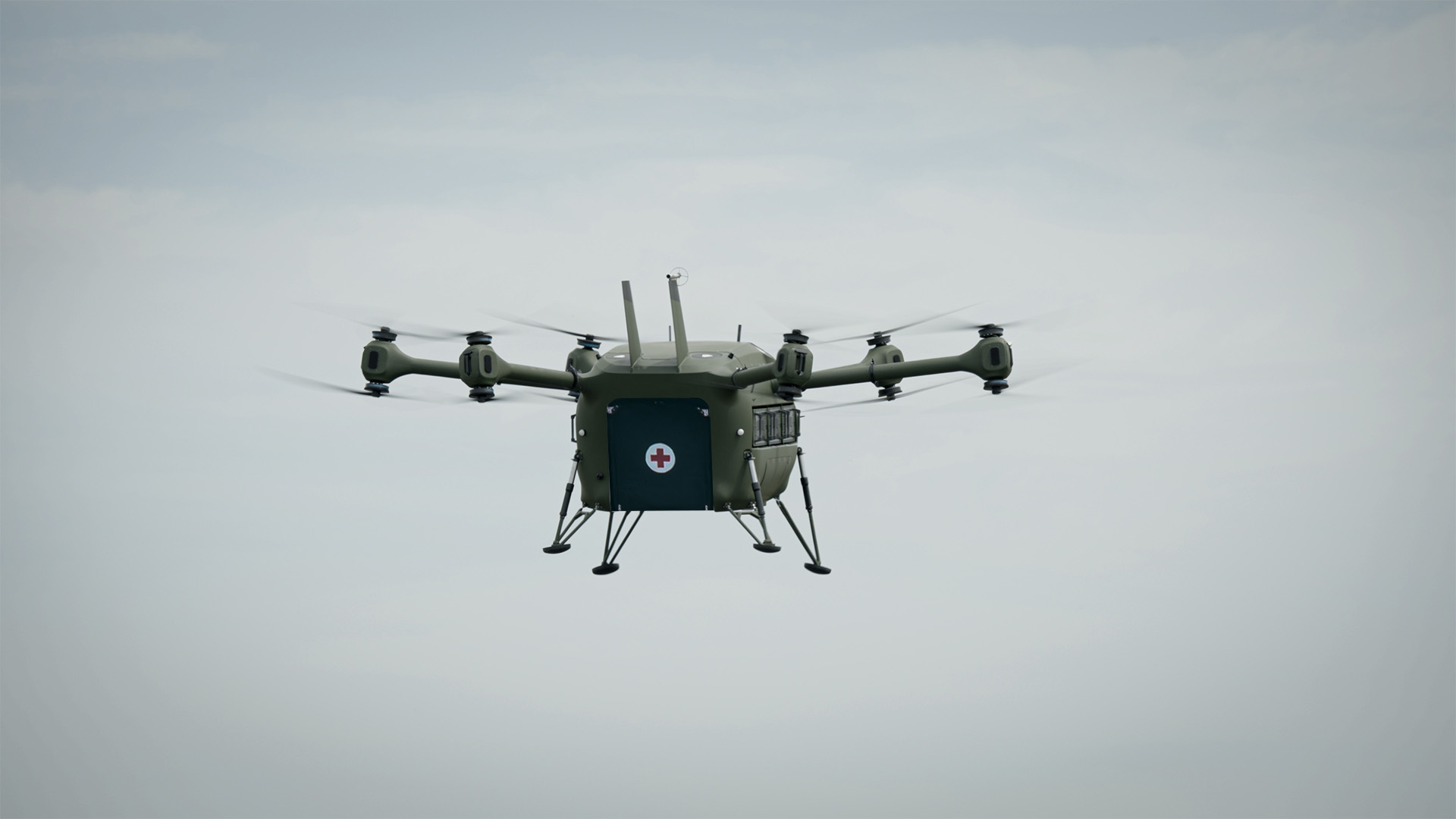
German unmanned aircraft developer Avilus has completed the maiden flight of the Grille X4, moving its casualty-evacuation UAV programme into a more mature pre-series production phase.
The aircraft is the first fourth-generation Grille unit from a five-aircraft pre-series run. The updated design introduces a distributed parachute system, a lighter and more robust monocoque structure, and production-process improvements intended to move the platform from experimental development toward repeatable manufacture.
Designed for casualty evacuation and payload movement in contested or difficult terrain, the Grille X4 sits in a growing class of military UAVs built around battlefield logistics rather than surveillance or strike. Dispersed forces need ways to move wounded personnel, medical supplies, batteries, munitions, and specialist equipment without exposing vehicles and crews on predictable routes. Drones have already altered reconnaissance and attack; larger uncrewed aircraft are now beginning to alter the logistics chain behind the front line.
A casualty-evacuation UAV brings a different engineering challenge from a small tactical drone. It must carry meaningful payloads, operate reliably in poor conditions, tolerate difficult landing zones, and satisfy safety demands that become far more demanding when a human casualty may be carried. It also needs to be maintainable by field units rather than laboratory technicians, placing pressure on airframe design, modular replacement, software health monitoring, propulsion support, and battery management.
The lighter monocoque structure is central to that balance. Weight saved in the airframe can be converted into payload, endurance, safety systems, or operating margin. Producing lightweight structures at repeatable quality, however, brings its own manufacturing burden. Composite or advanced structural production must control tolerances, bonding, inspection, repairability, and environmental durability, while military users will also want confidence that damage can be detected and repaired quickly in forward conditions.
The distributed parachute system points to a broader safety requirement as larger UAVs move closer to troops, medical teams, and urban environments. Recovery systems, redundancy, flight termination, detect-and-avoid functions, and certification evidence are becoming part of the production package for uncrewed aircraft with meaningful mass. The challenge shifts from building a flyable demonstrator to proving a repeatable air system that can be bought, maintained, insured against mission risk, and trusted near personnel.
Germany’s interest in uncrewed support aircraft reflects a wider European reassessment of battlefield logistics. The war in Ukraine has shown how exposed supply routes, evacuation corridors, and repair vehicles can become under artillery and drone observation. Small UAVs have changed the sensor and strike layer, but larger systems could reshape the movement of people and material across dangerous ground.
The autonomy and production challenge echoes other advanced UAV work now moving through Western defence industry. Boeing MQ-28 tests exportable autonomy from US range explored how autonomous aircraft architectures are being prepared for exportable military use. Grille X4 occupies a different niche, but the manufacturing task is similar: turn experimental capability into a repeatable product that can be configured, supported, upgraded, and produced in useful numbers.
Pre-series production is therefore a critical stage. It tests whether suppliers, assembly methods, quality control, and maintenance assumptions can survive repetition. One prototype flight can prove technical feasibility. A small production batch starts to reveal whether the aircraft can become a serviceable defence product.
European UAV demand is rising quickly, but production capacity remains uneven. Companies able to convert battlefield-relevant designs into repeatable manufacturing, clear sustainment models, and credible safety cases will be better placed than those relying on bespoke prototypes. Grille X4’s next challenge will be measured not only in flight hours, but in how consistently the aircraft can be built, repaired, and adapted for military users.