IN Brief:
- Hannover Messe 2026 placed defence production inside the wider industrial technology agenda, with focus on scale, automation, software, and resilient supply chains.
- The fair connected defence readiness with robotics, secure edge systems, fuel cells, retrofit technologies, and digital manufacturing infrastructure.
- Governments face growing pressure to build industrial ecosystems that can accelerate output before long-cycle procurement programmes catch up.
Hannover Messe 2026 placed defence production in the part of the industrial economy where it now belongs: among factories, automation systems, software architectures, power technologies, and supplier networks. The dedicated Defense Production Area gave a defined setting to a challenge now running through European defence planning — how quickly national industrial bases can turn requirement into output when warning times shrink.
Complete platforms were not the main focus. The emphasis sat further upstream, with the conditions that make platforms possible: qualified production processes, resilient suppliers, secure data, adaptable lines, reliable power, and the ability to move from low-rate complexity to accelerated manufacture without rebuilding the industrial base from scratch. Defence capability may be judged by what reaches the field, but capacity is created earlier, in tooling decisions, component flows, digital assurance, and the commercial confidence needed to invest.
Ukraine has forced that distinction into view. Demand for drones, munitions, sensors, communications equipment, electronic warfare systems, maintenance support, and battlefield power has moved faster than peacetime procurement habits were designed to handle. European governments are committing more money to defence, although budgets only become capacity when they are converted into orders, certified processes, skilled labour, traceable materials, and production lines able to run at the required tempo.
Hannover framed defence production as an industrial systems challenge rather than a specialist procurement topic. Technologies already established across automotive, aerospace, electronics, and advanced manufacturing are being pulled into defence with sharper requirements around security, qualification, and operational consequence. Flexible automation has to coexist with assurance; digital systems have to support speed without weakening control; suppliers have to move closer to defence demand while meeting the standards that make their output usable.
Rheinmetall’s robotics, teleoperation, and autonomous systems presence gave the debate a practical engineering edge. Remote-controlled vehicle operation and robotic assistance in harsh or unstructured environments draw on many of the same foundations as advanced manufacturing: robust communications, controlled autonomy, human-machine interfaces, and software-defined control. Defence manufacturers and operators are increasingly working from the same industrial toolbox, even when the final applications differ.
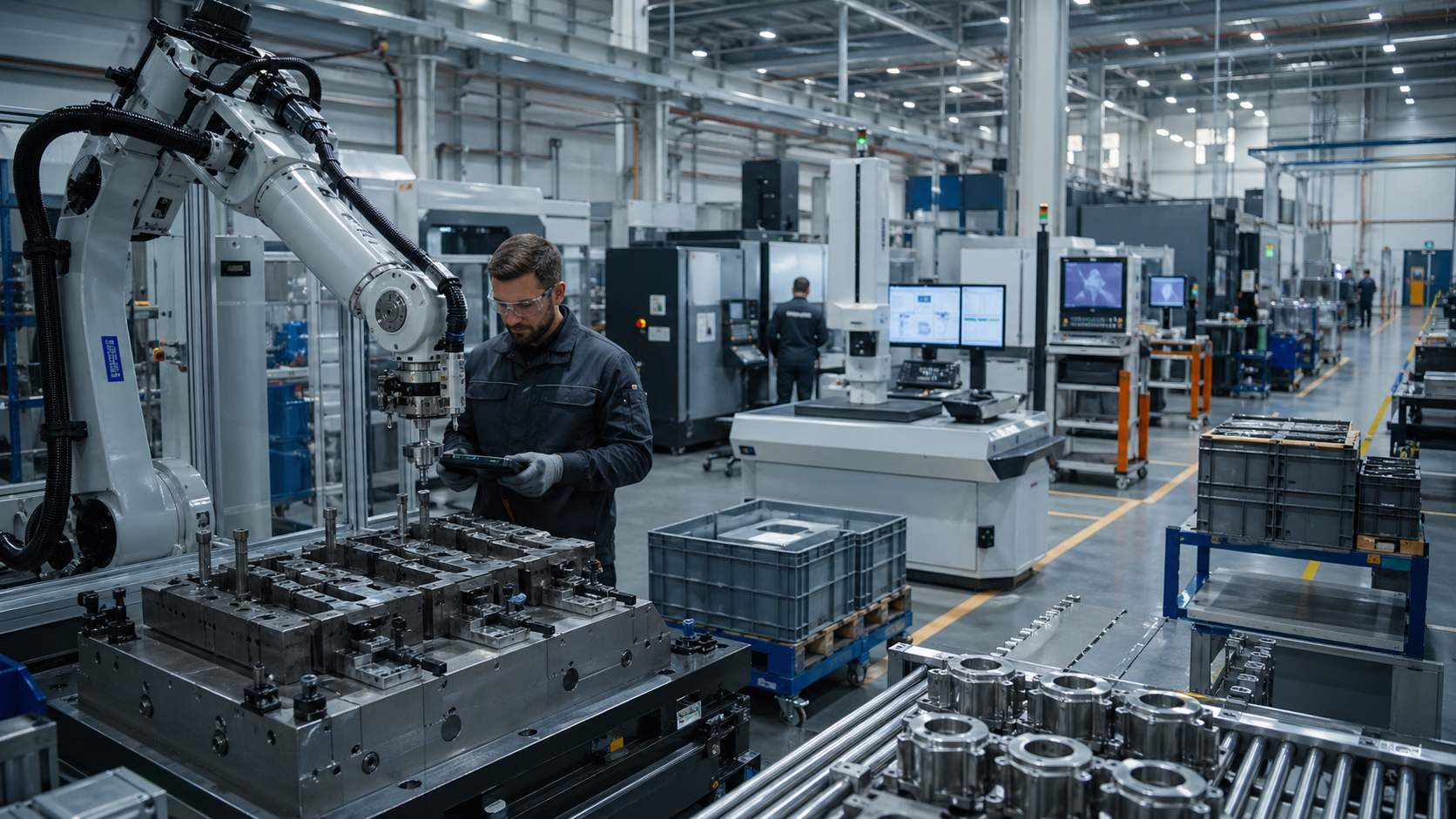
Mobile robotics added a factory-floor layer to that overlap. Defence production has often been associated with complex, lower-volume work, but low volume does not remove the need for flow, repeatability, and safe handling. Autonomous material movement and flexible intralogistics can help production lines respond when volumes change, variants proliferate, or sensitive components need to move through controlled environments with less manual intervention. The prize is a production system with fewer brittle points.
The software layer is becoming just as important as the physical line. SAP used Hannover to connect readiness with procurement, logistics, maintenance, manufacturing, training, and personnel planning, while Dell and Intel focused on secure edge deployment for factories and mission-critical environments. Defence manufacturing is becoming more dependent on live production data, trusted software environments, and the ability to run AI and digital workloads close to equipment rather than treating the factory as a disconnected back office.
A defence factory increasingly has to prove what was built, where components came from, which process data supports quality claims, and whether software and firmware can be trusted. Traceability, cyber-secure industrial systems, and protected edge infrastructure are no longer administrative layers around manufacturing. They are part of how confidence is built into the equipment before it leaves the line.
Power and upgradeability add further pressure to the industrial base. SFC Energy’s EMILY 12000 tactical fuel-cell system, presented for defence applications, addressed the need to power communications, sensors, drones, IT infrastructure, and deployed mission equipment where fuel logistics, endurance, and acoustic signature influence performance. Diehl Aerospace’s cockpit tablet and retrofit demonstrator approached readiness from another direction, showing how existing aircraft could gain mission-control and situational-awareness functions without wholesale replacement of onboard systems.
Those examples pull defence capacity deeper into the civilian industrial base. Machine-tool builders, electronics manufacturers, sensor companies, software developers, energy-system providers, automation specialists, additive manufacturing businesses, logistics operators, and cyber-secure infrastructure suppliers all sit closer to defence production than they once did. Prime contractors still integrate the final systems, but the tempo of any future ramp-up will depend on the depth, readiness, and security of the networks beneath them.
Relevant technology does not make a supplier defence-ready by default. Qualification requirements, export controls, documentation standards, material traceability, protected data, and long-term assurance demands create a different operating environment from most civilian markets. Bringing more industrial companies into the defence base will require clearer demand signals, faster procurement routes, and investment in the less glamorous machinery of readiness: certification, workforce development, secure digital infrastructure, and production capacity that exists before a crisis.
Europe has considerable engineering depth, but engineering depth is not a mobilisation plan. Hannover Messe 2026 showed defence production moving into the mainstream of industrial technology because the distinction between national security and industrial capacity is becoming harder to sustain. DSEI Germany’s arrival in Hannover in 2027 will give the defence sector its own dedicated stage, but the harder work sits in the factories, data systems, supplier contracts, and production lines that determine whether capability can become repeatable output when it is needed.